
How Sheep Manure Turns into Nutrient Rich Fertilizer
16 July 2026
Sheep dunged nutrient-rich organic fertilizer for plants, made with the help of maggots. Built on community empowerment and a zero-waste principle.




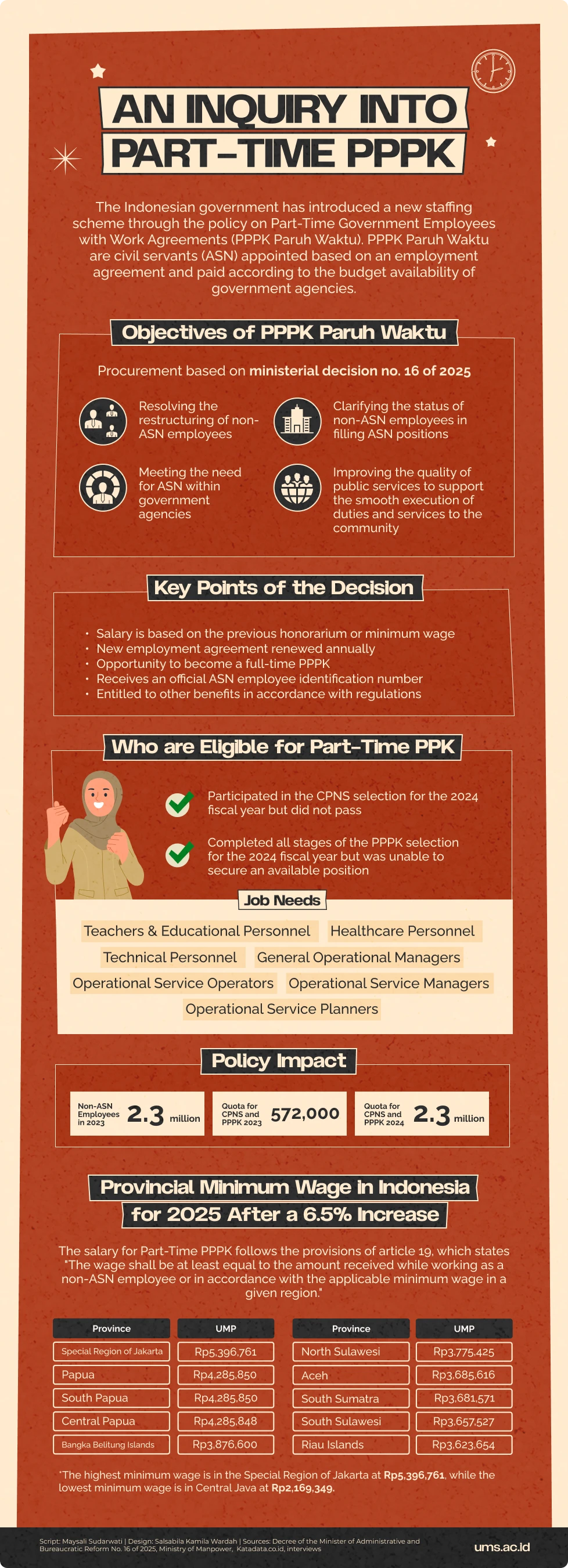
The Ministry of Administrative and Bureaucratic Reform (Kemenpan RB) has officially issued new regulations regarding Part-Time Government Employees with Work Agreements (PPPK). These regulations are outlined in Ministerial Decree No. 16 of 2025 concerning Part-Time Government Employees with Work Agreements, signed on January 13, 2025, by the Minister of Administrative and Bureaucratic Reform (Menpan RB) Rini Widyantini, in Jakarta.
This policy comes after the announcement of the 2024 PPPK selection results and the 2024 Civil Servant Candidate (CPNS) selection results. According to the Menpan RB decision, those categorized as Part-Time PPPK include Teachers and Educational Personnel, Healthcare Personnel, Technical Personnel (specialized skills), General Operational Managers (office staff), Operational Service Operators (public/community services), Operational Service Managers, and Operational Service Planners.
Rini Widyantini, stated that the objectives of this new policy include resolving the management of non-ASN employees, meeting the needs of Civil Servants (ASN) within government institutions, clarifying the status of non-ASN employees for filling ASN positions, and improving the quality of public services to support the smooth execution of tasks and services for the community.
“Part-Time Government Employees with Work Agreements (PPPK) are civil servants (ASN) appointed based on a work agreement and paid according to the budget availability of the government institution,” states the First Article of Ministerial Decree No. 16 of 2025.
Met on Tuesday (21/01/2025), Dr. Mahameru Rosy Rochmatullah, S.E., M.Si., an accounting lecturer from the Faculty of Economics and Business (FEB) at Universitas Muhammadiyah Surakarta (UMS), viewed the decision issued by Menpan RB as a strategy for government budget efficiency, particularly if aimed at meeting the staff-to-institution ratio.
From his calculations, the government will spend less on recruiting part-time PPPK employees compared to hiring full-time PPPK or ASN workers. However, according to Katadata, there are still around 2.3 million non-ASN employees in 2023 relying on government recruitment.
Mahameru highlighted the government's hesitation in the first article to appropriately value the work of part-time PPPK employees. “This point reflects doubt and pessimism regarding the availability of government budgets to cover the salaries or wages of part-time PPPK workers,” said the member of the Indonesian Accounting Lecturers Association for the Central Java Region.
Meanwhile, the nineteenth dictum states that part-time PPPK employees should be paid at least the same amount they received as non-ASN employees or in accordance with the prevailing minimum wage in the region. If salaries are based on their prior honorarium, part-time PPPK workers may only receive between Rp100,000–350,000 per month.
The honorarium amount is far from sufficient to ensure the welfare of part-time PPPK workers. According to Radar Tulungagung, the Chairman of the Honorary Teachers’ Struggle Forum (FPGH) PGRI Tulungagung, Candra Dian Rahman, has demanded the Tulungagung Regency Government to raise the minimum salary to Rp1 million per month from the current honorarium.
“As part-time PPPK employees, we only receive very low salaries. If this demand is not addressed, we are prepared to halt teaching activities and take to the streets,” said Candra to Radar Tulungagung.
Mahameru, who sees the decree as a form of budget efficiency, questions the system for allocating work for part-time PPPK employees. According to Menpan-RB Decree Number 347 of 2024, part-time PPPK employees are only required to work 4 hours per day.
He also raised concerns about working hours for healthcare workers. It is not feasible for health workers to leave their patients after completing 4 hours of work each day.
“In my view, the use of the term ‘part-time PPPK’ is merely a strategy to ‘bind’ honorary workers whose skills or expertise are still highly needed by government institutions,” he said.
Previously, as reported by Antara, former Deputy for Human Resources (HR) Apparatus at the Ministry of PAN RB, Alex Denni, explained the concept of part-time work. Alex suggested that honorary workers could maximize their time by seeking additional income after their government work hours
“For example, a math teacher in certain areas might only have classes twice a week. With part-time work, they could also teach at private schools, madrasahs, or offer tutoring,” Alex said.
With the part-time scheme, Alex believed honorary workers can make better use of their time to earn extra income after completing their government work hours.
The government's efforts to ensure the welfare of part-time PPPK employees need further clarification, as there are still far too many honorary workers earning well below the minimum wage.
The Institute for Demographic and Poverty Studies (IDEAS) and GREAT Edunesia Dompet Dhuafa once conducted a survey of 117 honorer/contract teachers. The results showed that 74 percent of honorer/contract teachers earn less than Rp2 million, and 20.5 percent of them earn less than Rp500,000.
Further findings revealed that 79 percent of respondents had debts, and 45.9 percent felt their teaching income was insufficient to meet their needs. Only 10.6 percent felt their income was adequate, with a small amount of money left over.
Mahameru also raised concerns about the potential for delayed payment systems, unlike full-time PPPK or ASN employees whose salaries are allocated from the employee budget. Drawing from his experience researching the public sector, Mahameru pointed out that the bureaucracy, characterized by a long and hierarchical authorization structure, could disrupt the timely payment of wages for non-employee budget workers. Delays could range from 2 to 5 months or result in lump-sum payments.
“However, employees’ needs continue to persist, and if their income isn’t regular, they will end up in debt, essentially robbing Peter to pay Paul,” he criticized.
This policy will heavily rely on how an institution executes it, particularly in its salary payment system. Ideally, Mahameru suggested, part-time PPPK employees should receive wages at least equivalent to the regional minimum wage, as stipulated in the nineteenth dictum.
“I predict there will be cases where part-time PPPK employees’ salaries do not meet expectations because institutions lack sufficient budgets,” he remarked.
The basic salary for part-time PPPK employees will not exceed that of permanent employees, such as full-time PPPK or ASN employees, especially if the payment system is based on hourly rates. “The key point is that no matter how much is earned, if it stays the same or increases insignificantly, it’s still futile,” he concluded.
Writer: Maysali Sudarwati
Translator: Farizal Luqman Majid
Editor: Al Habiib Josy Asheva
Sheep dunged nutrient-rich organic fertilizer for plants, made with the help of maggots. Built on community empowerment and a zero-waste principle.
Nothing’s more special than reading curated news just for you.
Subscribe to the UMS Newsletter for free today.