
How Sheep Manure Turns into Nutrient Rich Fertilizer
16 July 2026
Sheep dunged nutrient-rich organic fertilizer for plants, made with the help of maggots. Built on community empowerment and a zero-waste principle.




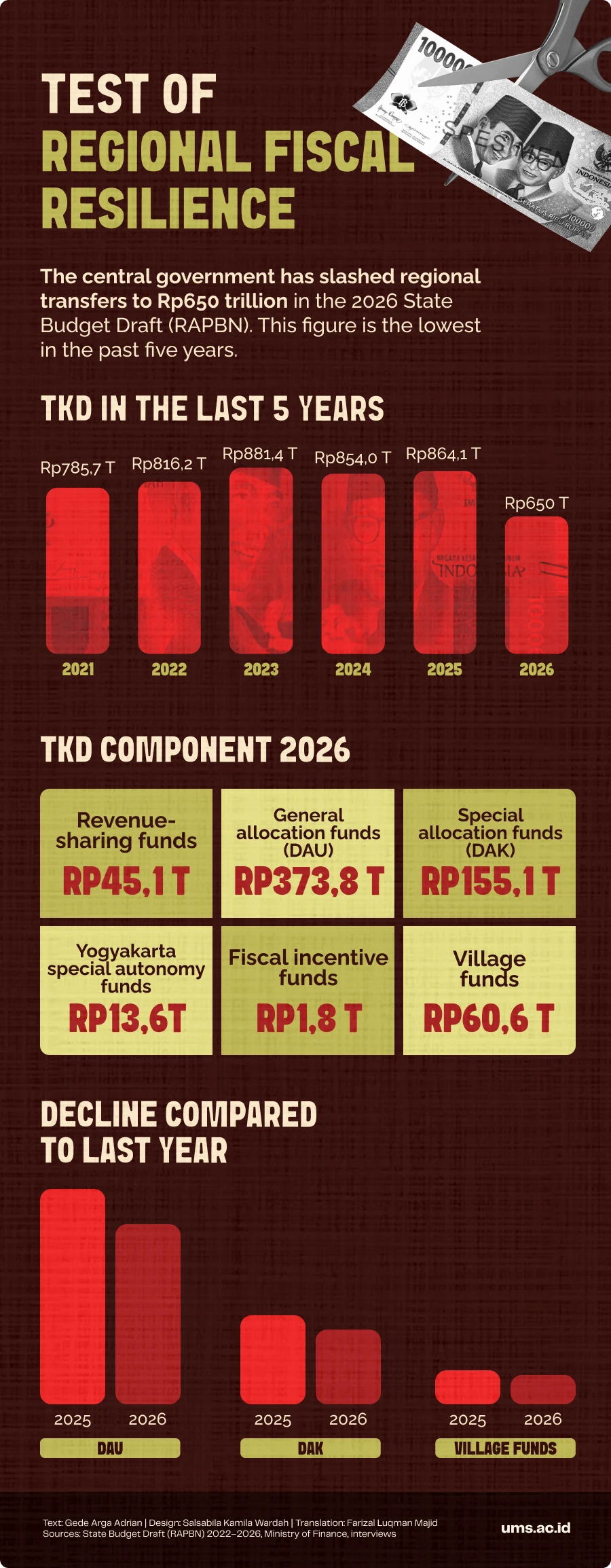
The government has slashed regional transfer funds in the 2026 Draft State Budget (RAPBN). Only Rp650 trillion has been allocated for transfers to regions (TKD), significantly lower than this year’s Rp864.1 trillion.
The 2026 allocation marks the lowest in the past five years. In 2021, TKD reached Rp785.7 trillion, which included general allocation funds, special allocation funds, and village funds.
Finance Minister Sri Mulyani Indrawati explained that part of the TKD budget for 2026 would be redirected to central government spending under ministries and agencies.
“Even though the spending is carried out by the central government, it is the people in the regions who will benefit,” said the Minister during her budget speech on August 15.
Deni Aditya Susanto, S.E., M.Ec.Dev., Lecturer in Development Economics at Universitas Muhammadiyah Surakarta (UMS), believed that the cuts will limit regional governments’ fiscal flexibility. This limitation, he argued, could hamper development initiatives tailored to local needs.
“The immediate impact is that regions won’t be able to carry out development in line with their specific characteristics,” Deni said in a virtual interview on Tuesday (26/8/2025).
He further explained that the general allocation fund, one of the core components of TKD, is among those affected by the cuts. Yet, the general allocation fund has long been a key fiscal instrument to drive local development.
Deni added that the general allocation fund (DAU) is often used by local governments to realize political promises. This differs from the special allocation fund (DAK), which comes with earmarked spending requirements. “DAU is more flexible,” he explained.
Deni acknowledged that not all regions enjoy fiscal independence in their local budgets. In fact, more than 80 percent of local governments in Indonesia remain dependent on transfers from the central government. For many, locally generated revenue (PAD) is far from sufficient to drive development.
“There are regions where dependence on the central government reaches 95 percent. Their PAD is only 5 percent,” Deni said.
This fiscal imbalance has driven some regional administrations to scramble for quick fixes in boosting revenue. One recent example was the Pati Government in Central Java, which planned to increase property tax (PBB) rates by up to 250 percent in an attempt to raise PAD.
The policy sparked public outrage. On August 13, 2025, more than 80,000 residents of Pati took to the streets, staging a massive demonstration in front of the Regent’s Office.
The reason behind the protests in Pati was not only the PBB hike. Deni argued that the arrogance of Pati Regent Sudewo also triggered public anger. “In Pati, I think it was a misstep in communication strategy, and there was also a sense of arrogance,” said Deni.
A similar move was made by the Pekanbaru City Government, which planned to increase PBB rates by up to 300 percent. The proposal likewise drew public protests, spreading widely on social media.
According to Deni, this phenomenon reflects one of the impacts of reduced TKD on regions that are not yet fiscally independent. Raising PBB has become the instant shortcut to boost local PAD, rather than exploring other potential sources such as restaurant taxes, levies, or vehicle taxes.
“If taxes cannot be pushed further, for example, the number of restaurants is fixed, hotels remain the same, visitor numbers don’t increase, retribution is stagnant because vehicle traffic is limited, then the one thing that can be quickly increased is PBB,” Deni explained.
The policy of raising PBB, however, was deemed hasty and indiscriminate, treating land and property owners the same across the board. Deni observed that Pati’s government was reluctant to conduct in-depth curation to determine which properties or lands were actually eligible for the tax hike.
He urged both Pati and other local governments to curate taxable objects so that PBB increases would be more targeted and would not burden low-income communities.
Curation, he added, could be done by analyzing the tax object sale value (NJOP). ”For example, if the average NJOP is still around Rp200,000–300,000, then there’s no need for a hike. But if the NJOP has reached Rp2–3 million, then an increase is reasonable,” he explained.
Local governments need to seriously identify alternative revenue streams. Regional potential must be fully maximized. Deni emphasized that boosting PAD does not always mean raising tax and levy rates. “There are many alternatives,” he stressed.
The first step, he suggested, is to expand the tax base. Conducting a curation of rising NJOP can serve as the starting point.
From such curation, local governments could also tap into another source of revenue: the duty on land and building rights acquisition (BPHTB), particularly in housing or land purchase schemes. Deni noted that BPHTB works well in credit-based transactions.
“Taxes and BPHTB can increase, but the public won’t feel the burden because payments are made in installments,” he added.
Local governments, he continued, should also be bold in collecting taxes from the utilization of natural resources in their regions. Let’s say mining activities that could significantly raise revenue. Such assertiveness would also help curb illegal mining, which has long caused losses to many regions in Indonesia.
Regional asset management should likewise be maximized. Idle land or buildings, Deni suggested, could simply be leased out to entrepreneurs. “Just by renting them out, the revenue would already be quite significant,” he explained.
In addition, the management of regional-owned enterprises (BUMD) should be optimized to strengthen PAD. Local governments can diversify BUMDs into sectors such as tourism, agriculture, industry, and mining.
Providing greater autonomy to BUMDs is key to enabling them to operate more professionally. Deni said that BUMDs should not always be directly managed by local governments, since such control often hampers performance due to excessive regional regulations.
“If it becomes a business unit managed directly by the local government, a BUMD has to be cautious. That’s where the principle of prudence applies,” he added.
BUMD management, Deni stressed, must be efficient and free from political interests. He lamented the fact that many BUMDs in Indonesia have instead become political instruments for regional heads, placing their cronies as directors, commissioners, or in other strategic positions.
Local governments are also expected to be proactive in communicating with the central government. In Deni’s view, communication is the key to ensuring that local development agendas are included within both physical and non-physical components of TKD.
However, Deni warned that all these measures would be meaningless if they were not accompanied by clear public communication. Local governments must conduct public testing of new policies and explain their benefits to the community.
He also underlined that local governments must avoid showing arrogance toward their constituents. With effective public communication and well-targeted policies, Deni is confident that communities will support the efforts taken by local governments to boost PAD.
Writer: Gede Arga Adrian
Translator: Farizal Luqman Majid
Editor: Al Habiib Josy Asheva
Sheep dunged nutrient-rich organic fertilizer for plants, made with the help of maggots. Built on community empowerment and a zero-waste principle.
Nothing’s more special than reading curated news just for you.
Subscribe to the UMS Newsletter for free today.