
How Sheep Manure Turns into Nutrient Rich Fertilizer
16 July 2026
Sheep dunged nutrient-rich organic fertilizer for plants, made with the help of maggots. Built on community empowerment and a zero-waste principle.




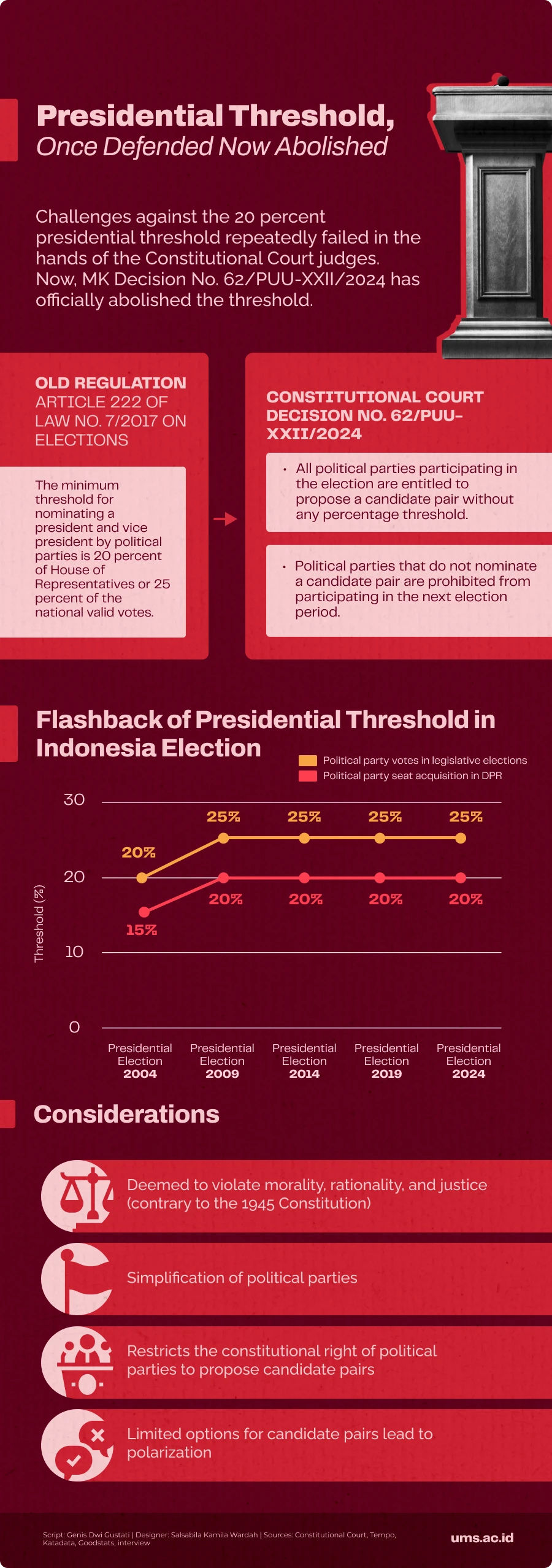
Recently, the Constitutional Court (MK) abolished the presidential threshold, a minimum requirement for nominating presidential candidates stipulated in Article 222 of Law No. 7 of 2017 on General Elections. This abolition refers to the ruling in MK Decision No. 62/PUU-XXII/2024, announced by the judges in the MK Courtroom, Jakarta, on Thursday (2/1/2025).
This decision has surprised many, as previous challenges against the presidential threshold had failed more than 30 times in the MK.
The presidential threshold is the minimum requirement that political parties or coalitions must meet to nominate a presidential and vice-presidential candidate. Under the old rule, parties or coalitions needed 20 percent of seats in the House of Representative (DPR) or 25 percent of the national valid votes in legislative elections.
The elimination of the presidential threshold didn’t come out of nowhere. According to a Katadata report, the MK considered that this threshold restricted democratic space as it was deemed contrary to the 1945 Constitution. The second consideration was that proposing candidate pairs based on the threshold was not effective enough in simplifying the number of political parties participating in the elections.
Third, the dominance of certain political parties has limited the constitutional rights of other political parties to propose candidate pairs. Fourth, presidential elections have tended to feature only a limited number of candidate pairs, which has led to polarization.
Prof. Dr. Aidul Fitriciada Azhari, M.Hum., an expert of Law at Universitas Muhammadiyah Surakarta (UMS), remarked that the Constitutional Court (MK) has historically upheld the argument that the presidential threshold is part of an open legal policy entrusted to the DPR. “However, this time, the MK has taken a different approach, which I believe reflects a change in the institution's stance,” he said during an interview at the Faculty of Law, UMS Campus 1, Tuesday morning (7/1/2024)
The history of the presidential threshold, Aidul explained, originated from an intent to simplify the presidential nomination process. The hope was that by applying a threshold, only candidates with significant support would advance, preventing an overabundance of candidates that could split votes. Over time, however, the regulation has been criticized for favoring major political parties.
“The presidential threshold may seem logical on paper, but in practice, it often reinforces the dominance of major parties,” said the former Chair of the Indonesian Judicial Commission. Aidul further argued that the threshold rule has ultimately created transactional politics, where party coalitions are formed based more on political pragmatism than ideological alignment.
The MK's decision to eliminate the threshold is likely to have far-reaching implications. Normatively, smaller parties can now nominate their candidates without needing to ally with larger parties. However, Aidul cautioned that the reality may not be as straightforward.
“In theory, small parties can nominate candidates. But the political costs for a presidential election are enormous, reaching hundreds of trillions of rupiah. It’s unlikely small parties can bear that burden alone,” he added.
Aidul also strongly emphasized that the MK's decision carries fair shares of risks. One of the greatest concerns is the potential emergence of candidates lacking quality and competence.
“With the threshold removed, all parties, including smaller ones, have the opportunity to nominate candidates. But does this mean there will be more high-quality candidates? Not necessarily. We need to observe how this system is implemented,” he concluded.
Although many people enthusiastically welcome the abolition of the presidential threshold, some are concerned about the potential for political fragmentation. However, Aidul argued that such fragmentation is unlikely to occur.
“Indonesia has never experienced ideological political fragmentation. That’s no longer an issue for us. Nearly all parties here lack strict ideological divisions,” he said.
As an example, Aidul pointed to the stance of the Indonesian Democratic Party of Struggle (PDIP). While PDIP is supposed to be a secular nationalist party, it still strives to be perceived as religious. Similarly, the Prosperous Justice Party (PKS), known as an Islamist party, also attempts to display its nationalist side.
“It’s not like in Turkey, for instance, where the line between secular and Islamist parties is very clear. In Indonesia, everything is fluid. This fluidity ensures that ideological political fragmentation doesn’t pose a significant threat,” he elaborated.
The MK decision to abolish the presidential threshold is not only seen as a step toward a more inclusive democracy but also as a reflective stance by the institution on Indonesia's long legal journey. Previously, the MK faced intense criticism over the candidacy of Gibran Rakabuming Raka as vice president.
“I know for a fact that the MK was psychologically affected. Now they realize that mistakes were made and need to be corrected. I see the MK becoming more aware of its own independence. This is something that must be preserved,” said Aidul.
This is also evident in the latest case regarding the age requirement for gubernatorial and deputy gubernatorial candidates. The MK decision at the time effectively barred Kaesang Pangarep, Chairman of the Indonesian Solidarity Party (PSI), from running in the 2024 Regional Elections. According to Tempo, President Joko Widodo's youngest son had been rumored to be a potential candidate in Central Java’s 2024 gubernatorial race.
“This case took place in August 2024, when the MK firmly rejected changes to the age requirement. I see this as a form of ‘repentance’ by the Constitutional Court judges,” Aidul emphasized, highlighting the MK's increasingly prudent approach.
The MK decision to abolish the presidential threshold is not merely about reshaping Indonesia's political rules. It is also a moment of reflection for the nation to recognize the importance of preserving the quality of democracy.
Aidul expressed his agreement with the MK's decision, as the abolition of the presidential threshold opens opportunities to break the dominance of major political parties that have long controlled coalitions and presidential nominations. He hoped that all parties, political entities, the government, and society, can ensure that this decision truly ushers in positive change for Indonesia.
“In addition to what has been mentioned, abolishing the presidential threshold compels us to reevaluate the structure of party coalitions that have been built so far. Coalitions driven by political pragmatism must be replaced by those founded on ideology and a shared vision for national development,” Aidul advised.
He emphasized that with the potential increase in the number of candidates, political parties must focus on developing high-quality leadership to produce capable candidates. The government should implement policies that support an inclusive electoral process, while the public is encouraged to become more critical in selecting leaders to secure the nation's future.
Writer: Genis Dwi Gustati
Translator: Farizal Luqman Majid
Editor: Al Habiib Josy Asheva
Sheep dunged nutrient-rich organic fertilizer for plants, made with the help of maggots. Built on community empowerment and a zero-waste principle.
Nothing’s more special than reading curated news just for you.
Subscribe to the UMS Newsletter for free today.