How Sheep Manure Turns into Nutrient Rich Fertilizer
16 July 2026
Sheep dunged nutrient-rich organic fertilizer for plants, made with the help of maggots. Built on community empowerment and a zero-waste principle.




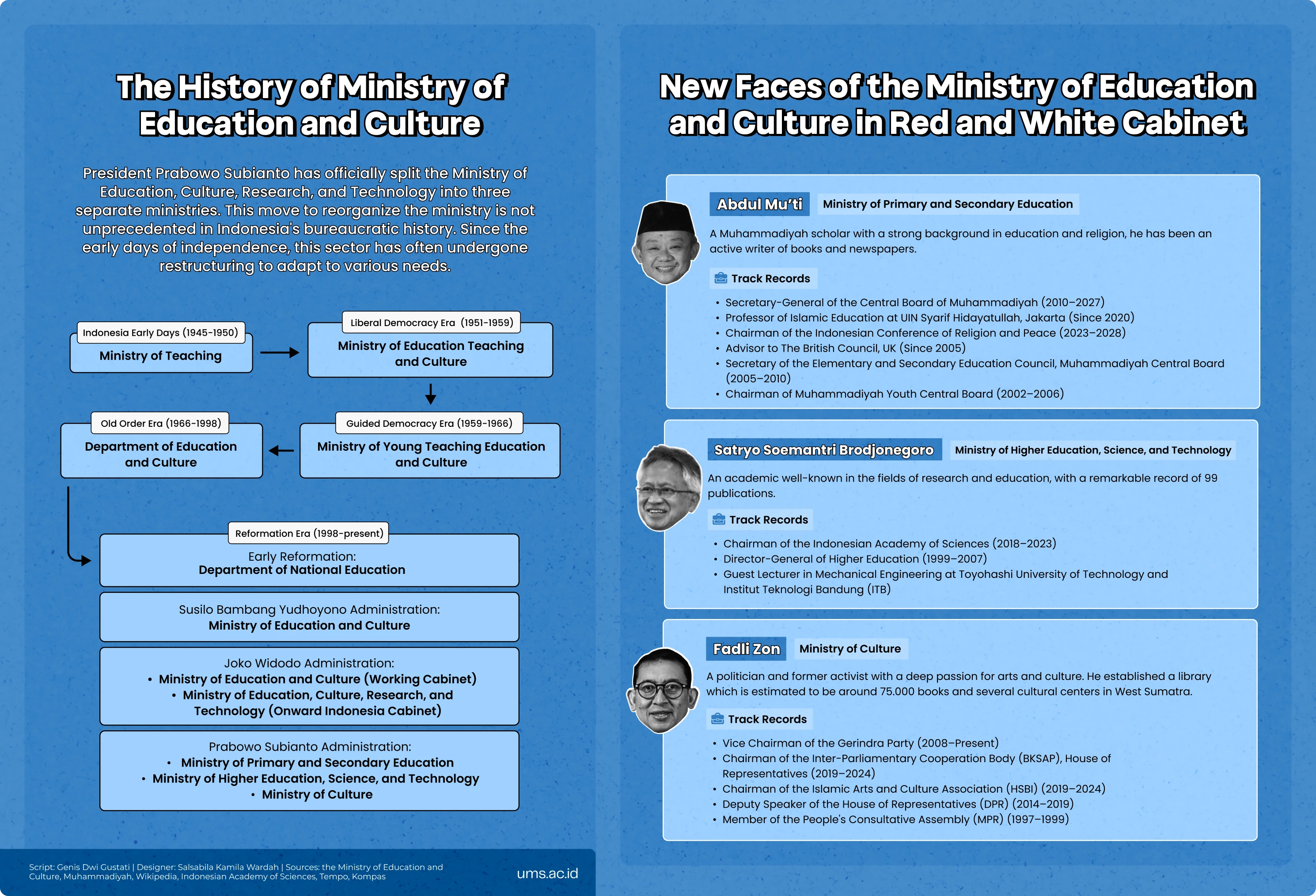
Under the new leadership of Prabowo-Gibran, there is now a Ministry of Primary and Secondary Education, led by Abdul Mu’ti; a Ministry of Higher Education, Science, and Technology, headed by Satryo Soemantri Brodjonegoro; and a Ministry of Culture, under the leadership of Fadli Zon.
This division has sparked mixed reactions among academics, including Prof. Dr. Harun Joko Prayitno, M.Hum., and Dr. Main Sufanti, M.Hum., both lecturers at Universitas Muhammadiyah Surakarta (UMS).
The restructuring of ministries is not new to Indonesian bureaucracy. Since independence, similar reorganizations have occurred, often adapting to the nation’s changing needs. During President Joko Widodo’s term, for instance, the Ministry of Research and Technology was merged into the Ministry of Education and Culture , forming the Ministry of Education, Culture, Research, and Technology in 2021 under Nadiem Makarim’s leadership.
Makarim’s tenure saw the introduction of the Merdeka Belajar and Kampus Merdeka curricula, although many of these programs faced criticism for their perceived lack of practical impact.
In our interview, Harun shared that this division aims to focus the bureaucratic scope of each sector, although it also introduces challenges in managing an expanded range of programs. “With this division, each is expected to sharpen their focus,” he remarked.
In the education sector, ministers and deputy ministers in the Prabowo-Gibran Cabinet are expected to assess and revisit certain policies from the previous administration to increase their effectiveness. One such policy is the Merdeka Belajar Kampus Merdeka (MBKM) program, which has garnered significant attention. Harun praised the concept of Merdeka Belajar, especially in providing flexibility for students, but suggested adapting its implementation to match the readiness of infrastructure across different regions.
“There needs to be an evaluation to ensure that each university and school, whether in major cities or rural areas, can implement this program effectively. Equitable educational infrastructure is key,” he stated.
Harun’s comments on educational inequality in Indonesia highlight the urgent need to improve access and quality of education, particularly in remote areas. According to data from GoodStats and the Statistics Indonesia (BPS) as of March 2023, 5.11% of rural residents have never attended school, compared to just 1.93% in urban areas. Additionally, only 27.98% of rural residents have completed 12 years of mandatory education, compared to 49.16% in urban areas.
These figures effectively serve as a map highlighting the significant gap in education between urban and rural areas. Addressing this disparity will be a major responsibility for the newly appointed ministers and deputy ministers in the education sector under President Prabowo Subianto’s Red and White Cabinet.
“Hopefully, moving forward, we’ll see efforts to improve educational infrastructure more progressive, so every child regardless of location, has equal learning opportunities, especially in 3T (frontier, outermost, and remote) regions," Harun added.
Similarly, Abdul Mu’ti, the Minister of Primary and Secondary Education, emphasized this commitment to equitable education when addressing the media at the office of the Kemendikbudristek. “Every citizen has the right to quality education. For the Kurikulum Merdeka, while it's already in place, not every educational institution has been able to implement it fully. We’ll take a comprehensive look, without rushing," he said on Monday (10/21/2024).
Mu'ti assured that his ministry would move swiftly to prioritize medium- and long-term goals within the Prabowo-Gibran administration. He also mentioned plans to listen to feedback from various stakeholders.
“Quality education requires improved facilities, and President Prabowo has already given the green light for prioritizing education in the national budget (APBN),” Mu'ti shared. When asked about the potential increase in the APBN to improve educational standards, he responded, “It seems so, yes. But the exact amount, I’m not sure yet.”
Read more: On the Crossroad of Kurikulum Merdeka
On the other hand, Harun believes that while the Kurikulum Merdeka has sparked debate, several of its initiatives have positively impacted education. For instance, in higher education, the Indonesian International Student Mobility Awards (IISMA) is a program he views as highly beneficial, providing Indonesian students the opportunity to study at leading universities worldwide.
“IISMA, in my opinion, should be retained. This program offers invaluable academic experience while broadening students' networks and perspectives on an international scale,” commented Harun, the Vice-Rector I of UMS. He also highlighted the Wirausaha Merdeka (WMK) program as essential for empowering entrepreneurial skills and competitiveness in graduates.
Feedback on education policies from the Nadiem Makarim era also came from Main Sufanti, who pointed to the underlying issue of teacher welfare in Indonesia.
“Teacher welfare, especially for contract and part-time teachers, remains an unresolved issue. While digitalization programs and training have been widely promoted, the wages and allowances are insufficient relative to their workload," said Main.
Main's statement aligns with Databoks’ data, showing that 74.3% of contract teachers earn less than Rp2 million per month, with 20.5% of them earning below Rp500,000 monthly.
Read more: Breaking Down the Stigma of Socioeconomic Status in Education
“This issue must be resolved urgently! How can they teach effectively if they struggle to meet basic living needs? We're talking about the future of young generations, and it depends heavily on teachers who are well-compensated and valued,” urged the UMS lecturer of Indonesian Language and Literature Education.
The division can complicate the alignment of the vision of these three new entities. Main hopes that the synergy between Abdul Mu'ti, Satryo Soemantri Brodjonegoro, and Fadli Zon will be effective in achieving their shared goals.
“Coordination and communication between ministers must be strong so that education policies can be implemented in harmony,” she explained. Without a harmonious integration, the expected policies could become overlapping and less effective.
With this division, Main believes that the roles of each ministry can be more optimal in serving the public. However, she emphasized the importance of periodic evaluations of policies to ensure that educational goals are met.
The Minister of Education faces high expectations not only to review existing programs but also to create new innovations that align with societal needs.
“Surely, I and all educators in this country hope for the same. Hopefully, the new educational landscape will guide us towards equitable, quality, and prosperous education that is adaptive to global developments," Main expressed.
Writer: Genis Dwi Gustati
Editor: Al Habiib Josy Asheva
Translator: Farizal Luqman Majid
Sheep dunged nutrient-rich organic fertilizer for plants, made with the help of maggots. Built on community empowerment and a zero-waste principle.
Nothing’s more special than reading curated news just for you.
Subscribe to the UMS Newsletter for free today.