
How Sheep Manure Turns into Nutrient Rich Fertilizer
16 July 2026
Sheep dunged nutrient-rich organic fertilizer for plants, made with the help of maggots. Built on community empowerment and a zero-waste principle.




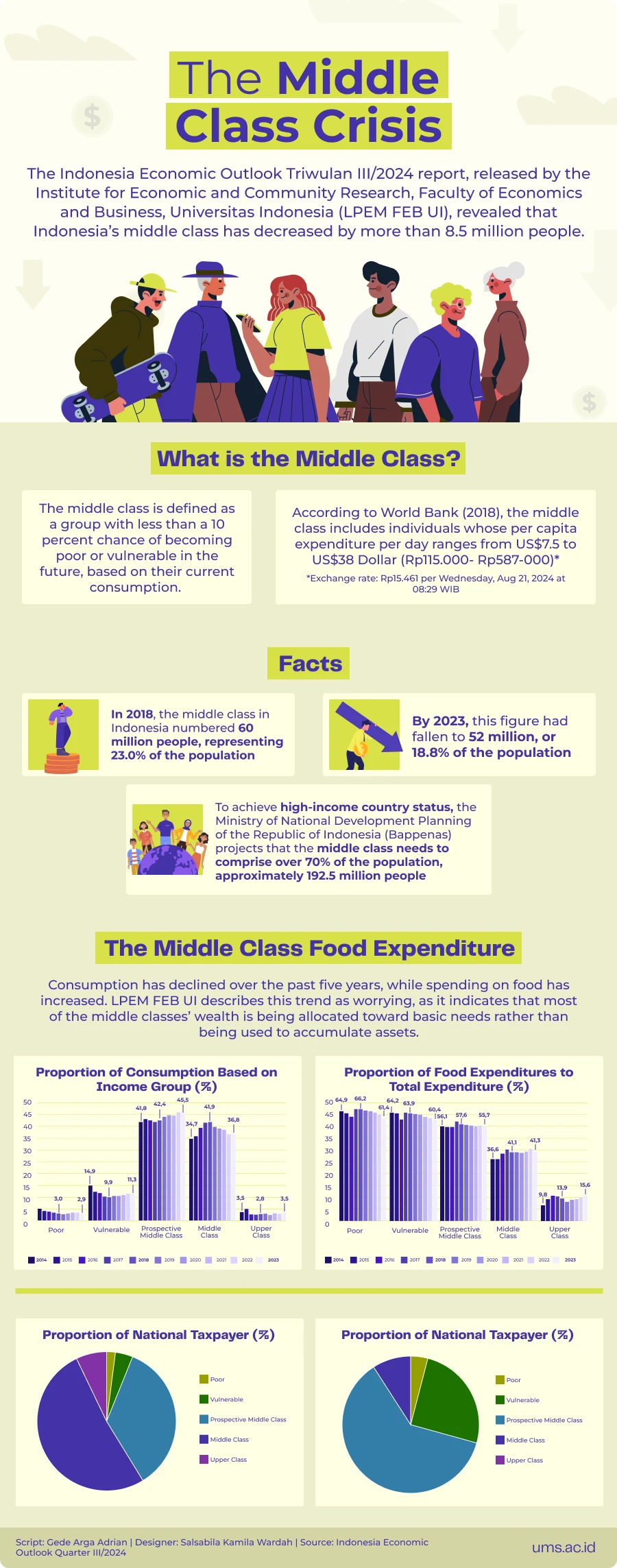
The Indonesia Economic Outlook Quarter III/2024 report, released by the Institute for Economic and Community Research, Faculty of Economics and Business, Universitas Indonesia (LPEM FEB UI), revealed that Indonesia’s middle class has decreased by more than 8.5 million people. From approximately 60 million in 2018, the middle class has dwindled to just 52 million by 2023.
According to LPEM FEB UI, the middle class is a group with less than a 10 percent chance of becoming poor or vulnerable in the future, based on their current consumption levels.
In 2014, the middle class population in Indonesia was 39 million people, making up 15.6 percent of the population. By 2018, this figure had risen by 21 million, reaching 60 million people, or 23 percent of the population.
Unfortunately, this growth has stagnated over the last five years. “As a result, the middle class population has decreased to only 52 million people, accounting for around 18.8 percent of the population today,” stated LPEM FEB UI in the research.
The decline in the middle class over the last five years went side by side with a slowdown in household consumption. In 2018, middle-class consumption accounted for 41.9 percent of total household consumption in Indonesia. By 2023, this figure had dropped sharply to 36.8 percent.
LPEM FEB UI research also revealed that middle-class spending on food increased from 36.6 percent in 2014 to 41.3 percent in 2023. These findings are concerning, as non-food expenditures, such as those on durable goods, health, education, and entertainment, indicate purchasing power and economic well-being more than food expenditures.
“An increase in the spending of food indicates a decline in the purchasing power of the middle class. The decline is concerning because it impacts aggregate consumption, which has been a key driver of Indonesia’s economic growth in recent years,” LPEM FEB UI noted in its research.
The Ministry of National Development Planning of the Republic of Indonesia (Bappenas) has stated that to achieve high-income country status by 2045, the middle class must grow to comprise 70 percent of the population.
This target is well-founded. According to Prof. Dr. Anton Agus Setyawan, an economic expert from Universitas Muhammadiyah Surakarta (UMS), the middle class is the most consumer-driven segment of society. Their consumption patterns boost demand for goods, which drives production and fuels economic growth.
“The middle class consists of those who spend between 1.2 million to 1.6 million rupiah per month on consumption,” he explained. “The lower the class, the more consumptive their behavior tends to be.”
Regarding taxation, the middle class is known for being compliant when paying taxes. According to the National Socio-Economic Survey (Susenas), 50.7 percent of taxpayers belong to the middle class. Additionally, the middle class receives relatively low subsidies, accounting for only 9 percent.
Anton expressed concern over the decline of the middle class in Indonesia, noting that this trend reflects a deterioration in the economy’s quality. “This indicates that our current economy is less robust than it was in the past,” he remarked.
According to Anton, the decline of Indonesia’s middle class began during the COVID-19 pandemic. Although the Indonesian economy managed to endure the crisis, Anton noted that the pandemic caused many middle class to lose income and jobs.
“Most of the middle class lack job security, meaning their employment is not sustainable over the long term,” said Anton.
Even after the pandemic ended, Indonesia’s economic growth has not been sufficient to prevent the middle class from slipping into poverty. This is evident in the ongoing decline in public consumption levels.
“Even though the economy is growing at a positive rate of 5 percent, it seems that the growth is not meeting expectations,” he added.
The decline of the middle class is also closely linked to global factors. According to Anton, the slowdown in the world economy can be attributed to global geopolitical conditions, such as the Russia-Ukraine war, the Israel-Palestine crisis, reduced demand in the United States, a slowdown in Chinese manufacturing, and rising global interest rates.
“The economic recovery process is not yet optimal due to global turmoil, which has led to a world economic downturn. The Ukraine-Russia war, for example, has disrupted global supply chains for goods and services,” continued the Dean of FEB UMS.
Anton acknowledged that efforts to support the middle class require a substantial budget. This is because the middle class, having previously enjoyed a stable income, had the freedom to choose and fulfill their needs. In contrast, the poor can be more directly assisted with cash transfers or other social assistance.
Indonesia’s current situation is unfavorable for incentivizing the middle class. Creating jobs for the middle class is also challenging, as it comprises skilled and educated workers.
“Offering blue-collar jobs is not a viable solution, as the middle class demand quality jobs with wages above the minimum wage, along with health insurance and retirement benefits,” Anton explained.
According to Anton, the government has keys to deal with this problem. These require reinforcements on economic efficiency by reducing extortion and corruption, workforce quality, and investment regulations in Indonesia.
When asked about National Strategic Projects (PSN), Anton noted that their impact on the middle class is more indirect.. He observed that most PSN are concentrated in sectors that do not significantly absorb labor.
“The PSN is expected to improve the investment climate and help build industries. These industries will, in turn, support the middle class by providing quality jobs,” he said.
A significant step the government must take is to encourage the emergence of new entrepreneurs who will create jobs within the community. He emphasized that these entrepreneurs should have a meaningful impact, particularly in new product development, creative industries, and digital businesses.
In addition, the government must focus on enhancing the investment climate, improving economic and business regulations, strengthening law enforcement, and eliminating overlapping rules.
“If necessary, strategic entrepreneurs should be offered incentives, such as tax holidays or other subsidies, to ensure their products can compete in the global market. This is more important than focusing on building National Strategic Projects (PSN),” he concluded.
Writer: Gede Arga Adrian
Editor: Al Habiib Josy Asheva
Translator: Farizal Luqman Majid
Sheep dunged nutrient-rich organic fertilizer for plants, made with the help of maggots. Built on community empowerment and a zero-waste principle.
Nothing’s more special than reading curated news just for you.
Subscribe to the UMS Newsletter for free today.