
How Sheep Manure Turns into Nutrient Rich Fertilizer
16 July 2026
Sheep dunged nutrient-rich organic fertilizer for plants, made with the help of maggots. Built on community empowerment and a zero-waste principle.



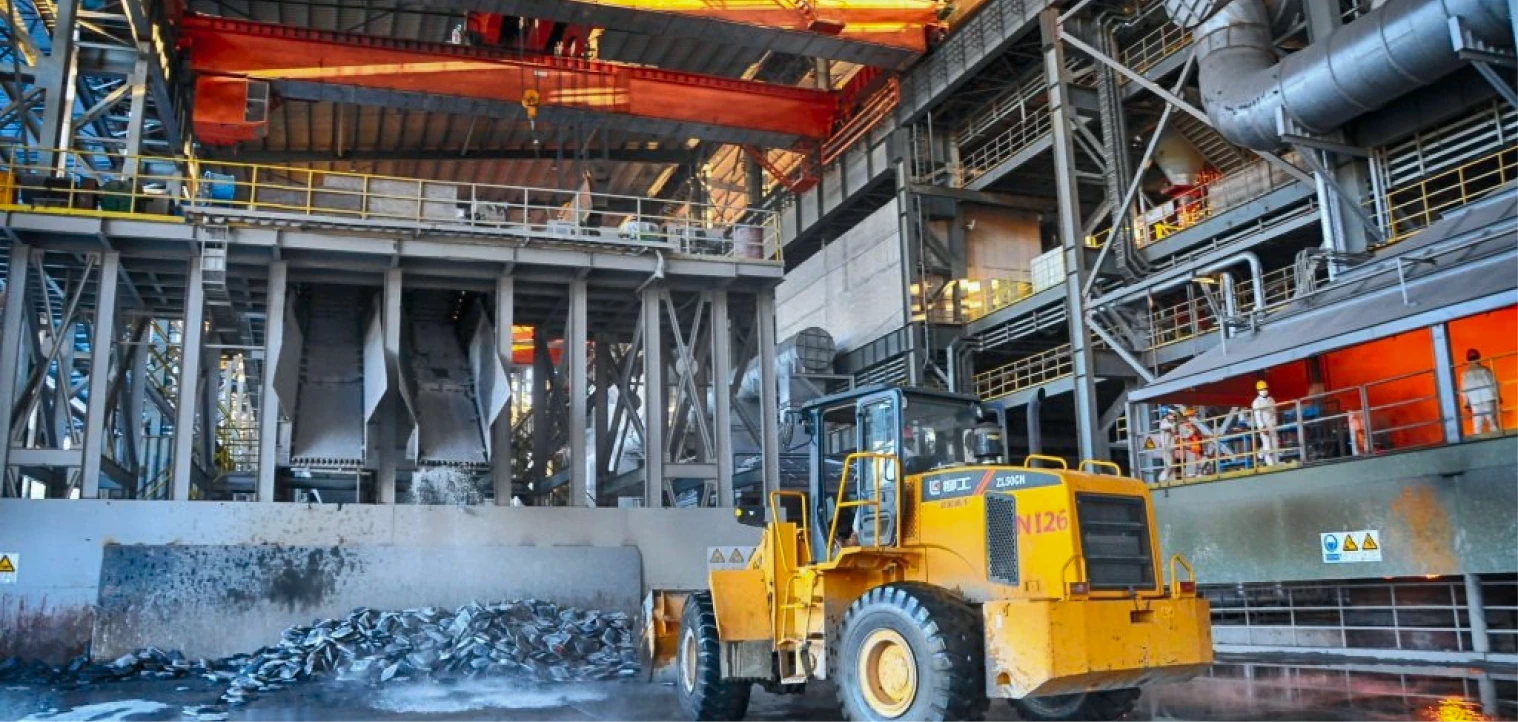
Another incident occurred at the PT Indonesia Morowali Industrial Park (IMIP) in Morowali, Central Sulawesi. One of IMIP’s tenants, PT Dexin Steel Indonesia, experienced an explosion leading to a fire on Friday (25/10/2024. The incident resulted in one fatality and one severe injury.
According to a Tempo.co report, the fire ignited in waste pond 8, triggered by an explosion in a pond with residual water. Henry Foord Jeebs, Chairperson of the Industrial Mining Workers Union (SBIPE) IMIP, explained that workers used dry slag to fill the water puddles to prevent explosions when waste was poured into the pond.
At the time of the incident, the loader operator, tasked with filling the pond with dry slag, was taking a break for afternoon prayers. A supervisor, Arnol, instructed the operator to resume filling the pond afterward.
However, a foreman from China continued to pressure Arnol to pour the waste into pond 8, citing the lack of available furnaces to hold the waste. Arnol had already warned the foreman about the water that hadn’t been fully covered at the bottom of the pond.
Before leaving pond 8, Arnol argued with the foreman and repeatedly warned him about the potential for an explosion. Arnol also requested the loader operator to pour more dry slag. Nonetheless, the foreman ignored these warnings and insisted on immediately dumping the waste into the pond.
Arnol then left the location. After walking about 20 meters away from pond 8, the explosion blasted.
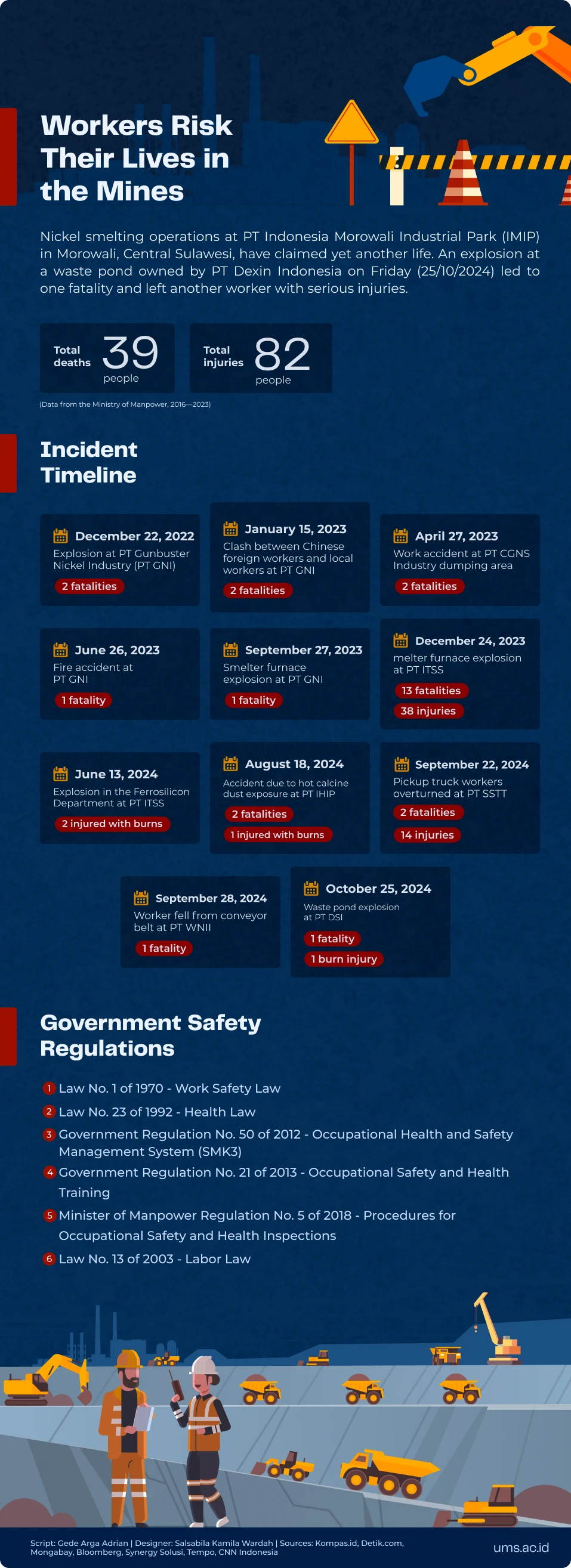
The accident at one of the tenants in the Indonesia Morowali Industrial Park (IMIP) added to the list of workplace accidents in the nickel downstream industry, which has been in operation since 2013. According to the Ministry of Manpower’s reports, 39 fatalities and 82 injuries occurred in the IMIP Morowali area between 2016 and 2023.
In the past two years, repeated accidents at IMIP Morowali have drawn public attention. For example, in December 2022, Detik.com reported an incident at PT Gunbuster Nickel Industry (PT GNI) that resulted in the deaths of two workers. One of them was TikTok content creator Nirwana Selle, known for sharing content about working in Morowali.
The largest accident occurred on December 24, 2023, when a smelter furnace owned by PT Indonesia Tsingshan Stainless Steel (ITSS) exploded. At least 18 people lost their lives in the blast, including 8 foreign workers and 10 Indonesian workers.
Occupational health and safety (OHS) expert from Universitas Muhammadiyah Surakarta (UMS), Sheena Ramadhia Asmara Dhani, S.K.M., M.K.K.K., highlighted safety practices in mining companies. “If I'm not mistaken, there have been around 300 workplace accidents there, ranging from minor to severe incidents,” Sheena stated in a virtual interview on Tuesday (5/11/2024).
Sheena called these recurring accidents “extraordinary events” due to the unusual frequency of such incidents at a licensed mining company.
Prior to receiving an operational license, companies are required to have a Contractor Safety Management System (CSMS), an OHS management system for contractors as mandated by Government Regulation No. 50 of 2012. CSMS serves as proof that contractors and subcontractors are committed to applying OHS in all areas of their work.
The UMS Public Health lecturer criticized the lack of commitment to OHS implementation among downstream nickel companies in Morowali. This concern has been underscored by requests from the SBIPE to both mining companies and the government to conduct safety audits.
“SBIPE itself is concerned about OHS and senses that something is amiss with safety practices in Morowali,” she added.
Sheena identified poor OHS communication as the primary reason for the high rate of workplace accidents at IMIP Morowali. According to her, mining companies are responsible for effectively conveying OHS information to all employees.
Sheena emphasized the importance of strictly enforcing work permits to ensure worker readiness, covering aspects such as physical condition, personal protective equipment, and the safety of tools and machinery.
The principle of stop work action (SWA) should also be firmly upheld, allowing both companies and employees to halt work upon detecting any potential accident risks, no matter how minor.
“There are many hazards that are left unchecked, building up over time," Sheena noted. She warned that neglecting potential dangers, combined with inadequate OHS communication, risks creating even larger disasters in the future. “Ultimately, unchecked hazards become a ticking time bomb.”
Enhancing OHS communication is essential to ensure protection for all workers, especially within the mining industry.
In healthcare, there is a concept known as the “golden time,” which refers to the critical window for medical intervention. According to Sheena, OHS is indispensable in mining because most mines are located in remote areas far from healthcare facilities.
“For example, if someone suffers bleeding for more than 20 minutes, they could bleed out and die. The travel time from a worksite to a healthcare facility can take 15-20 minutes, assuming a vehicle is already prepared,” she explained.
It must be acknowledged that on-site OHS supervision remains weak. In a December 26, 2023, edition of Kompas, the Central Sulawesi Department of Manpower admitted that, although they conduct routine inspections, their supervision has not been optimal.
“Based on our monitoring and oversight so far, the OHS system at IMIP is fairly good. There haven’t been issues, and it complies with regulations. However, we also admit that our supervision could be better,” said Arnold Firdaus, Head of the Central Sulawesi Department of Manpower and Transmigration, speaking to Kompas on Tuesday (26/12/2023) and quoted on Wednesday (6/11/2024.
The government has paid special attention to ensuring the security and safety of workers, with regulatory guidelines that include Law No. 1 of 1970 on Occupational Safety, Minister of Manpower Regulation No. 5 of 1996 on OHS Management Systems, and Government Regulation No. 50 of 2012 on Implementing Occupational Safety and Health Management Systems.
According to Sheena, these government efforts should be accompanied by a strong commitment from employers, especially those in the mining sector, to fully implement OHS practices. However, she noted that many companies still view OHS as an added expense.
If companies are willing to invest in OHS management, workplace accidents could be prevented, reducing expenses associated with medical treatment for workers, compensation costs, and support for the families of deceased employees.
“OHS is not the responsibility of just one party, it is a shared obligation. We all must work together to ensure a safe working environment,” Sheena emphasized.
Writer: Gede Arga Adrian
Editor: Al Habiib Josy Asheva
Translator: Farizal Luqman Majid
Sheep dunged nutrient-rich organic fertilizer for plants, made with the help of maggots. Built on community empowerment and a zero-waste principle.
Nothing’s more special than reading curated news just for you.
Subscribe to the UMS Newsletter for free today.