
How Sheep Manure Turns into Nutrient Rich Fertilizer
16 July 2026
Sheep dunged nutrient-rich organic fertilizer for plants, made with the help of maggots. Built on community empowerment and a zero-waste principle.




Across Indonesia, children continue to insist on stepping into matrimony at a young age. The revision of the marriage age limit from 16 to 19 years has not significantly reduced the instances of child marriage in Indonesia.
Recently, the marriage of Gus Zizan and Kamila Asy Syifa has drawn public attention back to the topic of child marriage. While it is known that Gus Zizan is 19 years old, the concern arises from the age of his bride, who is only 17. Their marriage has faced harsh criticism from netizens, who argue it violates Law No. 16 of 2019 concerning Marriage.
Based on data from the Ministry of Women's Empowerment and Child Protection, the government has successfully reduced the target for lowering child marriage to 6.92% in 2023. This figure brings good news when considering the target set in the National Medium-Term Development Plan (RPJMN) 2020-2024, which was 8.74%.
Despite this, the rate of child marriage dispensations remains high. Data from the Religious Courts indicates that over 63,000 applications for child marriage dispensations were decided by the courts in 2020. This number decreased to approximately 61,000 in 2021 and further dropped to around 50,000 in 2022.
Factors contributing to child marriage in Indonesia are closely linked to social pressures, cultural norms, and sometimes misguided religious perceptions. Parents often argue that child marriage serves as a safeguard against behaviors deemed inappropriate, such as dating, which may lead to zina (premarital sex). However, according to Dr. Wiwien Dinar Pratisti, M.Si., a developmental psychologist at Universitas Muhammadiyah Surakarta, this approach merely blinds us to more fundamental issues.
“Using religious justifications, like ‘Well, it’s better than dating, which can lead to sin,’ only masks a lack of sexual education and parental supervision. child marriage is not a solution. it simply shifts the risk from one problem to an even bigger one,” the UMS psychology lecturer explained.
She emphasizes that child marriage is often a decision that overlooks the mental and emotional readiness of adolescents.
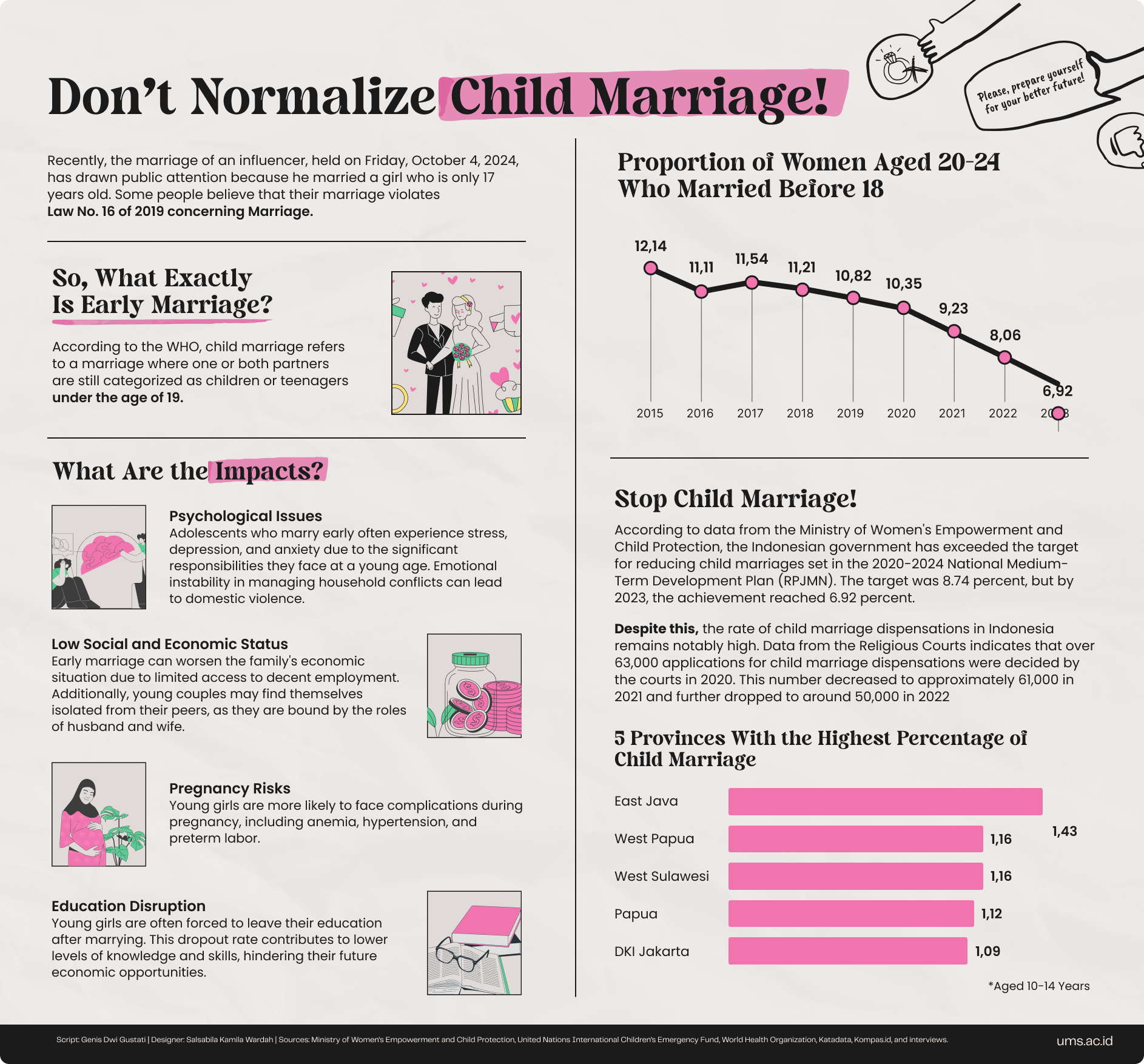
The impacts of child marriage are not limited to individuals but extend to social and economic realms, with far-reaching consequences that young couples must grapple with.
Child marriage often invites psychological distress, especially for those who are unprepared for the responsibilities it entails.
“Teenagers forced into the roles of husband or wife, during an age when they should be focused on self-development, often face psychological issues like anxiety, depression, and conflicts that may lead to divorce,” explained Wiwien.
Supporting Wiwien's concerns, data from the Directorate General of Religious Courts of the Supreme Court, collected by Statistics Indonesia, reveals that there were 408,347 divorces in 2023. The primary cause of these dissolutions was disputes and quarrels, accounting for 251,828 cases or 61.67% of total divorces in the country.
Child marriage also frequently traps individuals in a cycle of poverty. With education cut short and limited skills, young couples find it difficult to compete in the job market. Financial unpreparedness exacerbates their struggles to meet basic needs, heightening the risk of structural poverty.
Moreover, child marriage poses significant risks to reproductive health, particularly for young girls. They are more likely to face complications during pregnancy, including anemia, hypertension, and preterm labor.
According to dr. Boy Abidin, Sp.OG., as reported by Kompas.com, pregnancies in those who are not yet physically or mentally ready can lead to serious health issues. The mother may suffer from miscarriage, anemia, and even death, while the baby is at higher risk of being born prematurely and experiencing stunting.
Referring to Koran Tempo, data from the National Socioeconomic Survey (Susenas) from 2015-2022 indicates that child who marry child face significant challenges in completing their education. Their chances of graduating from junior high school or high school are slim. Less than 1 percent of children who marry young are able to graduate from university. This data highlights that child marriage disrupts children's access to education, making it harder for them to improve their standard of living in the future.
Statistics on child marriage in Indonesia reveal that many teenagers must abandon their dreams after marrying. The option to continue school becomes increasingly difficult for those who have to take on household responsibilities. This creates a long-standing struggle for children to access higher education.
“The heartbreaking reality is that when education is cut off, their chances of escaping poverty diminish significantly, creating a cycle that is hard to break,” added the expert.
Emotional maturity is an essential factor that cannot be overlooked in any marriage. Teenagers who marry without emotional readiness are more vulnerable to instability within their relatioship.
Young couples often face inner turmoil and role tensions that are beyond their years. Wiwien explained, “child marriage often increases the risk of domestic violence because both parties may lack the mental preparedness to handle conflicts and differing opinions. The emotional instability of adolescents can lead to exaggerated reactions in conflict situations.”
The issue of child marriage in Indonesia cannot be resolved merely with wise words. It requires commitment and collective awareness from all elements of society. “
We must not let child marriage become an escape from social pressures! Every decision needs careful consideration,” Wiwien warned.
She believes that comprehensive education on reproductive health, along with improved access to education, should be at the forefront to prevent child marriage. Intensive support from families and communities is also crucial. By breaking the cycle of child marriage in Indonesia, we have the opportunity to save future generations.
“Marriage is not just about uniting two individuals. It's about the readiness to embark on a long and challenging journey together. This choice can carry significant consequences if made without sufficient preparation. Families play a critical role here, let’s give our children the chance to grow, dream, and reach their fullest potential before taking the step into marriage,” Wiwien concluded.
Writer: Genis Dwi Gustati
Editor: Al Habiib Josy Asheva
Translator: Farizal Luqman Majid
Sheep dunged nutrient-rich organic fertilizer for plants, made with the help of maggots. Built on community empowerment and a zero-waste principle.
Nothing’s more special than reading curated news just for you.
Subscribe to the UMS Newsletter for free today.