
How Sheep Manure Turns into Nutrient Rich Fertilizer
16 July 2026
Sheep dunged nutrient-rich organic fertilizer for plants, made with the help of maggots. Built on community empowerment and a zero-waste principle.



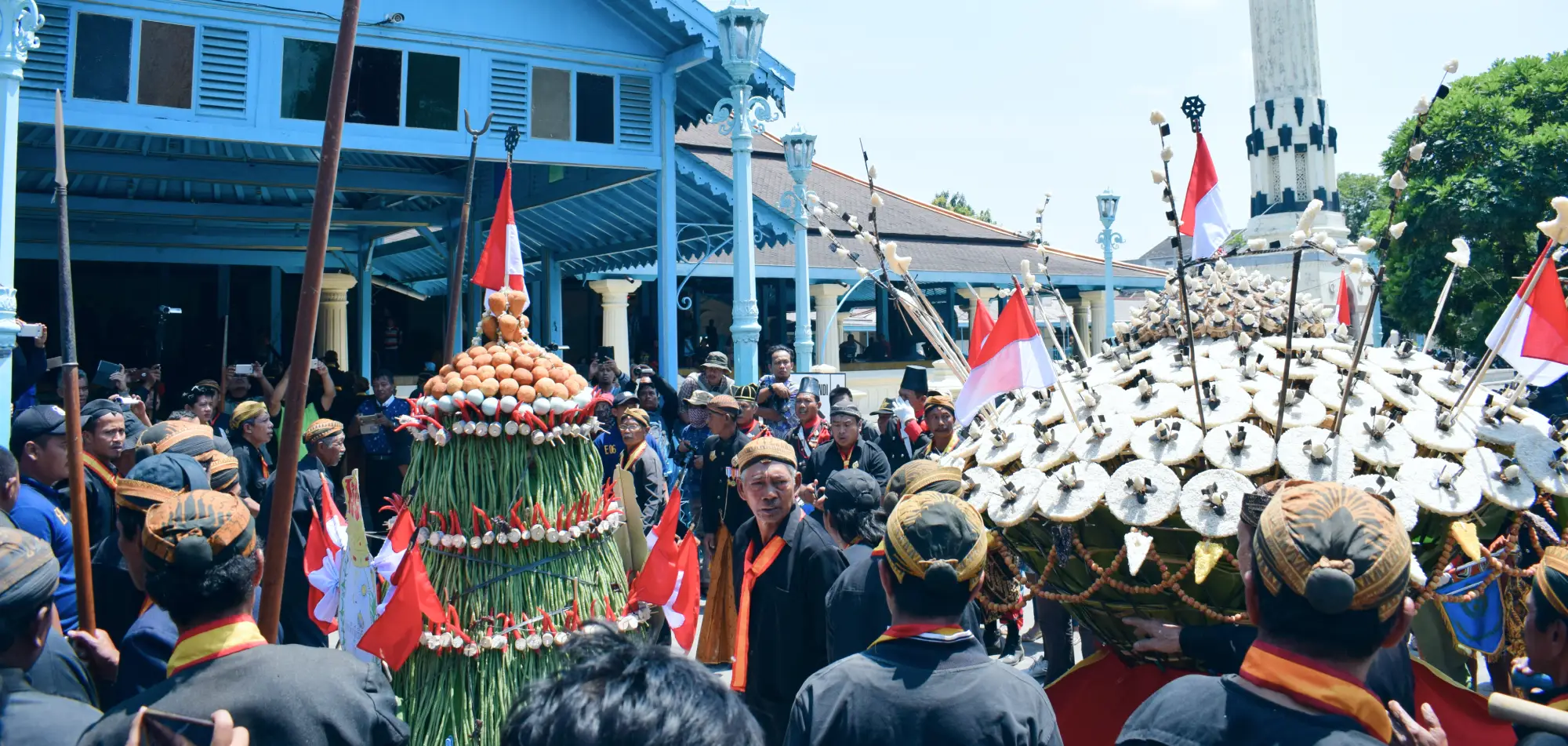
The scorching August sun felt blistering as several merchants hustled their goods around the North Square of Surakarta Palace. From noon until night, they lined the edges of North Square Street, joining in the festive spirit of the Sekaten to celebrate Maulid Nabi Muhammad.
Sekaten is a celebration of the Prophet Muhammad's birth, introduced by Sunan Kalijaga during his journey to spread Islam in Java in the 15th century. Six centuries later, the tradition is still preserved by both the Surakarta Sunanate and the Yogyakarta Sultanate.
The Penghulu Tafsir Anom of Kasunanan Surakarta, Kanjeng Raden Aryo Tumenggung Muhammad Muhtarom who is also the head of the Surakarta Grand Mosque, explained that the word Sekaten originates from syahadatain meaning the two sentences of the Islamic creed. "The Javanese found it difficult to pronounce syahadatain so they shortened it to Sekaten," said Muhtarom at his residence on Wednesday (4/9/2024).
In the Surakarta Sunanate, the Sekaten celebration begins with niyaga, or gamelan musicians, performing on the Kyai Guntur Madu and Kyai Guntur Sari gamelans in the courtyard of the Surakarta Grand Mosque. These two gamelans are played alternately for a week, starting at 2 p.m. and continuing until dusk each day.
Muhtarom explained that before the Sekaten festivities begin, the palace servants hold a ceremony inside the Surakarta Kasunanan Palace. Afterward, the two gamelans are carried to the Surakarta Grand Mosque. The event is scheduled to take place on Monday (9/9/2024).
The two gamelans are heirlooms of the Surakarta Kasunanan Palace. According to warisanbudaya.kemendikbud.go.id, the Kyai Guntur Madu gamelan was crafted in 1796 during the reign of Pakubuwana IV, as marked by the Naga Raja Nitih Tunggal sengkalan. The Kyai Guntur Sari gamelan, located in the northern Pradangga Ward, symbolizes syahadat Rasul. Kyai Guntur Sari dates back to 1644 and is a legacy of Sultan Agung Hanyokrokusumo.
The Kyai Guntur Madu gamelan is the first to be played, with the niyaga performing a piece called Rambu. Rambu is derived from the Arabic robbuna, meaning "Allah, my Lord". This music serves as a special tribute to God, marking the start of the sacred performance.
Meanwhile, the Kyai Guntur Sari gamelan plays Rangkung, a term derived from the Arabic word roukhun, meaning great soul. In Javanese, rangkung refers to barang kakung, symbolizing male figures such as the Prophet, the Caliphs, and the Kings of Mataram, all of whom were men.
The Sekaten festival will reach its peak on Monday (16/9/2024) with a grand procession of two gunungan (mountain-shaped offerings) carried by the palace servants from Kori Kamandungan to the courtyard of the Surakarta Grand Mosque.
Both gunungan are filled with crops and various traditional snacks. Once they arrive at the mosque courtyard, the headmen will offer a prayer, after which the gunungan are distributed and contested by the crowd. This procession, Hajad Dalem Garebeg Mulud, is a key part of the Sekaten tradition.
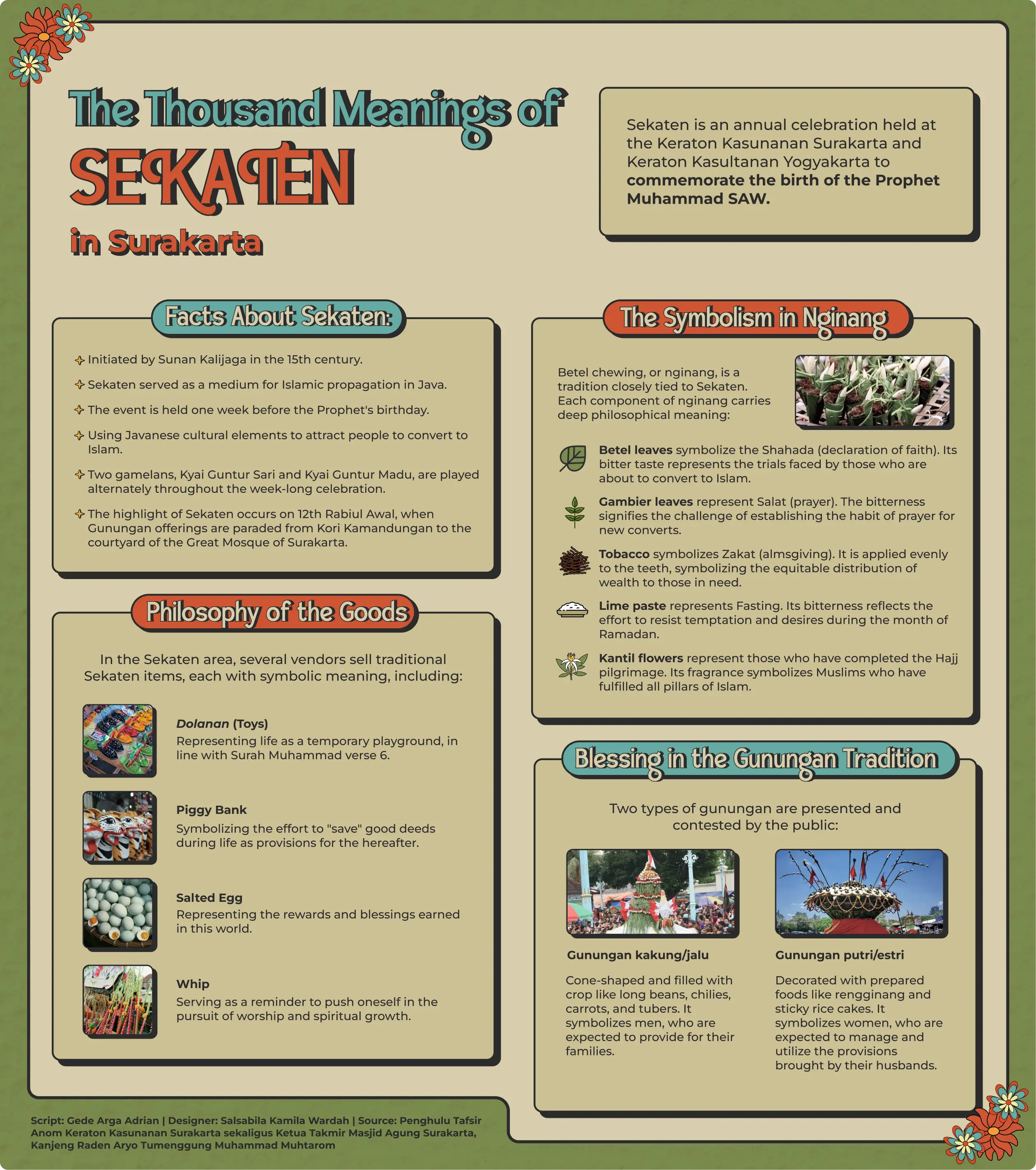
During Sekaten, numerous merchants set up stalls around the Square of the Surakarta Kasunanan Palace. Among the variety of goods sold, certain items are traditional to the event, such as dolanan (traditional toys), piggy banks, ndhog kamal (salted eggs), and whips. According to Muhtarom, each item holds symbolic meaning and is an integral part of the Sekaten celebration.
Traditional toys, or dolanan, symbolize the idea that the world is merely a place to play, reflecting a deeper spiritual message. This aligns with Surah Muhammad, verse 6, which states, “Indeed, life is nothing but play and amusement. But if you believe and fear Allah, He will reward you and will not ask for your wealth.”
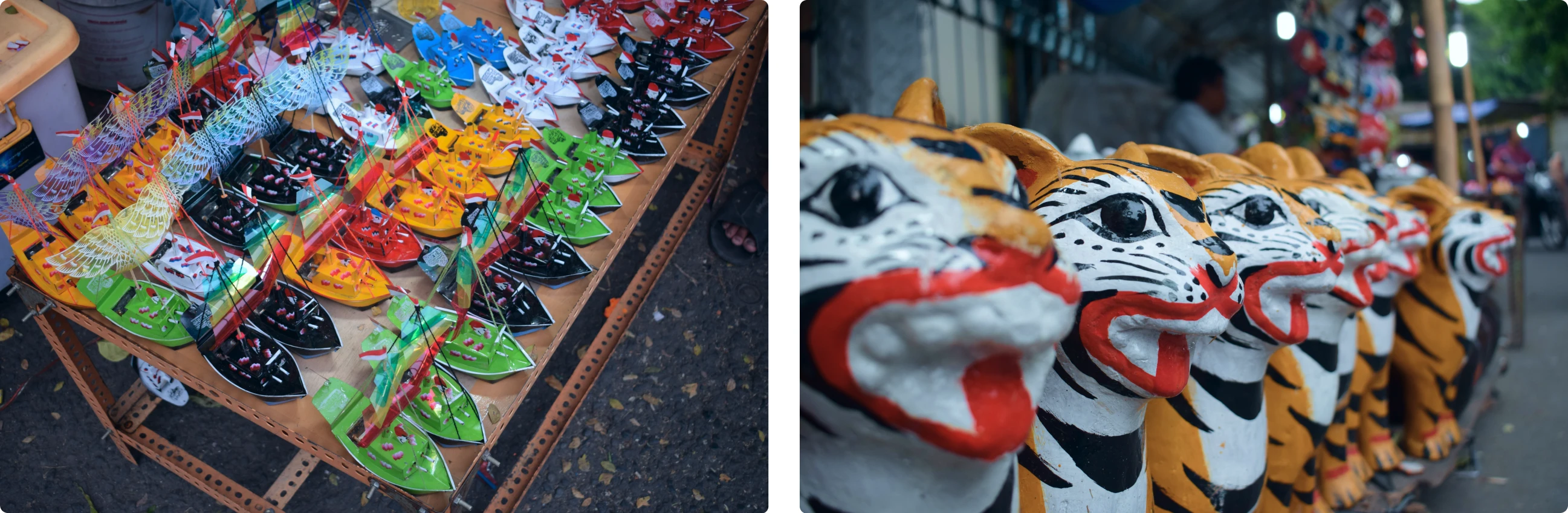
LEFT: A photo of traditional toys or dolanan in the Sekaten area. RIGHT: A photo of a piggy bank that represents the effort to save for charity. Gede Arga Adrian/UMS Public Relations
Muhtarom explained, “Since life is like a mere game, Muslims should strive not to become the object of the game, but rather the subject, actively shaping their path in life.”
The piggy bank symbolizes the human effort to “save” good deeds during life to prepare for the afterlife. Meanwhile, the salted eggs represent the reward for these deeds.
The whip promotes the philosophy of encouraging humans to keep striving for good deeds. “Humans are given desires by Allah and possess the nature to act. Therefore, they must be ‘whipped,’ or motivated, to push them toward doing good,” Muhtarom continued.
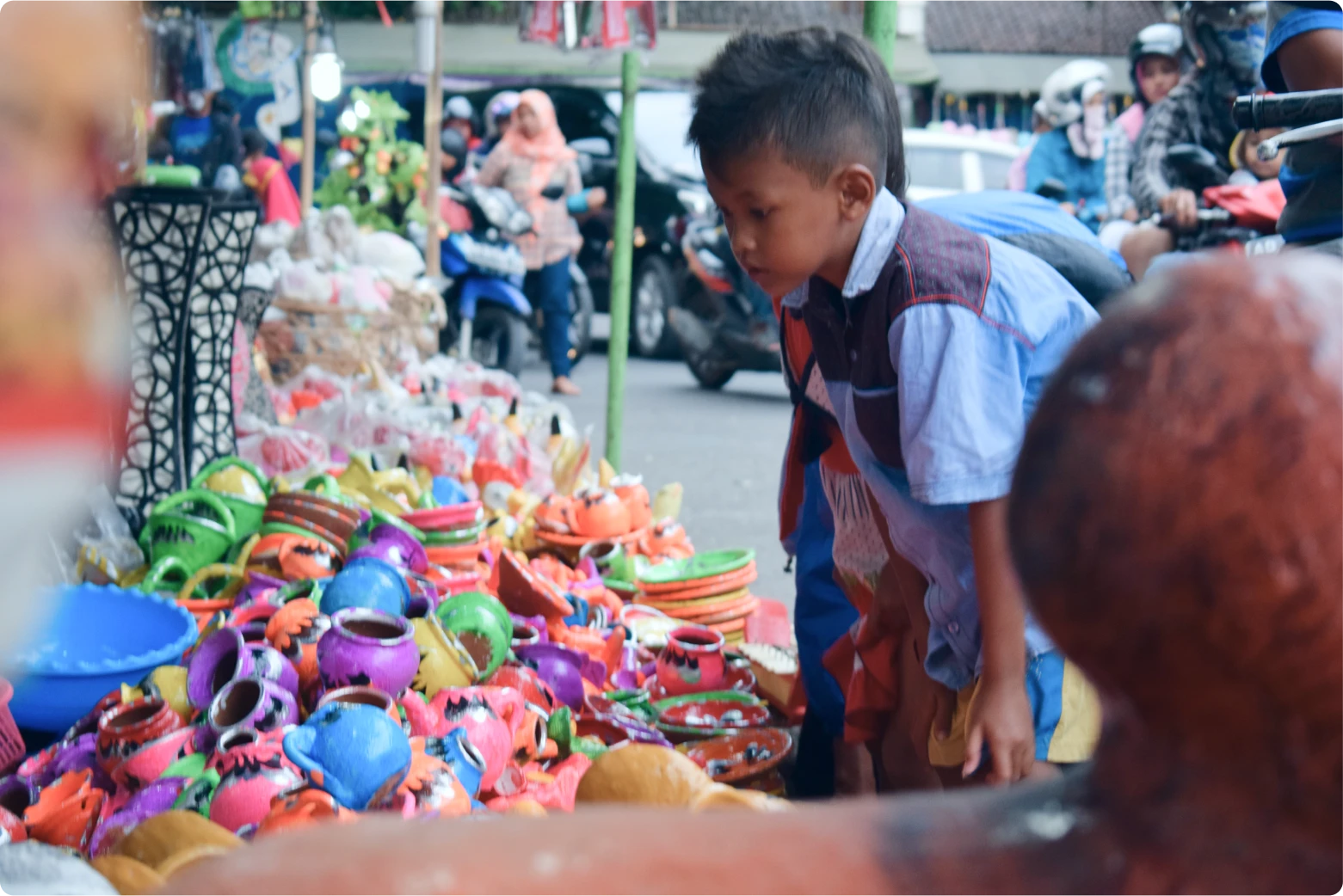
A child looks at traditional toys sold in the Sekaten area. Gede Arga Adrian/UMS Public Relations
As with other Javanese traditions, Sekaten doesn’t lack philosophy or meaning. Our conversation with Muhtarom became even more engaging as we delved into the many layers of meaning behind Sekaten.
The philosophy begins when a person recites syahadat and steps through the gapura of the mosque. The word gapura is derived from the Arabic ghofuro, meaning forgiveness. This signifies that those who enter the mosque are considered cleansed of their past sins, entering a state of purity.
The hadith narrated by Bukhari says: “If a person accepts Islam and practices it sincerely, Allah will erase all their past sins. After that, every good deed they do will be rewarded ten to seven hundred times over. As for their bad deeds, they will only be held accountable for them according to their severity, unless Allah chooses to forgive them.”
Upon entering the gapura, visitors will notice two small joglo (traditional vernacular Javanese houses) on either side of the gate. These structures are used to house and play the gamelan during the week leading up to the Grebeg Mulud, a procession to celebrate Prophet Muhammad’s birthday.
Two types of gamelan, known as Kyai Guntur Madu and Kyai Guntur Sari, symbolize the masculine and feminine. These two forms of gamelan represent an interpretation of Allah SWT power in creating humans in pairs, as male and female. From this pairing, humanity multiplies and brings forth future generations.
Two gamelan sets are placed in the courtyard near the gate of the Surakarta Grand Mosque. Historically, the purpose of placing the gamelan in the mosque’s courtyard was to attract those who had not yet embraced Islam and to serve as a medium for spreading Islamic teachings.
The technique of playing these two types of gamelan carries an interesting philosophical meaning. Rather than being played simultaneously, the two gamelans are performed alternately. This approach aims to create balance and harmony, allowing listeners to experience and appreciate the music more clearly.
Muhtarom explains the concept of tidak saur manuk (everything should be harmonious, not separated), which can be applied to everyday life. He likens it to a balanced relationship in a household: “For example, when the husband is angry, the wife listens. And when the wife is upset, the husband listens. This mutual understanding creates harmony, and synchronization.”
When the gamelan is played, those who have purified themselves through syahadat (declaration of faith) eagerly reach for the janur. This palm leaf decoration hangs around the gamelan. The word janur is believed to come from the Arabic phrase ja’a nur, meaning “the opening where the light comes.” This light portrays the guidance that people seek throughout their lives.
One of the traditions closely associated with Sekaten is chewing betel leaves, commonly known as nyirih or nginang. Those who chew betel leaves consume five main ingredients: betel leaf, gambier leaf, tobacco, lime or injet, and kantil flower. According to Muhtarom, each ingredient represents a philosophical meaning, representing the Five Pillars of Islam.
With its bitter taste, the betel leaf represents those who are about to convert to Islam by reciting the syahadat (declaration of faith). The first test for someone entering Islam is letting go of worldly attachments.
“Reciting the syahadat is bitter. It’s filled with challenges, trials, and inner conflict,” Muhtarom explained. He gave the example of someone with high social status, vast economic connections, and wealth who decides to become mualaf (someone who converts to Islam). Are they ready to lose everything they’ve achieved? “Even though it’s bitter, it’s a part of the Pillars of Islam,” he added.
With its bitter taste, the gambier leaf represents salat (prayer), especially for mualaf. The daily prayer routine poses challenges, as it is a human’s obligation to the Divine. Muhtarom also mentioned that the rewards from God for performing salat are often not immediately apparent to people.
Though not consumed, tobacco’s bitter taste symbolizes zakat (charity). Muhtarom explained that zakat and charity share the meaning of distributing one’s wealth to those in need. The way tobacco is spread evenly over the teeth represents the idea of spreading wealth. “Charity is like tobacco, spread it evenly, don’t keep it all for yourself,” he said.
Fasting is represented by lime or injet. Its bitter taste signifies the self-discipline required during fasting, where one must resist temptations and control desires throughout Ramadan.
Lastly, the kantil flower portrays those who have completed the pilgrimage, hajj. The fragrant scent of the flower embodies Muslims who have fulfilled the Five Pillars of Islam, emerging as better individuals after enduring trials and hardships. “Those who have performed hajj become role models. They are like pervading fragrant.” Muhtarom concluded.
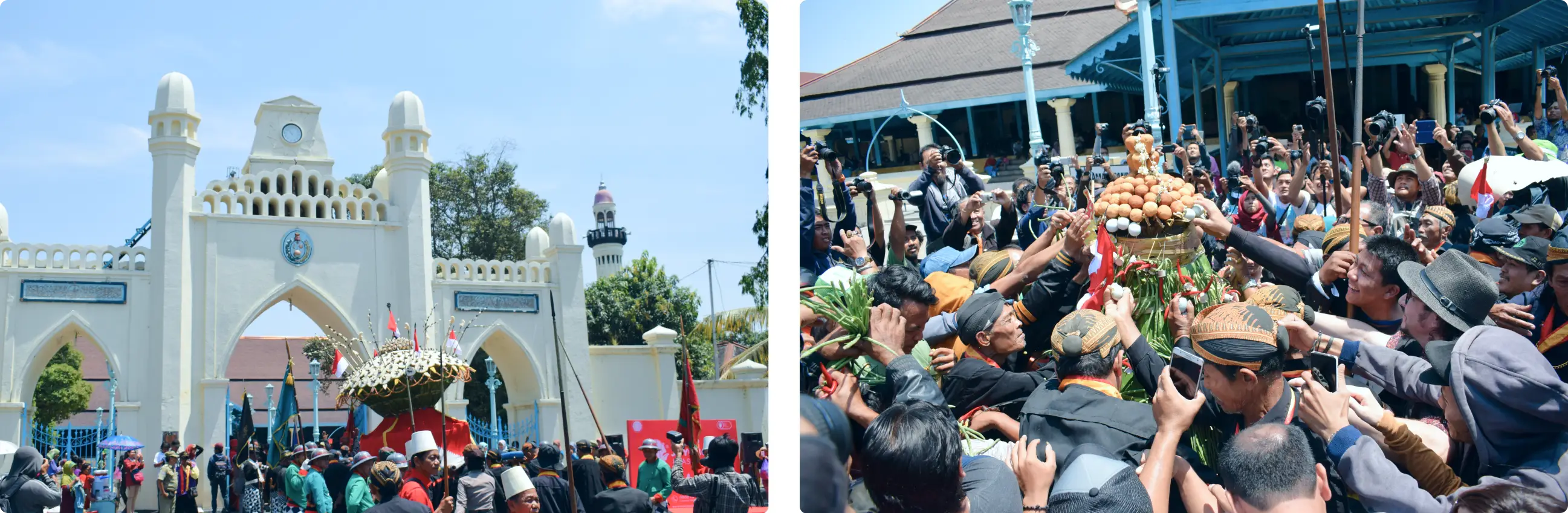
LEFT: Gunungan being carried to the Surakarta Grand Mosque. RIGHT: People are fighting over the gunungan jalu or kakung in the courtyard of the Surakarta Grand Mosque. Gede Arga Adrian/UMS Public Relations
The Sekaten celebration reaches its peak during the Hajad Dalem Garebeg Mulud, an event held to commemorate the birthday of the Prophet Muhammad SAW. In this event, two gunungan (offering in the shape of mountain) are paraded. These two are called Gunungan Jaler and Gunungan Estri.
The Gunungan Jaler, also known as Gunungan Kakung, is a mountain-shaped structure filled with agricultural produce like long beans, chili peppers, carrots, and tubers. This symbolizes the role of men, who are expected to provide for their families.
“A man must be a protector and provider of essential needs for his family through basic sustenance,” Muhtarom explained.
On the other hand, the Gunungan Estri is decorated with prepared food items, such as rengginang (rice crackers) and sticky rice cakes. The Gunungan Estri represents women or wives in the household, who are responsible for managing and making the most of the provisions brought by their husbands for the family.
“A woman must be able to manage finances. No matter how much her husband earns, she must handle it wisely,” added the Penghulu Tafsir Anom.
Both gunungan are carried in a procession to the courtyard of the Grand Mosque, where prayers are recited before the gunungan are distributed among the community. “Once the prayers are said, distribute them fairly,” he said.
However, he noted a shift in the community’s understanding of this distribution. The gunungan should be shared equally without the need for competition. He expressed regret over the common practice of people scrambling to grab the offerings, saying, “Fighting over the gunungan is not our culture. Its essence is not part of our tradition.”
“The true concept is qanaah (contentment). Blessed are those who have contentment, and woe to those who are greedy,” Muhtarom concluded.
Writer: Gede Arga Adrian
Editor: Al Habiib Josy Asheva
Translator: Farizal Luqman Majid
Sheep dunged nutrient-rich organic fertilizer for plants, made with the help of maggots. Built on community empowerment and a zero-waste principle.
Nothing’s more special than reading curated news just for you.
Subscribe to the UMS Newsletter for free today.