
How Sheep Manure Turns into Nutrient Rich Fertilizer
16 July 2026
Sheep dunged nutrient-rich organic fertilizer for plants, made with the help of maggots. Built on community empowerment and a zero-waste principle.



President Jokowi’s decision to lift the two-decade ban on sea sand exports has faced harsh criticism from various groups. One prominent opponent is former Minister of Maritime Affairs and Fisheries, Susi Pudjiastuti,
“Hopefully, this decision will be revoked. The environmental damage will be far greater. Climate change is already being felt and is having an impact. Let’s not make it worse by mining sea sand,” Susi tweeted from her personal X account on Sunday (28/5/2024).
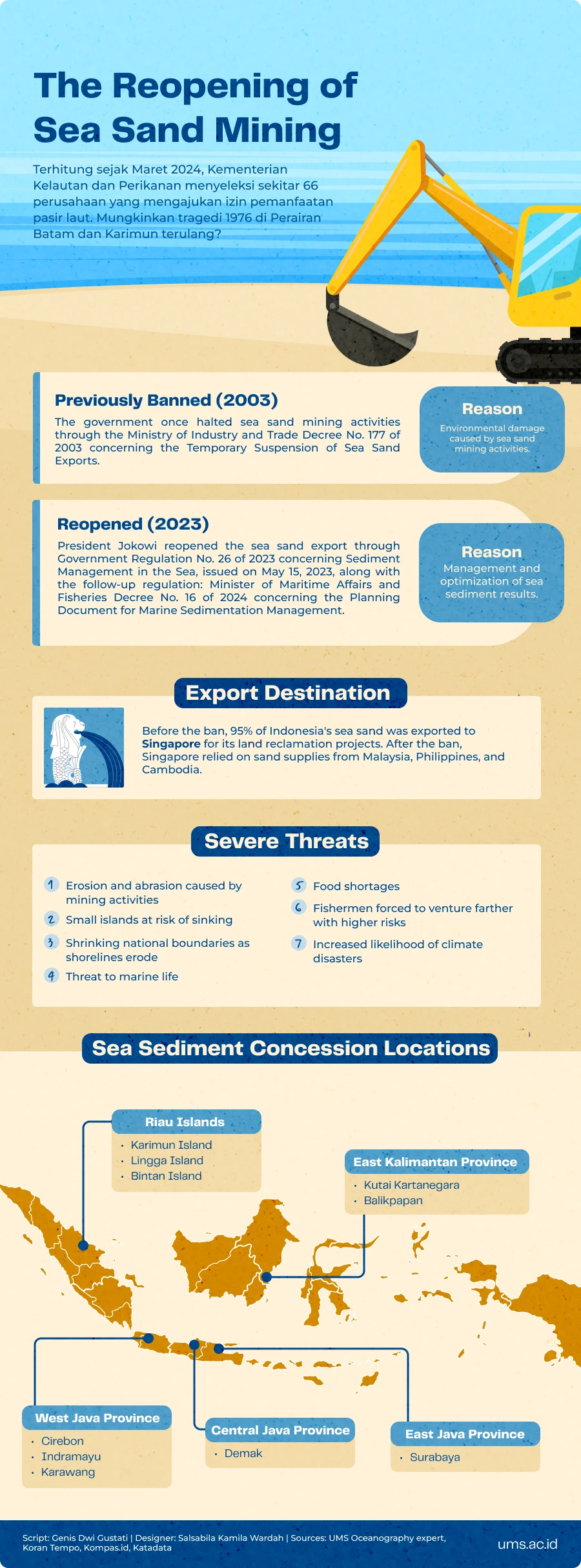
While the government frames this as “marine sediment” export, the reality is much more complicated. Jokowi stated that the goal of the export is to clear shipping routes from accumulated sediment. The enactment of Government Regulation (PP) No. 26 of 2023 on the Management of Marine Sediment, along with the issuance of Minister of Maritime Affairs and Fisheries Decree No. 16 of 2024 on Marine Sediment Management Planning Documents, officially marks the resumption of this activity, which had previously been banned.
However, it’s important to clarify: “sediment” refers to material deposited on the seafloor, while what is primarily exported is sea sand.
According to data reported by Koran Tempo, in 1976, the waters around Batam and Karimun in the Riau Islands were recklessly dredged to reclaim land for Singapore. The material used for this reclamation was largely sea sand, excavated from depths of 10-30 meters below the sea surface, not a sediment. Thanks to sand from Indonesia, Singapore’s land area grew by 25%, from 580 square kilometers in 1960 to 660 square kilometers in 1999. The current reasoning behind sediment dredging could be seen as a cover for a history of over-extraction that risks repeating itself.
Afif Ari Wibowo, S.Si., M.Sc., an oceanography expert from Universitas Muhammadiyah Surakarta (UMS), explained that sea sand mining not only erodes the material that forms the seafloor’s foundation but also disrupts the balance of marine and coastal ecosystems.
Quoting the United Nations, the ocean absorbs about 25% of the carbon dioxide emissions produced by humans. If sea sand mining is opened excessively, the ocean’s ability to absorb carbon emissions will be disrupted.
“The environmental damage caused could be far greater than the short-term economic benefits of this export activity,” said the UMS Geography lecturer
On the other hand, based on the Ministry of Maritime Affairs and Fisheries Decree No. 16 of 2024, the ministry has allocated seven coastal water regions for dredging, with a total volume of 17.64 billion cubic meters and a total area of 5.81 billion cubic meters. These exploitation sites are located along the northern coasts of Java, including Demak Regency, Surabaya City, Cirebon Regency, Indramayu Regency, and Karawang Regency. Other locations are in the waters near Kutai Kartanegara Regency and Balikpapan City in East Kalimantan, as well as around Karimun Island, Lingga Island, and Bintan Island in the Riau Islands.
“Indonesia must avoid repeating the mistakes of the past in damaging the waters around the Riau Islands and other mining sites. Sea sand mining is an example of how natural resource exploitation can cause lasting damage. Small islands could disappear due to erosion, and the balance of marine ecosystems is at serious risk,” Afif added.
Afif, a lecturer who teaches Coastal and Small Island Regional Planning, explained that sand mining activities will directly impact the balance of abiotic and biotic elements in the sea.
“This dredging activity will alter water currents and wave patterns, which in turn affects coastal areas. Coastal regions will become more vulnerable, potentially facing higher waves, stronger currents, and eventually suffering from erosion or abrasion,” Afif elaborated.
He also mentioned the issue of turbidity resulting from sand dredging, or what the government refers to as sediment. “
“Turbidity won't just occur at the mining site. It can spread across vast distances due to ocean currents and waves, which will definitely disrupt marine life such as coral reefs and fish,” he continued.
From a biotic standpoint, encompassing marine flora and fauna, the impact of sand mining is significant. The rich marine ecosystem, particularly coral reefs and seagrass beds, is under threat of destruction. Coral reefs, which serve as crucial habitats for fish and various marine species, are highly vulnerable to physical disruption.
According to reports from Kompas.id, mining tailings, mud waste from the mining process, are carried by ocean currents, contaminating waters even miles away from the mining site. These tailings smother coral reefs and force fish and other marine creatures to flee. Worse, this environmental destruction threatens the livelihoods of fishermen.
Fishermen are among the most vulnerable groups affected by the wrongful policy, as it directly impacts food security and the welfare of coastal communities.
“Fishermen in coastal areas rely heavily on the balance of marine ecosystems. Ocean sand mining destroys fish habitats, causing a drastic decline in fish populations,” Afif explained.
This is a heartbreaking irony. Indonesia, known for its maritime wealth, allows its people to suffer due to policies enacted by its leaders that, instead of supporting them, destroy their livelihoods.
The ecosystem damage caused by sand mining extends far beyond the mining site itself. The sharp decline in fish populations threatens local fisheries, and if this continues, the fishing industry could face severe downturns.
Fishermen are forced to venture further into deeper waters, facing higher risks and increased operational costs, as the once-abundant fishing areas become harder to reach. In addition to the danger of accidents at sea, they must bear the financial strain of longer trips.
Quoting Bisnis.com, Bhima Yudhistira, the Executive Director of Celios, explained that sea sand exports risk creating unemployment in coastal areas. He noted that the sea sand mining model, using suction dredgers and barges, is capital-intensive rather than labor-intensive. In their report, it was estimated that the number of local fishermen could decrease by around 36,400, forcing many to shift from fishing to other sectors.
“In several areas, the drastic decline in fish stocks has led to local food shortages. If left unchecked, either the local economy or national food security could also be at risk,” Bhima emphasized.
Afif stressed the importance of reviewing the environmental impact of this policy, advocating for a comprehensive analysis before any action is taken.
According to Kompas.id, the government has already offered “sea sediment” management opportunities to a number of entrepreneurs, with the Ministry of Maritime Affairs and Fisheries (KKP) reviewing 66 companies for this purpose.
In hydro-oceanographic studies, there are various applications that can simulate oceanic hydrodynamics, including waves, currents, tides, and sediment transport.
“The government could use these models to predict whether currents will shift, how waves will behave, and where the sediment will move. Will the seabed’s morphology change? Will it affect coastal conditions? All these factors can be forecasted,” said Afif, noting that Indonesia already has the technology to implement such models on a large scale.
Afif suggested that these models could serve as mitigation tools to ensure mining activities do not disrupt marine and coastal ecosystems. With accurate predictions, preventive measures could be taken early to protect the environment.
“However, this policy still needs to be re-evaluated because it is risky. We must not allow our waters to be exploited without considering their ecological and social balance,” he concluded.
Writer: Genis Dwi Gustati
Editor: Al Habiib Josy Asheva
Translator: Farizal Luqman Majid
Sheep dunged nutrient-rich organic fertilizer for plants, made with the help of maggots. Built on community empowerment and a zero-waste principle.
Nothing’s more special than reading curated news just for you.
Subscribe to the UMS Newsletter for free today.