
How Sheep Manure Turns into Nutrient Rich Fertilizer
16 July 2026
Sheep dunged nutrient-rich organic fertilizer for plants, made with the help of maggots. Built on community empowerment and a zero-waste principle.



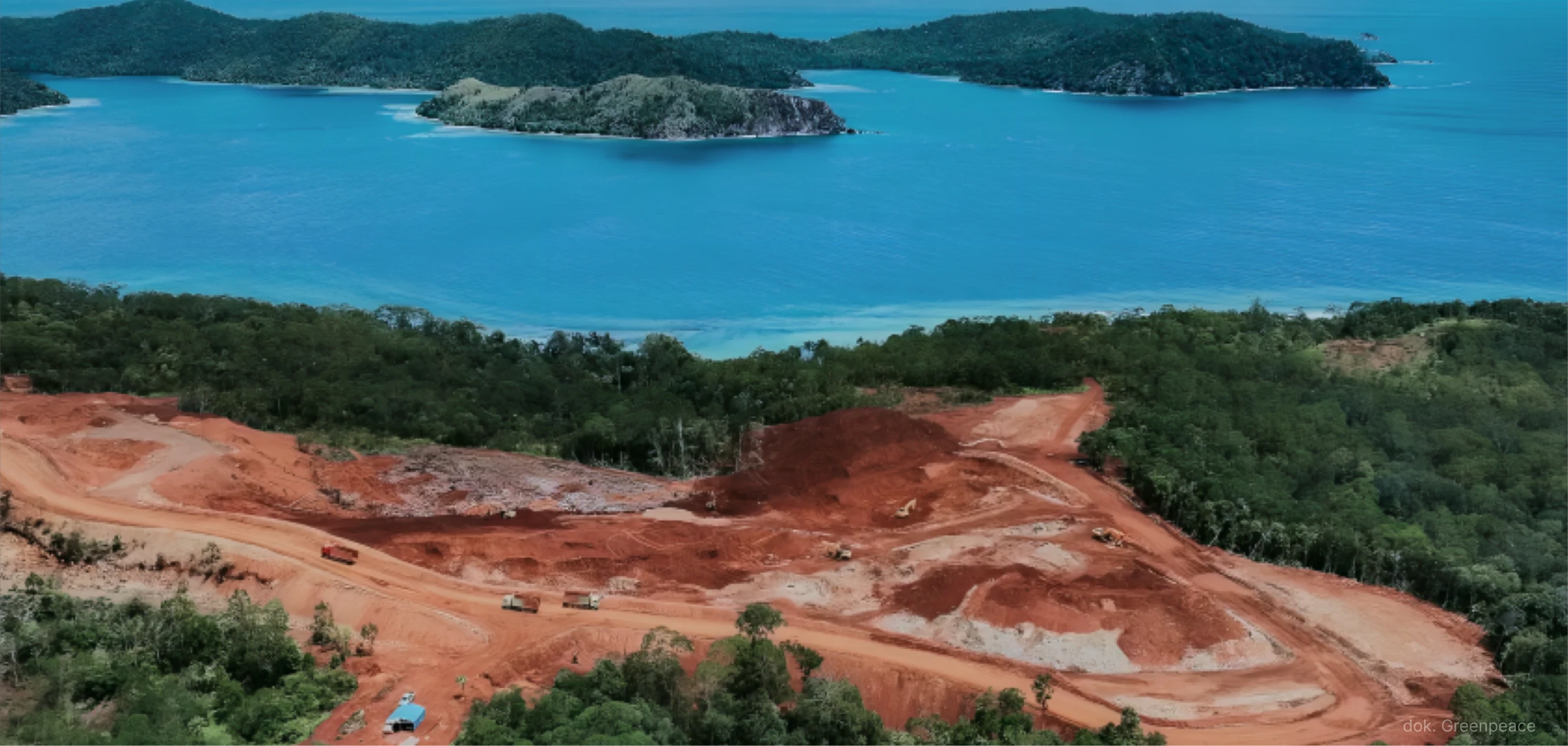
The Indonesian government has officially revoked four out of five nickel mining business permits (IUP) previously granted to companies in Raja Ampat, Southwest Papua, on Tuesday, June 10, 2025. According to a report by Tempo, the decision came after findings from Greenpeace and several other environmental organizations revealed severe environmental damage in the area due to mining activities.
Raja Ampat is known to host around 75 percent of the world’s coral reef species and is home to more than 2,500 species of marine fish. Unfortunately, Greenpeace's report states that at least 500 hectares of forest have already been cleared for mining. If all mining concessions proceed, more than 8,700 hectares of natural forest are projected to be lost.
Meanwhile, the Ministry of Environment and Forestry (KLHK), which conducted a direct investigation, found that mining activities at several sites violated the Law on Coastal and Small Island Management. Several companies were found to be operating without Environmental Impact Assessment (AMDAL) documents or adequate waste management systems.
Of the five mining companies previously operating, only one has been allowed to continue, namely PT Gag Nikel. Minister of Energy and Mineral Resources, Bahlil Lahadalia, stated that the company was considered to have managed its waste properly in accordance with its AMDAL documentation.
“The President has instructed us to closely monitor environmental impacts. As of now, we believe operations can continue,” said Bahlil, as quoted by Tempo, Thursday (20/6/2025).
However, such claims fail to ease public concerns. One such concern was voiced by Dr. Aditya Saputra, S.Si., M.Sc., a geography lecturer at Universitas Muhammadiyah Surakarta (UMS), who stated that mining activities, in general, cause environmental damage that is difficult to recover from.
“The nickel mining in Raja Ampat is just one case. If mining is not properly controlled, the potential impacts are extremely serious. This applies to all regions in Indonesia,” Adit emphasized during an online discussion, Thursday (20/6/2025).
In recent years, nickel mining has become a prime target for global industries. Nickel is a key component in lithium battery production, which forms the backbone of the energy transition toward electric vehicles.
According to Mongabay, Indonesia, often cited as having the world’s largest nickel reserves, has become a field of exploitation for giant mining companies. Alarmingly, the surge in global demand has driven mining expansion into ecologically sensitive areas like Raja Ampat.
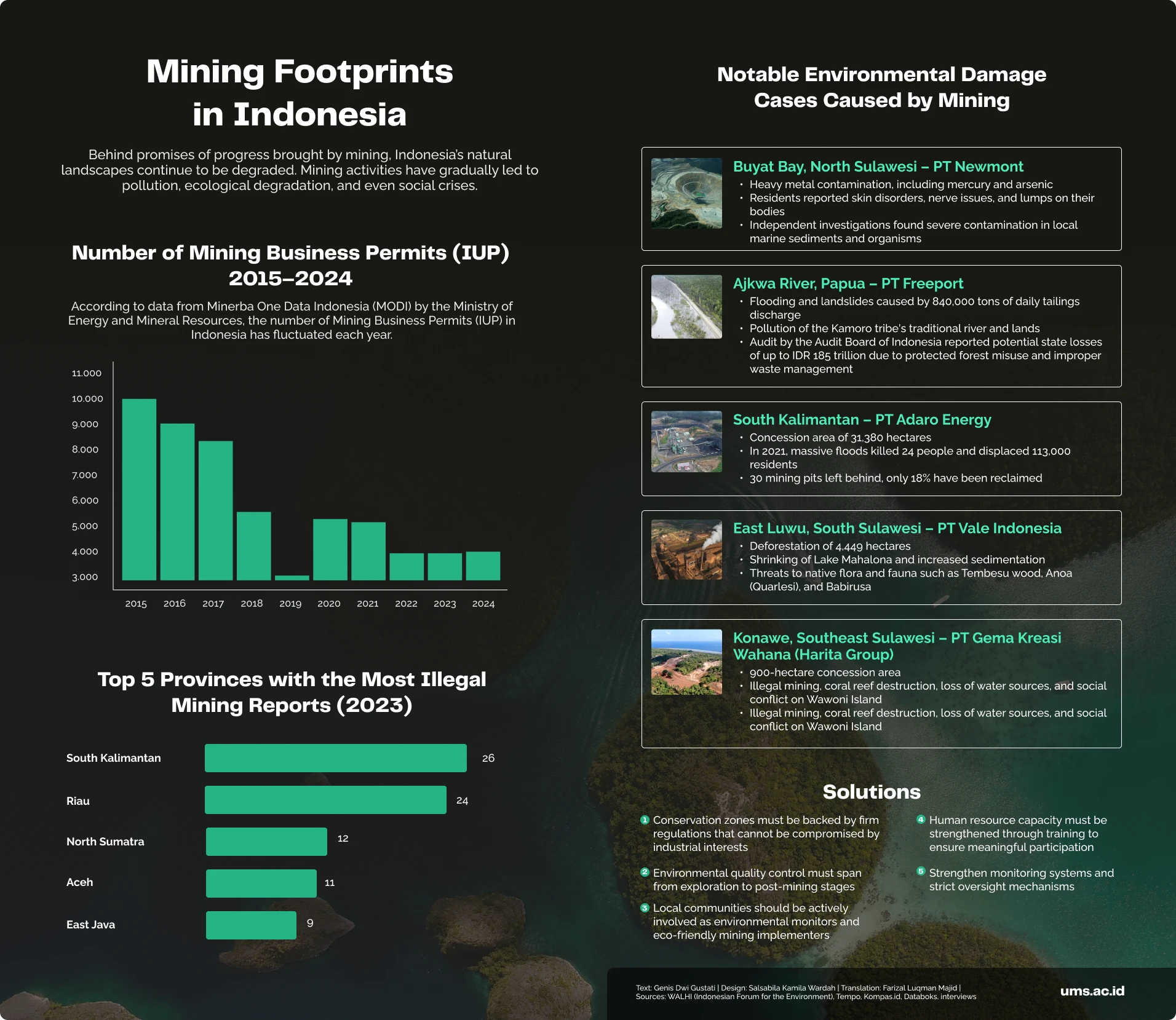
“Environmental damage isn’t limited to West Papua. In Bangka Belitung, tin mining has been ongoing for a long time and has partly caused severe land degradation and environmental destruction,” said an activist from the Center for Environmental Studies. Without careful planning, monitoring, and post-mining rehabilitation, he argued, mining activities will only lead to environmental disasters.
From an environmental geography perspective, mining without proper planning triggers various forms of ecological damage.
Adit explained that land clearing for mining results in vegetation loss, increased erosion rates, and higher surface water runoff.
“As a result, during heavy rains, water is no longer absorbed into the ground but flows directly on the surface, causing floods and landslides,” he explained.
The soil carried by runoff also leads to severe marine sedimentation, directly impacting coral reefs, seagrasses, and entire coastal ecosystems. This sedimentation was highlighted by Greenpeace and several scientific institutions, which observed that many of Raja Ampat’s prime diving sites are now experiencing reduced water quality and coral cover due to silt particles from mining zones.
According to Kompas.id, Indonesia lost 1,901 square kilometers of forest due to mining between 2010 and 2014. These rampant mining activities accounted for 0.7 percent of the total forest loss of 267,591 square kilometers since 2000. One of the most severe cases is coal extraction in East Kalimantan, the main driver of mining-related deforestation in Indonesia.
Another significant case is PT Freeport Indonesia, operating in Papua. Although it is one of Indonesia’s largest contributors of foreign exchange and tax revenue, Tempo reports that Freeport has caused substantial ecological damage.
Several mining companies now claim to implement the concept of green mining, such as PT Bayan Resources Tbk, PT Berau Coal, PT Gag Nikel, and others that loudly declare their commitment to promoting environmentally conscious mining. These companies appear to be replanting trees on former mining lands, building waste treatment systems, and launching environmental campaigns.
According to Adit, such claims must be scientifically tested and closely monitored by the state. “Green mining is great if it’s truly carried out with sincerity. But it shouldn’t just become a media slogan. On the ground, things might not be done properly,” he observed.
Adit pointed to Canada as an example of a country that applies green mining principles seriously. The Maple Leaf nation rigorously monitors environmental quality from the exploration phase through to post-mining activities.
“In Indonesia, the monitoring system is still far too lax. The government must take the lead role as a regulator,” he suggested.
He added that the government should also involve local communities in sustainable mining projects. Of course, this must be accompanied by efforts to improve human resource capacity. Local governments and mining companies should work together to build the competence of residents so they can participate on an equal footing.
"Local communities must not end up as mere spectators. They need to be actively empowered, as workers, watchdogs, or conservation partners," Adit added.
One concrete solution Adit proposed is the need for strict conservation mapping. “We must determine which areas are suitable for mining and which must be protected. The regulations already exist. If an area falls under conservation, mining should be strictly prohibited,” he stressed.
However, in reality, many conservation zones still lack detailed studies, making them vulnerable to manipulation or reclassification, as in the case of the nickel mining in Raja Ampat.
Even though four mining permits have now been revoked, one company is still allowed to continue operations under the pretext that the mining site lies outside the Geopark area.
“They say the government, through the Ministry of Environment and Forestry (LHK) and ESDM, will strictly monitor the activity. But once again, monitoring alone is not enough,” Adit warned.
Firm regulations, strong commitment, and widespread public support are essential to preserving Raja Ampat. Because if Raja Ampat can be damaged, there’s no guarantee that other regions in Indonesia won’t follow.
Writer: Genis Dwi Gustati
Translator: Farizal Luqman Majid
Editor: Al Habiib Josy Asheva
Sheep dunged nutrient-rich organic fertilizer for plants, made with the help of maggots. Built on community empowerment and a zero-waste principle.
Nothing’s more special than reading curated news just for you.
Subscribe to the UMS Newsletter for free today.