
How Sheep Manure Turns into Nutrient Rich Fertilizer
16 July 2026
Sheep dunged nutrient-rich organic fertilizer for plants, made with the help of maggots. Built on community empowerment and a zero-waste principle.



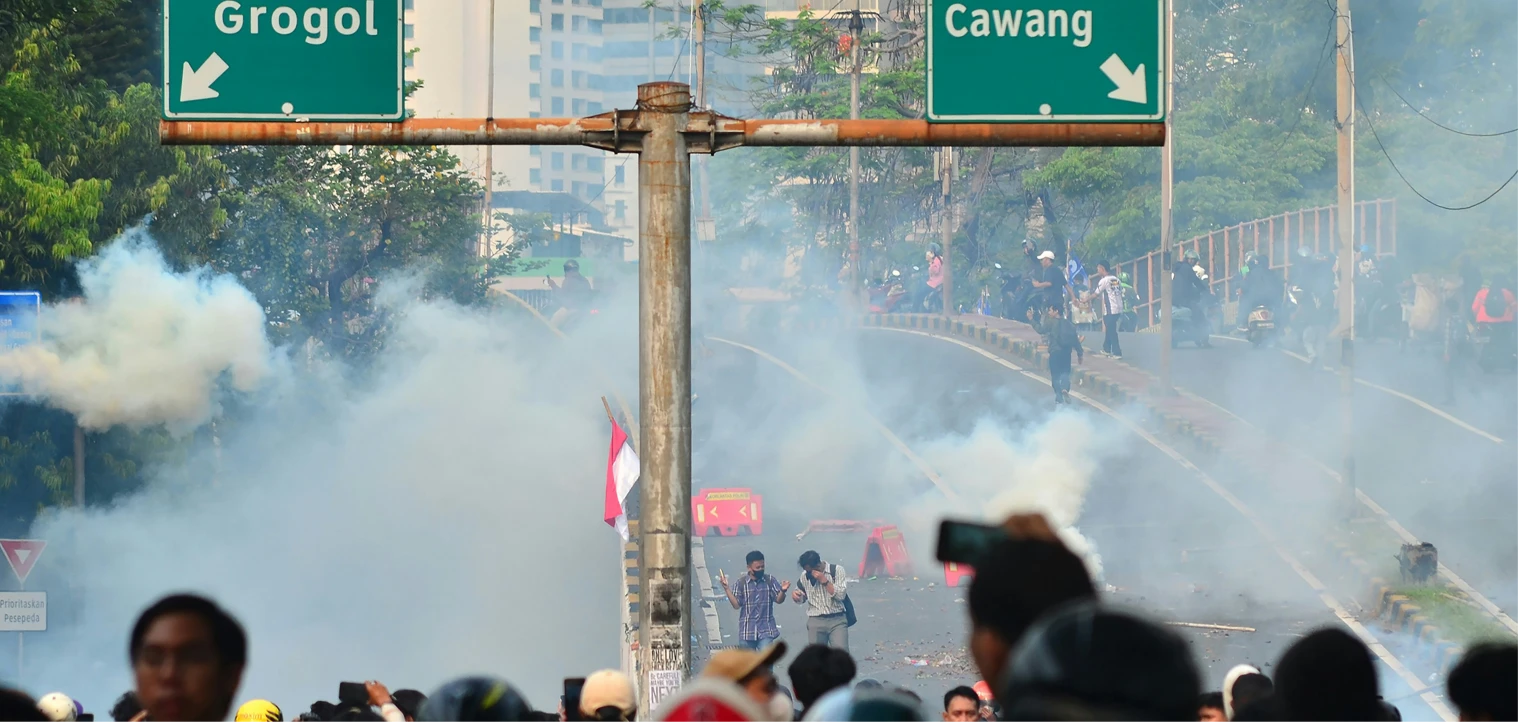
The public has once again raised concerns over the police’s use of tear gas during a series of protests from August 25–31, 2025. The controversy stems from the fact that the tear gas was not only deployed to disperse protesters, but also spread into nearby residential areas.
In Indonesia, the use of tear gas is legally permitted. It is commonly employed as a crowd-control tool, regulated under the Chief of Indonesian National Police Regulation No. 1 of 2009.
However, its use continues to spark debate. The main issue is that tear gas deployed by security forces often spreads into civilian neighborhoods. In several documented cases, authorities have even used expired tear gas.
Tear gas is a chemical weapon designed to stimulate the tear glands, forcing the eyes to produce excessive tears. Because of this effect, it falls under the category of lachrymators (tear-inducing agents).
So, what is tear gas actually made of? apt. Ahmad Fauzi, S. Farm., M.Farm., a lecturer at the Faculty of Pharmacy, Universitas Muhammadiyah Surakarta (UMS), explained that tear gas is typically composed of two primary chemical agents
Tear gas contains chemical agents known as 2-chlorobenzylidene malononitrile (commonly called CS gas) and oleoresin capsicum (OC), better known as pepper spray.
“For current use, only these two chemical agents are globally permitted: CS gas and OC gas,” explained Fauzi on Thursday (3/9/2025).

Fauzi noted that the CS and OC components in tear gas cause eyes to redden and can trigger breathing difficulties.
The effects on the human body can vary, generally grouped into two categories: local effects and systemic effects.
Local effects of tear gas include:
Meanwhile, the systemic effects of tear gas exposure include:
“These local effects typically last for about 30 minutes after exposure. However, the systemic effects can be worsened if the tear gas being used has already expired,” Fauzi added.
So, what should people do if exposed to tear gas? Fauzi explained several immediate steps that can be taken:
Fauzi also advised people who plan to join demonstrations or happen to be around protest zones to prepare protective gear such as masks. In addition, laboratory safety goggles can help shield the eyes from tear gas exposure.
“But abroad, when tear gas is thrown, sometimes the crowd throws it back at the officers,” he joked.
Fauzi also reminded the public not to apply toothpaste on the face, as there is no scientific evidence that toothpaste can block the effects of tear gas.
The police often resort to tear gas to disperse or control crowds. One of the darkest tragedies linked to its use occurred during the football match between Arema and their rival Persebaya Surabaya at Kanjuruhan Stadium, Malang, East Java, on October 1, 2022.
The public remembers it as the Kanjuruhan Tragedy. At that time, police fired tear gas to disperse the spectators. Unfortunately, the ensuing panic drove hundreds of people to crowd into one of the exit gates.
As a result, a deadly stampede occurred, leaving 135 people dead in what became the worst football tragedy in Indonesia’s history.
Most recently, tear gas was used to push back students staging a demonstration in Bandung City on Monday (1/9/2025). Police fired tear gas that spread into the campuses of Universitas Islam Bandung and Universitas Pasundan. The incident injured dozens of students, medical workers, and security officers.
Writer: Gede Arga Adrian
Translator: Farizal Luqman Majid
Editor: Al Habiib Josy Asheva
Sheep dunged nutrient-rich organic fertilizer for plants, made with the help of maggots. Built on community empowerment and a zero-waste principle.
Nothing’s more special than reading curated news just for you.
Subscribe to the UMS Newsletter for free today.