
How Sheep Manure Turns into Nutrient Rich Fertilizer
16 July 2026
Sheep dunged nutrient-rich organic fertilizer for plants, made with the help of maggots. Built on community empowerment and a zero-waste principle.




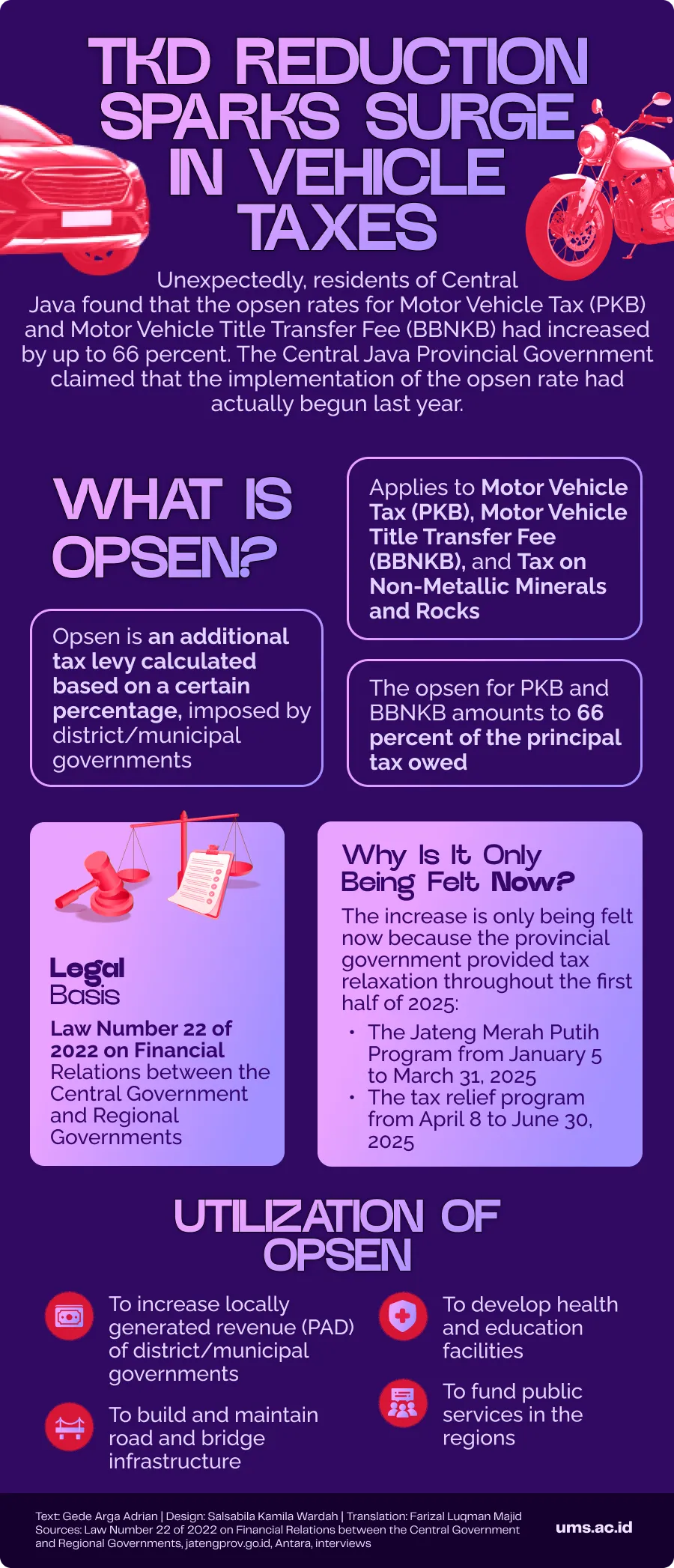
Since early 2026, residents of Central Java have been alarmed by the increase in the opsen (additional tax levy) rates for Motor Vehicle Tax (PKB) and Motor Vehicle Title Transfer Fee (BBNKB), which reached 66 percent. The policy sparked protests from various segments of society, particularly across social media platforms.
The Provincial Government of Central Java stated that the policy had actually been in effect since last year. However, the public did not immediately feel the increase because tax relief measures were provided throughout the first half of 2025.
The incentives included the "Jateng Merah Putih" program, which ran from January 5 to March 31, 2025, and a tax relief program from April 8 to June 30, 2025.
Responding to the controversy, the Governor of Central Java, Ahmad Luthfi, issued a policy granting a five percent discount on PKB until December 2026. The measure is expected to help ease the burden of outstanding tax obligations resulting from the opsen increase.
Acting Head of the Central Java Regional Revenue Management Agency (Bapenda), Muhamad Masrofi, explained that the policy was introduced as a response to the aspirations and concerns of Central Java residents.
"Based on the dynamics developing in society regarding motor vehicle tax payments, Governor Ahmad Luthfi has instructed us to conduct a study on relaxation measures. The results of the technical team's review were then submitted to the Governor and approved through the issuance of this Governor's Decree," Masrofi explained, as quoted from jatengprov.go.id, on Friday (27/2/2026).
Deni Aditya Susanto, S.E., M.Ec.Dev., a lecturer in Development Economics at Universitas Muhammadiyah Surakarta (UMS), stated, "The opsen on PKB does not actually violate regulations," he said in a virtual interview on Friday (27/2/2026).
The opsen PKB is an additional levy imposed on the principal motor vehicle tax, collected by district or municipal governments. The amount of the opsen is set at 66 percent of the principal tax owed. The regulation concerning the opsen PKB is stipulated in Law Number 22 of 2022 on Financial Relations between the Central Government and Regional Governments.
Although it does not violate regulations, Deni noted that the significant increase has surprised many taxpayers. This is especially true for car owners, whose principal tax is considerably higher than that of motorcycle owners. In addition, car owners must also pay the Mandatory Road Traffic Accident Fund Contribution (SWDKLLJ), which ranges from approximately Rp143,000 to Rp153,000.
For example, if the principal PKB for a car is Rp4,000,000, then the opsen would be calculated as follows: 66% × PKB = 66% × Rp4,000,000 = Rp2,640,000
Thus, the total amount payable would be: PKB + opsen + SWDKLLJ
Meanwhile, after the 5 percent PKB discount, the calculation scheme becomes: (PKB – 5%) + opsen + SWDKLLJ
Deni also highlighted the decision of Governor Ahmad Luthfi to provide a PKB discount. The move has the potential to reduce the tax burden on the public. However, this option may also reduce provincial revenue.
"PKB revenue goes to the province, while the opsen goes to the regency or municipality. PKB is one of the largest components of provincial revenue," he explained.
Deni views the increase in the opsen PKB in Central Java as a consequence of reductions in TKD. As a result, several regional heads have decided to raise the opsen as a practical solution to boost local revenue.
"The structure of the 2026 State Budget (APBN) still follows a deficit framework. Since this year's deficit is already very large, transfers to regions have been tightened," he said.
Although the Special Allocation Fund (DAK) component within TKD has increased, its allocation has become more restrictive. Deni noted that much of the DAK budget is earmarked for central government priority programs, one of which is the free nutritious meal program.
On the other hand, the General Allocation Fund (DAU) component within TKD has declined. This component is typically used to support regional development and fulfill the political promises of regional leaders.
Several regions in Central Java are experiencing increasingly limited capital expenditure for infrastructure. Tight fiscal capacity has reduced local governments' flexibility in managing road infrastructure and other public facilities.
“From a fiscal practice standpoint, this phenomenon does not violate regulations. However, it appears many budget allocations are now being inserted into posts that may not be entirely appropriate," Deni explained.
On paper, raising the opsen may seem like a quick fix to patch up regional fiscal constraints. However, Deni emphasized that increasing the opsen alone cannot comprehensively solve the underlying problem.
He suggested that local governments should optimize other revenue sources other than the motor vehicle tax opsen. According to Deni, the sharp and sudden increase in the opsen percentage is what sparked controversy among the public.
Other components that could be maximized include restaurant taxes, hotel taxes, and parking levies. Deni noted that these components do not need to rise drastically. "Local taxes should increase gradually," he said.
For example, parking fees in certain zones could be increased by Rp1,000. Such an increase, however, should be accompanied by improved vehicle security measures. This would demonstrate a tangible and immediate benefit felt directly by the public.
Meanwhile, an increase in restaurant tax could be implemented gradually, for instance, from 10 percent to 11 percent. Such an increase, Deni emphasized, should be accompanied by incentives from local governments, such as improved environmental cleanliness and better-organized parking areas.
Deni also encouraged the government to improve public communication with citizens. Transparency in the use of opsen revenue and other local taxes must be made clear and accessible. The goal is to build public trust in regional governments.
"The total opsen revenue must be communicated transparently in terms of how it is utilized. The results must be felt by the community. It should not be spent on official vehicles. That would hurt public sentiment," he stressed.
Writer: Gede Arga Adrian
Translator: Farizal Luqman Majid
Editor: Al Habiib Josy Asheva
Sheep dunged nutrient-rich organic fertilizer for plants, made with the help of maggots. Built on community empowerment and a zero-waste principle.
Nothing’s more special than reading curated news just for you.
Subscribe to the UMS Newsletter for free today.