How Sheep Manure Turns into Nutrient Rich Fertilizer
16 July 2026
Sheep dunged nutrient-rich organic fertilizer for plants, made with the help of maggots. Built on community empowerment and a zero-waste principle.



For Nova (24), an employee at a state-owned enterprise in East Java, nighttime is the perfect moment to relax after a day of hard work. However, the evening calm, which should be soothing, is instead replaced with booming dangdut music.
Just one house away from Nova's home in Tuban, East Java, her neighbor was busy preparing for a kenduri kawinan (a type of wedding feast). Apparently, the neighbor was doing a soundcheck the night before the wedding celebration the next day. That gigantic sound system played dangdut music almost the entire night.
Her neighbor’s antics left Nova unable to sleep well. To make matters worse, her room, located at the front of the house, was only a short distance from the source of the noise. Even the window glass in her room vibrated due to the intensity of the music played by her neighbor.
“That night, it was really late, around 9 or 10 PM. But that’s supposed to be rest time, right? They were doing the soundcheck right in front of the house until 3 in the morning,” Nova recalled during a phone interview on Thursday (19/12/2024).
That night’s incident left Nova and her family unable to sleep well. “Why are they doing a soundcheck at night?” Nova repeated her sister’s complaint.
Nova explained that it’s a common practice in her village to do soundchecks at night. There’s not much anyone can do to object to this habit. She observed that the villagers try to be understanding even though it’s disruptive. “That’s just how it is, living in a village,” she joked.
It’s not just at weddings; the booming sound system is also often played during the Takbiran night before Eid al-Fitr. On this occasion, loudspeakers are mounted on a truck and paraded around the village. Nova witnessed this during last Eid celebrations.
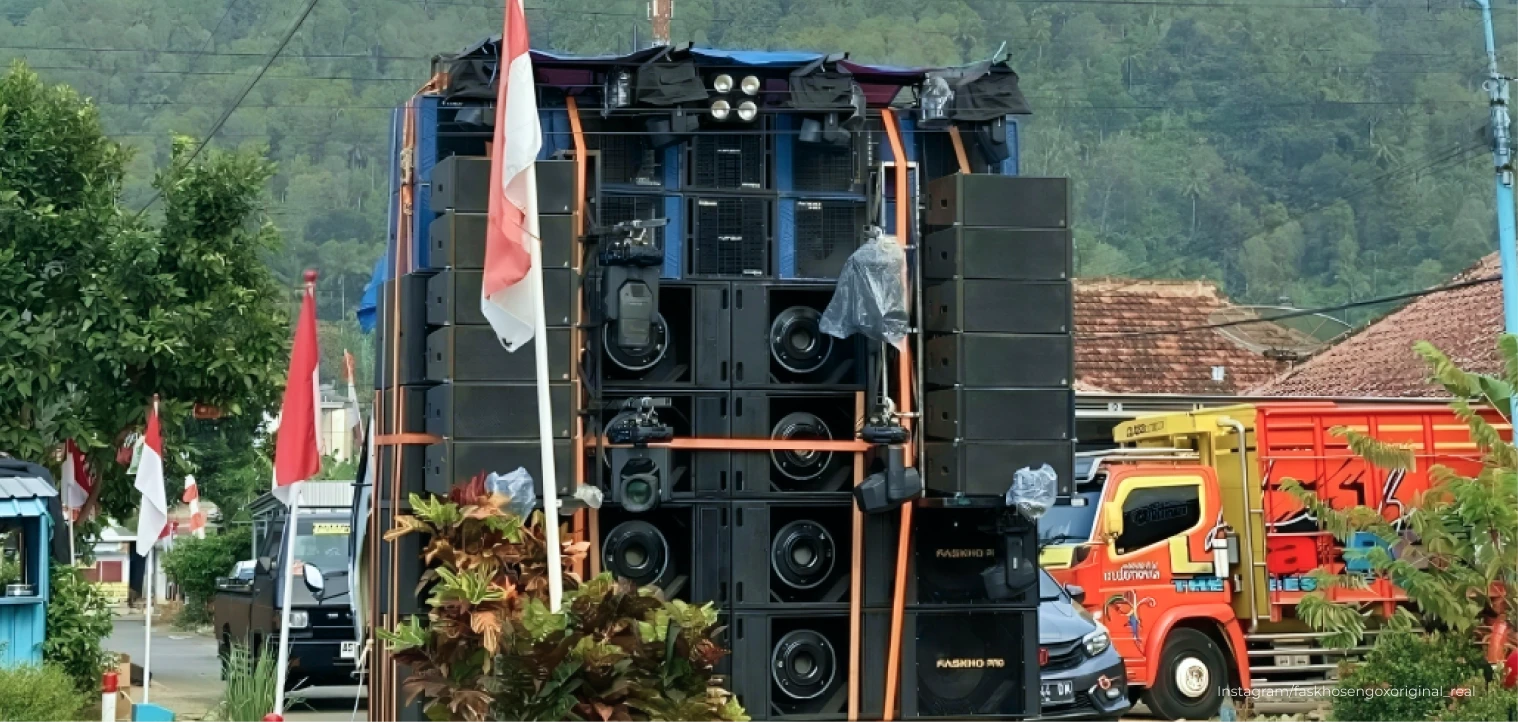
A truck loaded with massive sound system equipment passed by her house. Villagers followed the parade, riding motorcycles and trailing behind the truck. This parade is commonly referred to as “sound horeg.”
Sound horeg is a term for a large sound system that plays music at an extremely loud volume. Sound horeg is widely loved by the public as it provides free musical entertainment.
According to Hartanto (22), a man who once organized a sound horeg event, the culture of blasting loud music through sound systems has been growing since around 2011. The emergence of sound horeg began when sound system vendors in the Kediri, Malang, Blitar, and Tulungagung areas of East Java held parades and carnivals featuring dangdut music.
There are two types of sound horeg that have developed in East Java communities: stationary and carnival types. Typically, the stationary type is held in open fields, although it is sometimes set up on village streets for specific celebrations. Meanwhile, in the carnival type, the sound system is mounted on a truck and paraded around the village.
The equipment used for sound horeg is a subwoofer-type loudspeaker. This device is capable of producing booming bass sounds. Vendors usually assemble about 12 subwoofers on one truck, powered by an electric generator.
Trucks equipped with subwoofers are then adorned with decorative lights for illumination, especially if the parade takes place at night. “The sound system vendors modify their subwoofers individually to produce the most powerful bass,” said the Jombang native. “Since entertainment there usually involves dangdut music, they prioritize enhancing the bass sound.”
Sound horeg is typically played during Indonesia’s Independence Day celebrations, village events, or other special occasions. Hartanto explained that village administrations in East Java often allocate a special budget for organizing sound horeg carnivals.
However, it is not uncommon for these budgets to yield no profit for the vendors. Over time, the sound horeg parade has turned into a competition of prestige and a showcase for sound system vendors. Money becomes secondary, as long as the sound remains thunderous.

Noise pollution caused by sound horeg has sparked controversy. One reason is that the excessively loud sound can cause damage to structures, such as cracks in walls, shattered window panes, or falling roof tiles.
Some private and public facilities are deliberately damaged to accommodate the movement of the sound horeg carnival. This includes cutting shop roofs that extend into the street, removing bridge railings, and dismantling streetlights. Additionally, the loud noise from the carnival poses a serious risk to human hearing.
According to Kompas, sound horeg can reach noise levels of up to 135 decibels. This figure exceeds the noise limit recommended by the World Health Organization (WHO).
Ear, nose, and throat (ENT) specialist Dr. Arne Laksmiasanti, Sp.THT-KL., stated that WHO recommends a maximum safe sound volume of 85 decibels for a maximum duration of 8 hours.
Arne explained that sound horeg, with noise levels reaching 135 decibels, could lead to noise-induced hearing loss (NIHL). This condition falls under the sensorineural type of hearing loss. “It damages the nerve fibers in the inner ear,” Arne said when contacted via WhatsApp on Wednesday (18/12/2024).
Human ears subjected to high-decibel noise can suffer damage to the cochlea. There are two levels of cochlear damage: temporary hearing threshold shift and permanent hearing threshold shift.
Temporary hearing threshold shifts occur due to noise with a minimum intensity of 75 decibels. The effects include temporary hearing loss, a sense of fullness in the ears, and ringing sounds.
Meanwhile, permanent hearing threshold shifts result from noise exceeding 140 decibels. This can cause irreversible damage to the cochlea.
“If permanent hearing threshold shifts occur and result in irreversible damage to cochlear cells, hearing loss is incurable,” emphasized the doctor who teaches at the Faculty of Medicine, Universitas Muhammadiyah Surakarta (UMS).
Arne explained that individuals who experience permanent hearing loss due to cochlear damage still have a chance to restore their hearing. Two options are available: using hearing aids or undergoing cochlear implant surgery.
According to Alodokter, there are two common types of hearing aids: analog and digital. Analog hearing aids work by converting sound into electrical signals. Digital hearing aids, on the other hand, convert incoming sounds into numerical codes like those in computers. This allows them to be specifically programmed to amplify particular sound frequencies.
Cochlear implants are a medical procedure to replace the function of a damaged ear. Doctors install a small electronic device inside the ear to stimulate the auditory nerve. This device generates sound signals, which are then transmitted to the brain via the auditory nerve.
The device is particularly beneficial for individuals with sensorineural hearing loss. Users can recognize sounds, warning signals, and even understand phone conversations.
Hearing aids and cochlear implants should be considered a last resort. The best approach is to take proactive steps to prevent the negative impacts of sound horeg. It’s essential for communities to make wiser and more responsible choices when it comes to selecting safe and considerate forms of entertainment.
Writer: Gede Arga Adrian
Translator: Farizal Luqman Majid
Editor: Al Habiib Josy Asheva
Sheep dunged nutrient-rich organic fertilizer for plants, made with the help of maggots. Built on community empowerment and a zero-waste principle.
Nothing’s more special than reading curated news just for you.
Subscribe to the UMS Newsletter for free today.