
How Sheep Manure Turns into Nutrient Rich Fertilizer
16 July 2026
Sheep dunged nutrient-rich organic fertilizer for plants, made with the help of maggots. Built on community empowerment and a zero-waste principle.




Indonesia's labor market remains unstable in the face of global uncertainty, which has led to a sluggish national economy and weakened domestic consumption. Missteps in policymaking could further worsen the country’s economic condition.
Signs of economic turmoil are evident from the surge in layoffs over the past few months. According to Antara, the Ministry of Manpower (Kemnaker) reported that, as of Tuesday, May 20, 2025, Indonesia had recorded 26,455 layoffs.
Meanwhile, data from the Indonesian Employers Association (Apindo) shows that between January and March 2025, 73,992 workers were laid off. Apindo predicts the total number of layoffs could reach 250,000 by the end of the year.
Apindo Chairwoman Shinta Kamdani expressed deep concern over the situation. “That’s why we need investment in labor-intensive sectors, because these layoffs are very concerning for us,” Shinta said, as quoted by CNBC Indonesia on Tuesday (27/5/2025).
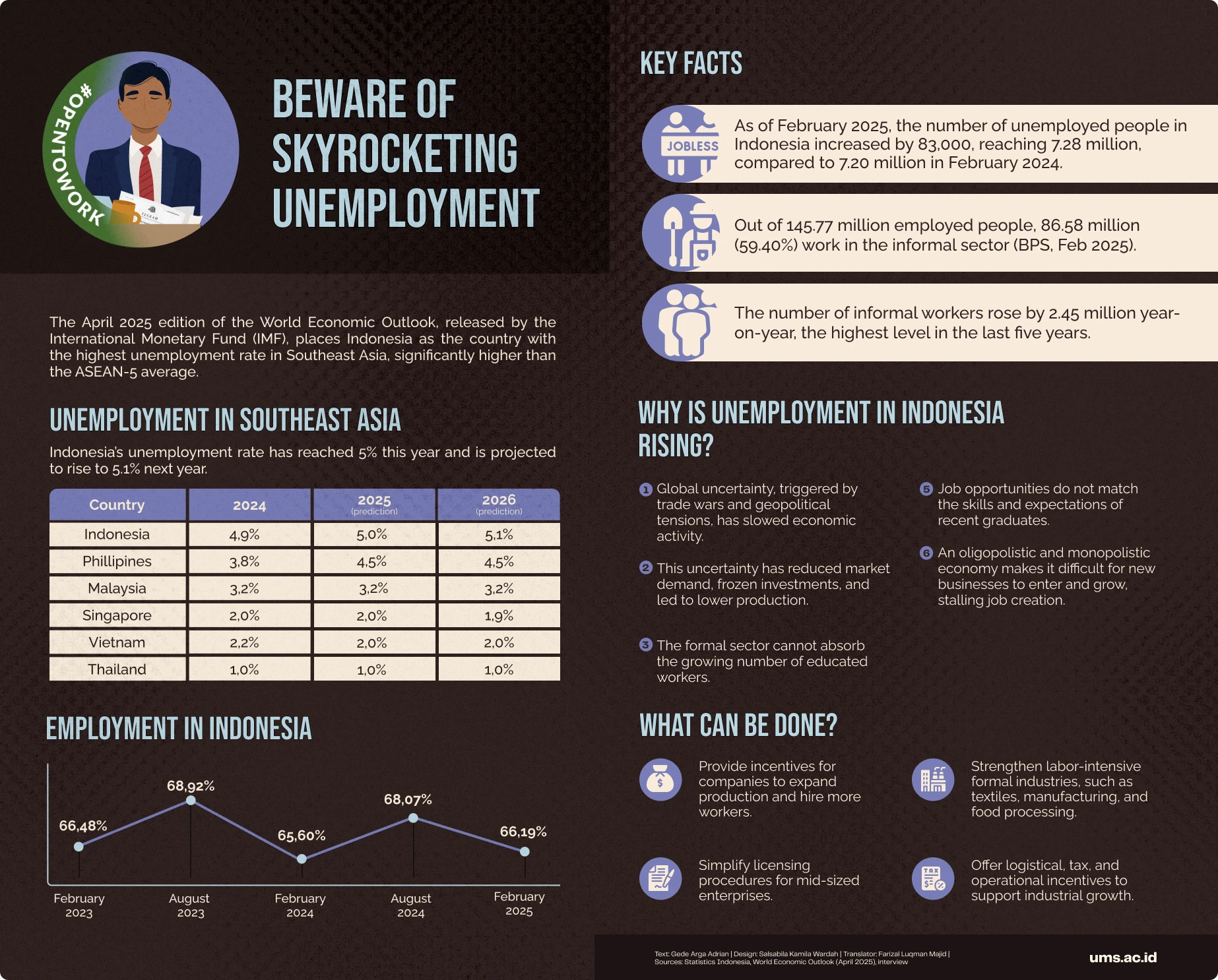
The April 2025 edition of the World Economic Outlook, released by the International Monetary Fund (IMF), ranks Indonesia as the country with the highest unemployment rate in Southeast Asia. In contrast, neighboring countries such as Malaysia, Singapore, Thailand, Vietnam, and the Philippines have relatively lower unemployment rates.
According to the report, Indonesia’s unemployment rate currently stands at 5 percent, with a projected increase to 5.1 percent in the following year.
The IMF attributes the rising unemployment to global uncertainty, which has caused joblessness to surge in many countries. This uncertainty stems from factors such as shifting global trade policies, growing protectionism, and escalating geopolitical tensions.
“Rising trade tensions and extremely high levels of policy uncertainty are expected to significantly affect global economic activity,” the report states.
These uncertainties have triggered a broad economic slowdown. As a result, market demand has dropped, prompting businesses to postpone expansion, cut back on investment, and reduce production spending. This chain reaction has directly impacted employment, resulting in lower labor absorption and a wave of layoffs.
Data from Indonesia’s Central Statistics Agency (BPS) indicates that the labor force grew from 149.38 million in February 2024 to 153.05 million in February 2025. However, this increase has not been matched by a decrease in unemployment over the same period.
Indonesia recorded 7.20 million unemployed people in 2024. By February 2025, the number rose by 83,000, reaching 7.28 million. This marks a 0.08% increase in unemployment over the one-year period.
Meanwhile, the proportion of the population working full-time in February 2025 stood at 66.19%, a decline of 1.88% from 68.07% in August 2024.
JThe continuing rise in unemployment through the end of 2025 is a growing concern. Prof. Dr. Bambang Setiaji, M.Si., Professor of Labor Economics at Universitas Muhammadiyah Surakarta (UMS), believed the formal sector is still unable to absorb a large labor force.“In the informal sector, there are jobs available, but they often don’t match the expectations or qualifications of graduates,” said Bambang on Wednesday (28/5/2025).
The rising number of unemployed should serve as a wake-up call for the government. Bambang urges the government to provide incentives for industries to grow and absorb more workers.
According to Bambang, one of the root causes of rising unemployment in Indonesia is the oligopolistic and monopolistic structure of its economy. With only a few business players dominating the market, newcomers struggle to enter and compete, resulting in limited job creation.
This situation forces a large portion of the workforce to turn to the informal sector, selling food or drinks on the streets, becoming online motorcycle taxi drivers, or worse, staying unemployed.
As of February 2025, data from Badan Pusat Statistik (BPS) shows that more than half of all employed Indonesians work informally. Out of 145.77 million people employed, approximately 86.58 million, or 59.40% are informal workers.
This marks an increase of 2.45 million informal workers compared to February the previous year, making it the highest figure in the past five years.
Bambang believed the informal sector was already too crowded. “The formal industry is oversaturated and really tough to compete,” said the former Rector of Universitas Muhammadiyah Surakarta (UMS) for the 2005–2017 term.
He emphasized that developing labor-intensive industries should be a top priority for the government in order to absorb the growing workforce. Bambang advocated for the development and strengthening of advanced industries such as automotive, manufacturing, and textiles.
“We still need to enter high-tech industries. Otherwise, our country will fall behind. A nation is only considered developed if it has strong high-tech industries,” he added.
He also stressed the importance of developing the agricultural industry, as the demand for food will always exist. In addition to absorbing more labor, strengthening the food industry aligns with efforts to achieve national food self-sufficiency.
Strong government intervention is needed to create new jobs on a massive scale. According to Bambang, the government must take bold steps to eliminate monopolistic and oligopolistic practices in Indonesia. At the same time, the licensing process for establishing formal and mid-sized businesses must be simplified.
“Mid-sized businesses should be supported with low capital costs. Affordable transportation and other related costs would also greatly help,” he concluded.
Writer: Gede Arga Adrian
Translator: Farizal Luqman Majid
Editor: Al Habiib Josy Asheva
Sheep dunged nutrient-rich organic fertilizer for plants, made with the help of maggots. Built on community empowerment and a zero-waste principle.
Nothing’s more special than reading curated news just for you.
Subscribe to the UMS Newsletter for free today.