How Sheep Manure Turns into Nutrient Rich Fertilizer
16 July 2026
Sheep dunged nutrient-rich organic fertilizer for plants, made with the help of maggots. Built on community empowerment and a zero-waste principle.



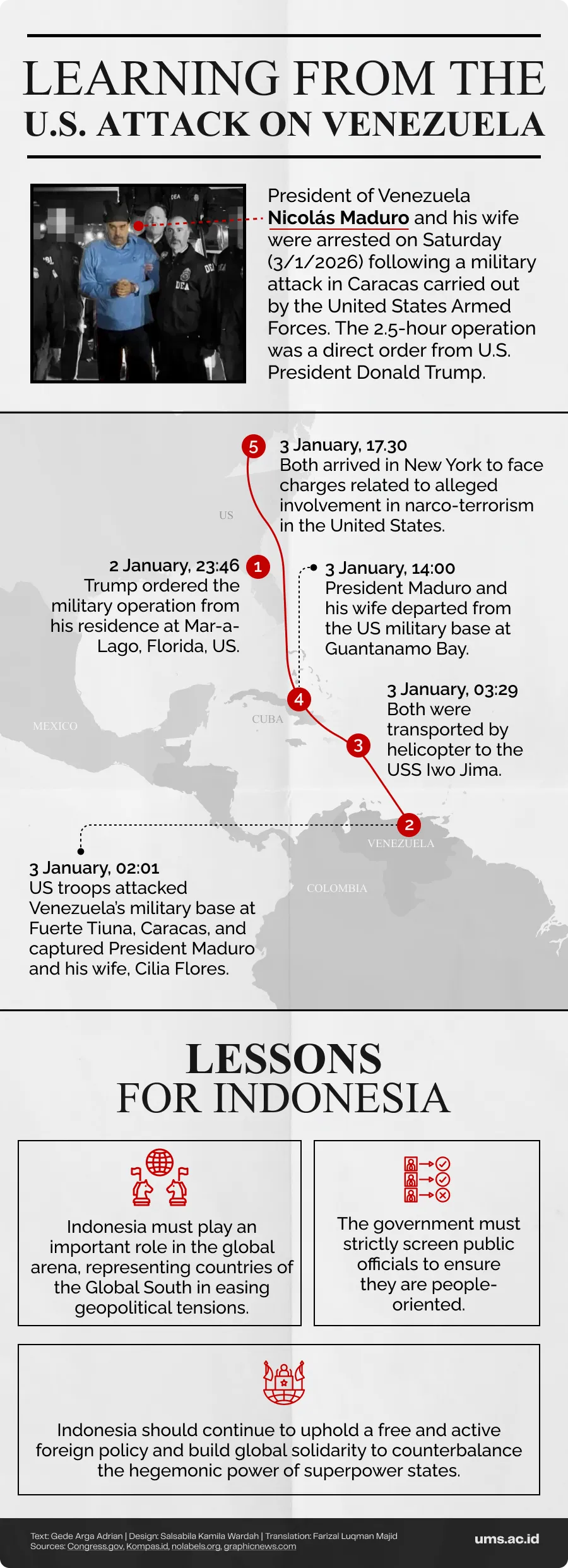
The year 2026 opened with a United States military attack targeting Caracas, Venezuela. The attack by the United States carried a mission to arrest Venezuelan President Nicolás Maduro and First Lady Cilia Flores. Both were subsequently taken to the United States on Saturday (3/1/2026).
US President Donald Trump accused Maduro of being the mastermind behind narco-terrorism crimes in the United States. Initially, Trump ordered the attack as an anti-narcotics law enforcement mission.
Trump later expanded the objective of the attack into a mission to manage Venezuela. In a press conference at the Mar-a-Lago Club, Palm Beach, Florida, Trump stated his plan to take over the management of Venezuela’s oil resources.
“We will rebuild the oil infrastructure (in Venezuela), which will cost billions of dollars,” Trump said on Saturday.
When reporters pressed Trump about the statement, he replied, “We will take a large amount of wealth from the ground, and that wealth will be given to the Venezuelan people and people outside Venezuela who were previously in Venezuela, and also to the United States as compensation for the damage caused by that country,” he said, as quoted by ABC News.
Venezuela’s fall into the hands of the United States has triggered condemnation from the international community. Malaysian Prime Minister Anwar Ibrahim stated that the US attack on Venezuela violated international law because it targeted a sovereign state. He urged the Trump administration to release Maduro and his wife.
“Whatever the justification, the forced removal of a sitting head of government through external action creates a dangerous precedent,” Anwar said on his X account, Sunday (4/1/2026).
Russia’s Ministry of Foreign Affairs condemned the US military aggression against Venezuela. Quoted by Reuters, the Russian Foreign Ministry denounced the justification for the attack as unfounded.
“The pretext used to justify these actions is groundless. Ideological hostility has overridden business pragmatism and the willingness to build relations based on trust and predictability.”
International Relations lecturer at Universitas Muhammadiyah Surakarta (UMS), Arief Isdiman Saleh, S.I.P., M.Si., Ph.D., stated that Trump’s actions have violated both US domestic law and international law. Domestically, Trump carried out the military attack without considering approval from two-thirds of Congress.
Even though Maduro is considered corrupt and authoritarian, Arief said the US government should not have carried out the operation without congressional approval. Such actions are not the first time they have been taken by The President of Uncle Sam.
The United States has the War Powers Resolution, enacted in 1973. This regulation limits the president’s authority to use military force without congressional authorization. Unfortunately, nearly every US president has conducted military strikes without congressional approval.
The US invasion of Venezuela also violates the Charter of the United Nations (UN), which states that every country has the right to run a sovereign government free from foreign intervention. “Trump arrested Maduro and then openly stated that Venezuela’s oil would be managed by the US for a certain period of time,” he said, Wednesday (7/1/2026).
The violation of the sanctity of the UN Charter by the US has clearly raised concerns within the international community. Arief said it is not impossible that similar invasion risks could occur in other countries. For example, China with Taiwan, Russia with Ukraine, or North Korea with South Korea.
Arief predicted that the US would take over the government through opposition forces. This has the potential to create divisions at the grassroots level and resistance against the US. “As long as the interim ruling party can be controlled by the US, America may not intervene,” he said.
Most recently, President Trump has called for elections to be held in Venezuela to select a new leader. However, the elections will not be conducted within the next 30 days.
“We have to fix this country first. You can’t hold elections. There’s no way people can vote,” Trump told reporters from NBC News.
The arrest of Maduro in the quick operation has raised public questions about how a sovereign head of state could be arrested by the military of another country in his own capital.
Two and a half hours is a relatively short amount of time to penetrate the inner circle of President Maduro. According to Arief, the United States was able to breach Maduro’s defenses with relative ease because it had previously carried out infiltration within the Venezuelan military.
“There was a betrayal, because many people from Maduro’s inner circle actually leaked information,” Arief said. He believed there were internal dynamics within the Venezuelan military that made the country’s defenses so easily breached.
Arief compared the situation to the U.S. attack on Panama in 1989. In that operation, the United States required around two weeks to overthrow Panama’s de facto leader, General Manuel Noriega.
The arrest of Maduro should serve as a lesson for Indonesia. Amid an increasingly uncertain global constellation, greater efforts are needed to safeguard national sovereignty.
Arief urged the government to respond with heightened vigilance. If Maduro could be captured due to defections among officials, a similar scenario could potentially occur in Indonesia.
“We also need to be cautious about who is within our own government. Are they truly serving the people, or do they have other interests?” he emphasized.
On the other hand, Indonesia has an opportunity to take parts in global political dynamics. Indonesia’s position as a representative of countries from the Global South, he added, should enable it to mobilize global solidarity to pressure superpowers to halt military aggression.
Such solidarity is crucial to counterbalance the hegemonic power of major world powers. Last Saturday’s attack further demonstrates that dominant global hegemonic forces continue to perpetuate modern-day imperialism. “Or neo-imperialism,” he concluded.
Writer: Gede Arga Adrian
Translator: Farizal Luqman Majid
Editor: Al Habiib Josy Asheva
Sheep dunged nutrient-rich organic fertilizer for plants, made with the help of maggots. Built on community empowerment and a zero-waste principle.
Nothing’s more special than reading curated news just for you.
Subscribe to the UMS Newsletter for free today.