
How Sheep Manure Turns into Nutrient Rich Fertilizer
16 July 2026
Sheep dunged nutrient-rich organic fertilizer for plants, made with the help of maggots. Built on community empowerment and a zero-waste principle.



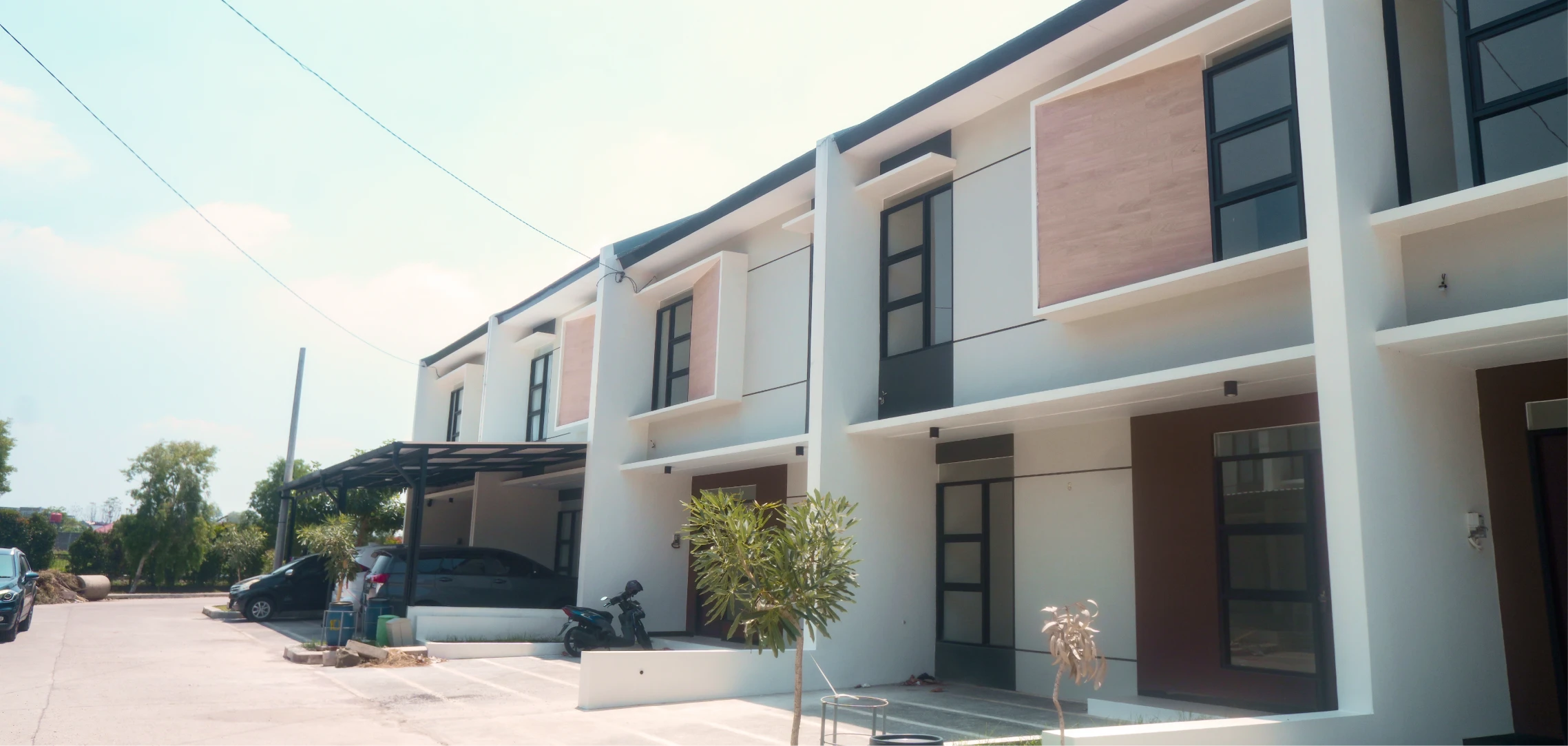
The Prabowo-Gibran administration's ambitious goal of building 3 million houses remains uncertain, as the Ministry of Housing and Settlements (PKP) has yet to release a clear roadmap for the project. This lack of direction has left housing developers in confusion, wondering, “Where is this heading?”
The 3 million houses was a campaign promise made by President Prabowo Subianto. The head of the Housing Task Force, Hashim Djojohadikusumo, stated that the government’s target is to build 15 million homes for low-income communities within five years.
Finance Minister Sri Mulyani Indrawati has allocated a budget of IDR 5.27 trillion for the PKP in 2025. The government has also set aside IDR 35 trillion for housing financing, which includes:
Deputy Minister of PKP, Fahri Hamzah, stated that the budget for the 3 million houses program comes from the state revenue and expenditure budget (APBN). Of the 3 million planned housing units, two million are allocated for rural areas, while one million are designated for urban areas.
Fahri noted that constructing 3 million houses would be difficult without APBN funding. “Relying solely on a business model approach would be quite challenging. Most people in rural areas already have houses , but many are unfit for habitation,” Fahri said, as quoted from Tempo on Tuesday (11/3/2025).
Housing Task Force member Bonny Z Minang stated that the government provides a subsidy of IDR 600,000 per month for each housing unit valued at IDR 100 million, with a 25-year loan term. Eligible recipients will receive a type 36 house with a land area of 70 square meters.
“If you ask whether someone can buy one for IDR 1 million, the answer is yes. They would need to add IDR 400,000. But in this first year, we don't want to push for that yet. Why? Because President Prabowo wants this to be uniform. We don’t want unfinished or abandoned houses,” Bonny said, as quoted by Kompas.com on Tuesday (11/3/2025).
Unfortunately, even after President Prabowo's first 100 days in office, the list of housing aid recipients is still being compiled. Bonny Z Minang emphasized that the 3 million houses program is exclusively for people living in extreme poverty. “Right now, the criteria for beneficiaries are still being finalized,” Bonny stated.
The preliminary criteria for prospective beneficiaries include:
Construction management expert from Universitas Muhammadiyah Surakarta (UMS), Ir. Muhammad Nur Sahid, M.T., M.M., urged the government to set up the criteria for recipients of the 3 million houses program. He emphasized the need to ensure that subsidized housing reaches the right beneficiaries while preventing property hoarding practices.
To accurately verify recipient data, Nur Sahid suggested that the government involve non-governmental organizations (NGOs) that can reach both urban and rural poor communities. He noted that NGOs tend to be more flexible in field operations.
“The main issue is identifying who will receive the subsidy. The program is good, but the target must be more specific. There are too many cases of subsidy misallocation,” Nur Sahid stated on Tuesday (11/3/2025).
Having worked in the construction sector since 1986, he acknowledged the challenges faced by lower-middle-class communities in purchasing houses, primarily due to high production costs.
“Building a house is expensive. Land prices are high. But people can’t afford them, even though the government subsidizes 7 to 10 percent,” he added.
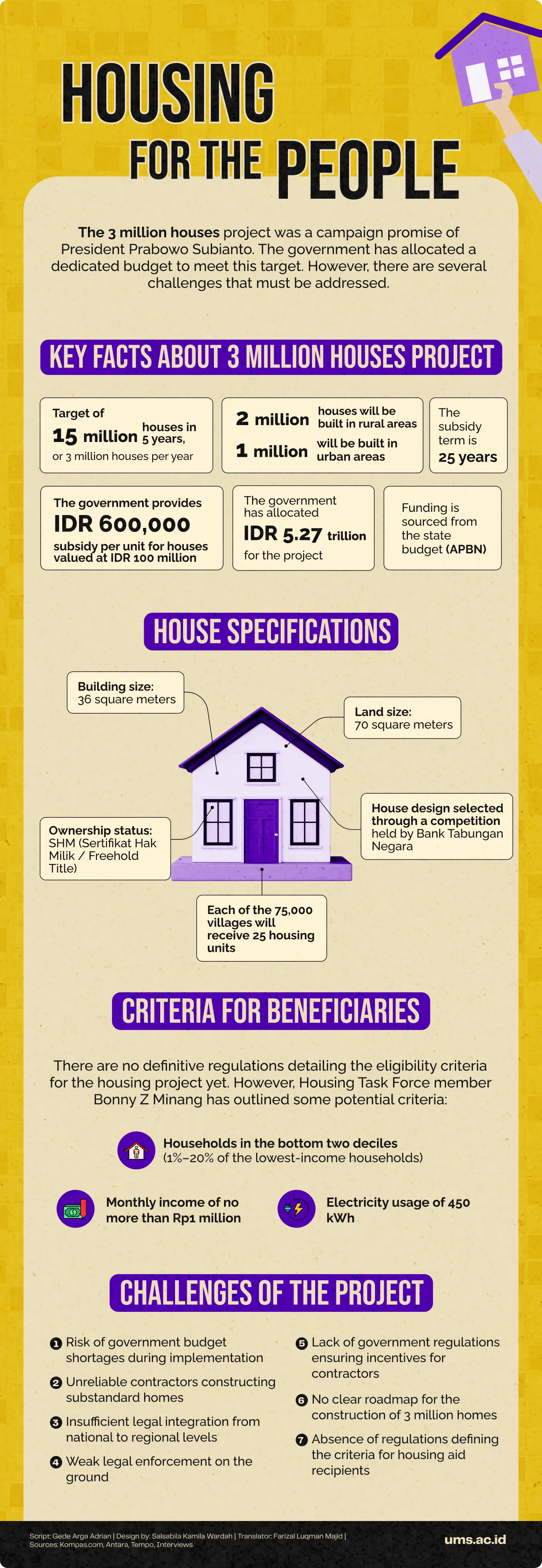
Nur Sahid stated that the project is not without its challenges. It demanded regulatory integration at the national, regional, and local levels to ensure smooth communication between policymakers and contractors across all sectors.
This regulatory integration, he continued, must be accompanied by strict and comprehensive law enforcement. “The regulations are already in place, but implementation in the field is the real challenge,” he lamented.
He also stressed the importance of carefully selecting contractors for the project. According to him, Indonesians tend to be opportunistic, often exploiting large government projects for personal gain.
Choosing honest contractors is essential to ensure that the houses meet established standards. “When we talk about opportunities, we must first identify the weaknesses. Don’t just agree to everything without understanding the potential pitfalls,” said the UMS Civil Engineering lecturer.
The risk of budget disruptions midway through the project is another major concern. The project heavily depends on the government's financial capacity. Nur Sahid urged the government to establish regulations that ensure continuous funding for the project. “If there’s a government regulation (PP), contractors can file lawsuits if any issues arise,” he asserted.
Nur Sahid also warned about the widespread issue of extortion by certain groups in various regions of Indonesia. Demands for a "share" from mass organizations (ormas) often delay construction projects.
Having spent years in the construction industry, Nur Sahid is well aware of the challenges posed by local extortion. While working on a hospital project in Solo, Central Java, he had to conduct multiple feasibility studies, one of which involved allocating extra funds for mass organizations.
Before launching the 3 million houses project, ensuring a healthy business environment must be a priority. One key aspect is enforcing laws thoroughly, particularly in cracking down on extortion practices.
“That’s a must, in my opinion. This is why many Indonesian entrepreneurs take their businesses abroad, because they’re burdened by both government-imposed costs and local extortion,” Nur Sahid added.
He acknowledged that building 3 million houses is no easy feat. Government incentives for contractors are crucial to boosting their performance and maintaining a healthy construction industry in Indonesia.
However, Nur Sahid cautioned that these incentives should be proportional to the quality of the properties built. “The incentives shouldn’t be top-grade while the resulting buildings are of subpar quality,” he added.
Writer: Gede Arga Adrian
Translator: Farizal Luqman Majid
Editor: Al Habiib Josy Asheva
Sheep dunged nutrient-rich organic fertilizer for plants, made with the help of maggots. Built on community empowerment and a zero-waste principle.
Nothing’s more special than reading curated news just for you.
Subscribe to the UMS Newsletter for free today.