


How Sheep Manure Turns into Nutrient Rich Fertilizer
16 July 2026
Sheep dunged nutrient-rich organic fertilizer for plants, made with the help of maggots. Built on community empowerment and a zero-waste principle.




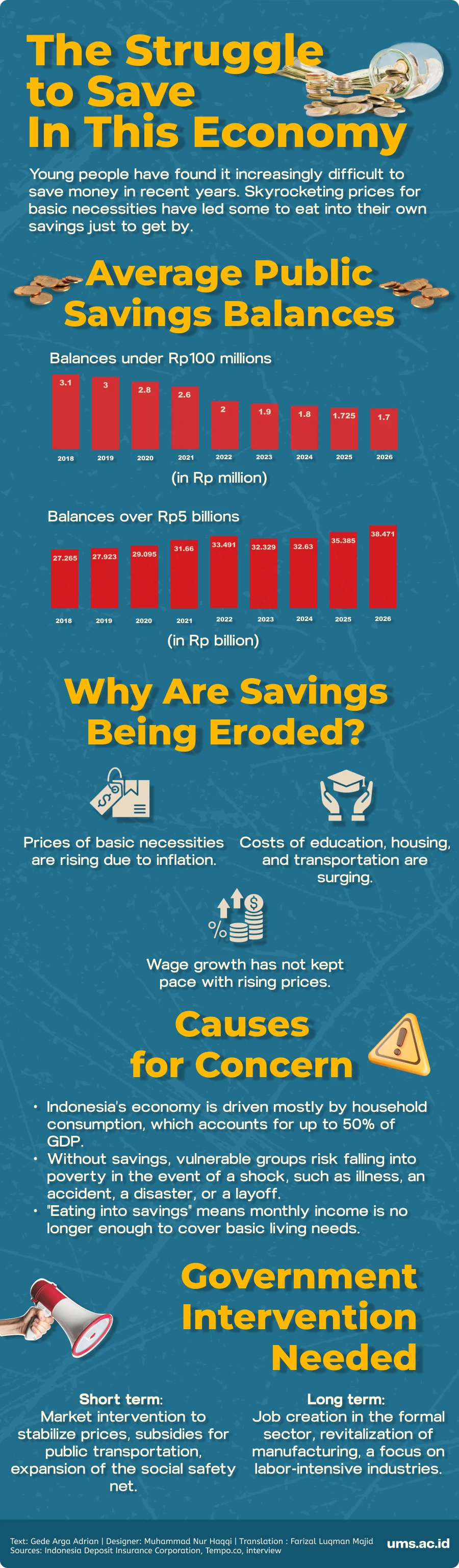
Savings balances in the small-account segment, those holding less than Rp100 million, have kept shrinking over the past eight years. Research by the National Banks Association (Perbanas) found that the average balance per account in this segment has eroded to Rp1.7 million as of May 2026, and stalled there.
Perbanas data put the small segment's average balance at Rp3.1 million in 2018. It fell to Rp1.8 million by 2024, then slipped again to Rp1.7 million in the first half of 2026
The top end went the other way. Accounts holding more than Rp5 billion saw their average balance climb to Rp38.773 billion as of May 2026, swelling up from Rp27.626 billion in 2018.
Perbanas chief economist Winang Budoyo said his organization is watching the decline in the small segment closely. The trend, he said, has produced what people now call mantab, short for makan tabungan, or eating into savings.
"It means there are more needs to cover than there is capacity to build savings," Winang said, as quoted by Narasi on Thursday (6/8/2026).
Dr. Mahameru Rosy Rochmatullah, S.E., M.Si., an accounting lecturer at Universitas Muhammadiyah Surakarta (UMS), said the falling balances are a symptom of weakening purchasing power and structural pressure on the economy, not simply a matter of poor financial literacy.
Teaching people to save will not be enough, he argued, unless their overall well-being improves alongside it. "We need policies that create formal jobs on a far larger scale, tighter regulation of predatory online lending, and government action to stabilize the prices of basic goods," he said Thursday.
The weakening of purchasing power is hitting Generation Z too, though Gen Z is one of the main pillars of national consumption. Research by the Mandiri Research Institute, titled "The Paradox of Gen Z Consumption," found that the group's share of consumption has risen over the past five years while the quality of that consumption has weakened.
The value of Gen Z spending from January to November 2025 fell 5.2 percent year on year. In other words, the rise in their consumption is being driven more by how often they buy than by how much they spend each time.
The Deloitte Global Gen Z and Millennial Survey for 2023/2024, meanwhile, found that more than half of Gen Z and millennials live paycheck to paycheck. The cost of living is their single biggest worry, well ahead of climate change or unemployment. The situation has been exacerbated by soaring inflation, while minimum wages have failed to keep pace.
Mahameru, the UMS accounting lecturer, said it is wrong to pin the blame on young people for not saving. Lifestyle plays some part, the coffee runs, the concert tickets, but it's a structural problem at its core.
He called the situation a perfect storm. Young people are living through prolonged wage stagnation that has not kept up with rising prices for the basics, housing, education, and food above all.
"It's not that they don't want to save. There's just no room left in the wallet once the basic monthly needs are covered," he explained.
Eating into savings and cutting back on the secondary things, entertainment, clothes, recreation, is not an ordinary lifestyle adjustment, Mahameru said. He described it as survival mode: people drawing down their last line of financial defense simply to eat and keep up with installments. Their main income, in other words, no longer stretches to cover the rising cost of essentials.
The damage runs deep, at both the household level and the national one. With no savings to fall back on, financial resilience collapses. A single small shock, an illness, an accident, a layoff, can tip a family into extreme poverty.
At the macro level, Indonesia's economy leans heavily on household consumption, which makes up more than half of GDP. When savings dry up, consumption stalls. Factory goods go unsold, companies cut costs, and layoffs follow in waves. "This is a vicious cycle that leads toward recession," Mahameru said.
Mahameru stressed that government intervention is urgently needed. The government, he said, must not get caught up in the headline 5 percent growth figure, since macro numbers often mask how hard things are at the micro level.
"If we ignore this, the widening inequality will set off social problems, more crime, and political instability," he said.
A slowdown can also produce a vulnerable group that today's poverty data doesn't capture, people who aren't counted as poor now but could tip over easily if a price shock hits. Left unchecked, Mahameru went on, the eating-into-savings trend will push Indonesia's Gini ratio the wrong way.
He urged the government to reorient its policies toward protecting the purchasing power of the lower and middle classes. So far, he said, policy has leaned more toward growth.
In the short term, that could mean intervening in markets to stabilize food prices, widening the social safety net to reach vulnerable workers and the lower-middle class, and subsidizing public transport to bring down daily living costs.
For the long term, the focus should be on creating formal-sector jobs and reviving manufacturing. "We need investment that absorbs labor, not just capital-intensive investment that benefits a handful of investors," he said.
Writer: Gede Arga Adrian
Translator: Farizal Luqman Majid
Editor: Al Habiib Josy Asheva
Sheep dunged nutrient-rich organic fertilizer for plants, made with the help of maggots. Built on community empowerment and a zero-waste principle.
Nothing’s more special than reading curated news just for you.
Subscribe to the UMS Newsletter for free today.