How Sheep Manure Turns into Nutrient Rich Fertilizer
16 July 2026
Sheep dunged nutrient-rich organic fertilizer for plants, made with the help of maggots. Built on community empowerment and a zero-waste principle.



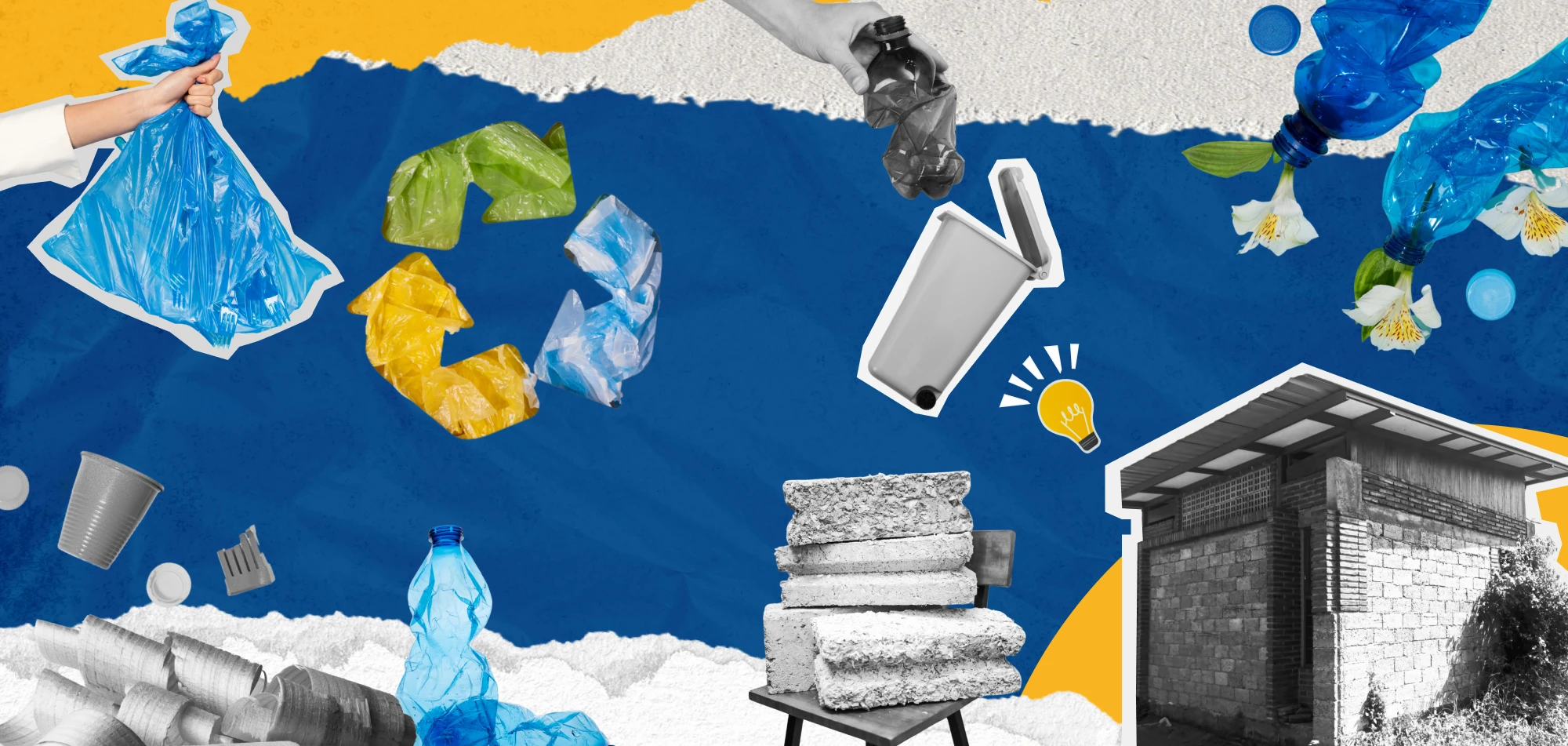
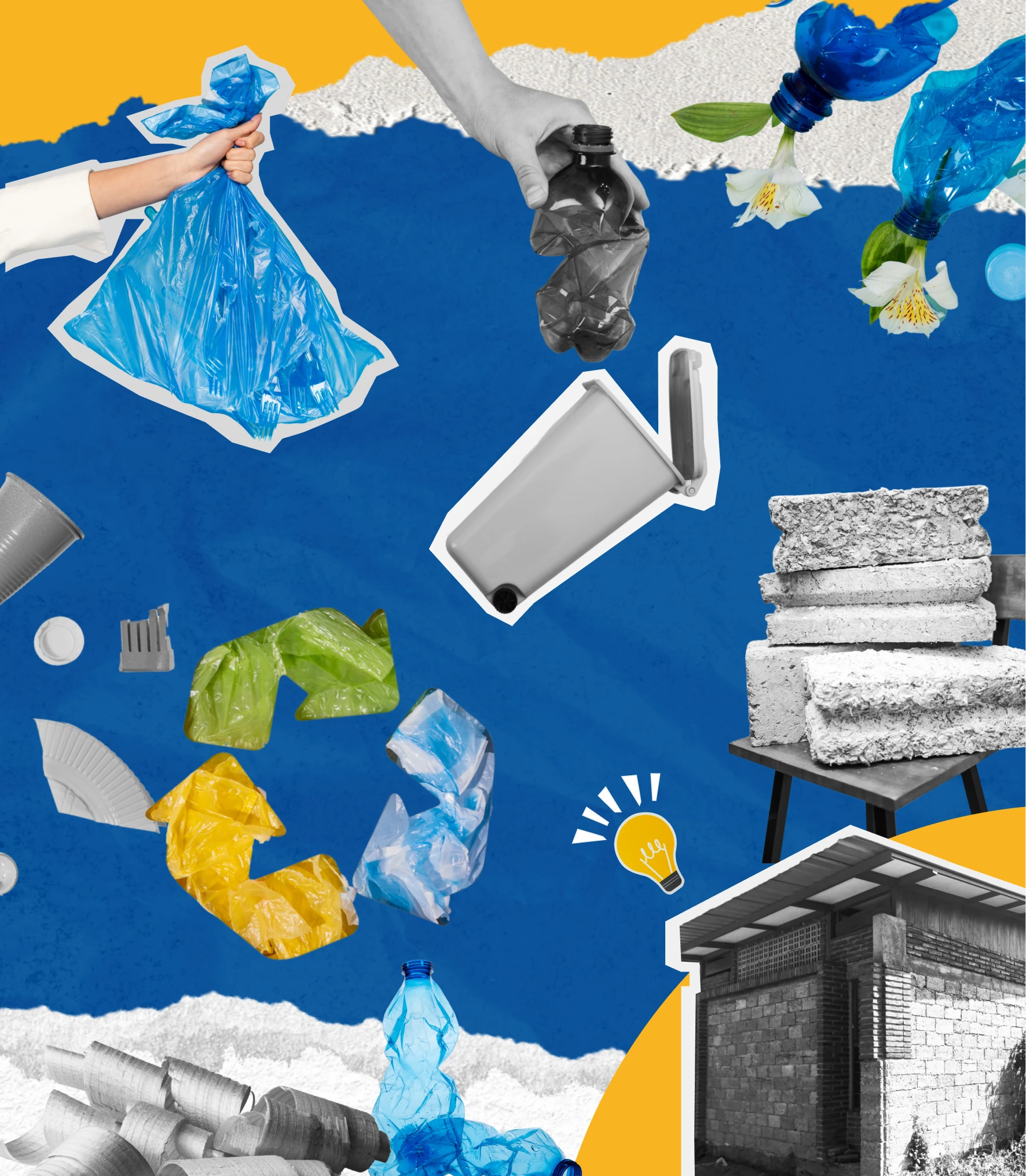
“Plastic is a waste that is tremendously difficult to break down. We need to find ways to reuse plastic waste instead of just throwing it away,” Dhani Mutiari told us in a discussion session.
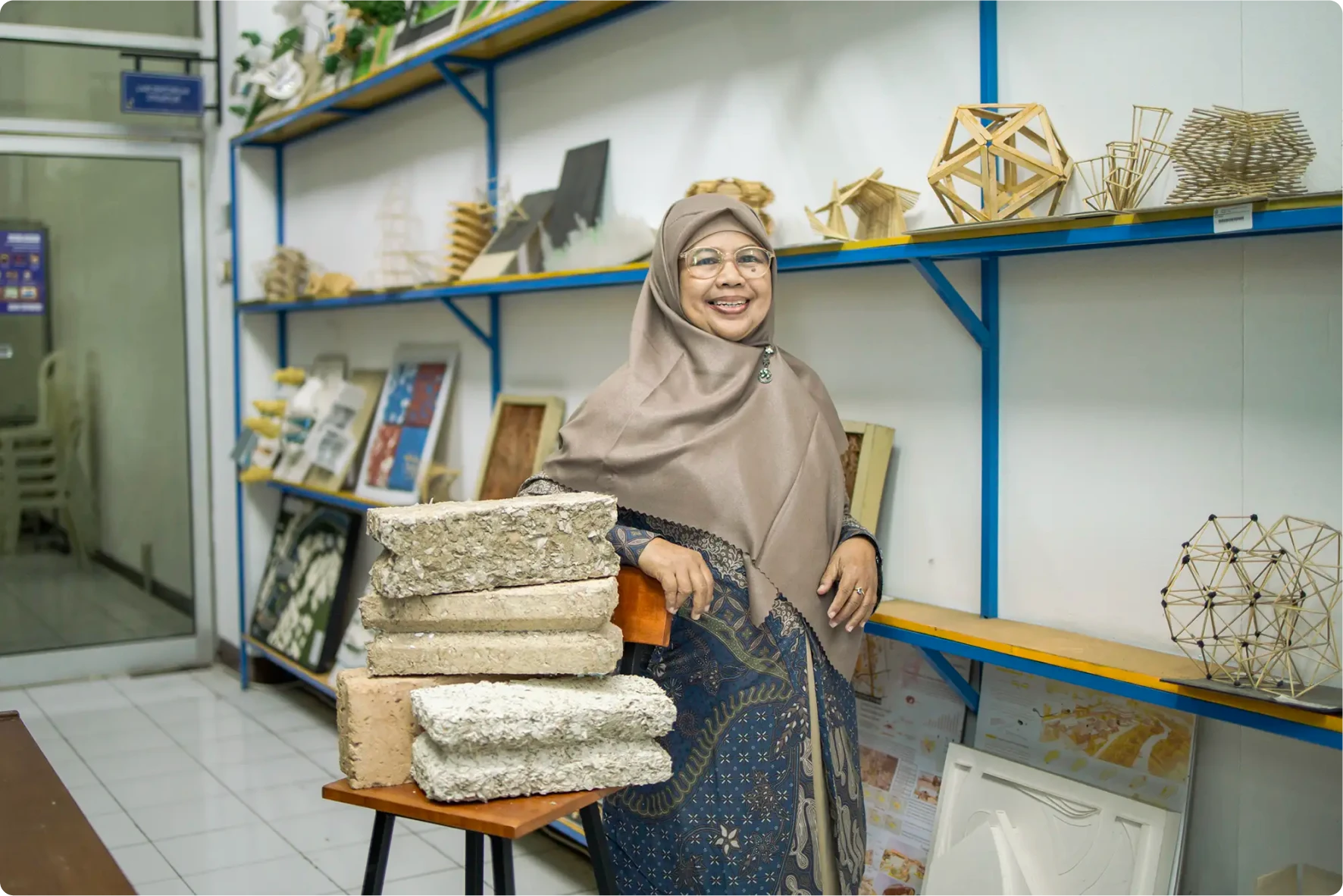
On Thursday, December 18, we met Dr. Ir. Dhani Mutiari, M.T., a lecturer of Architecture study program at UMS. Dhani is one of several UMS researchers who are working on a project to recycle plastic waste into plastic waste house. She is the leader of a team which includes Dr. Nur Rahmawati Syamsiyah, S.T., M.T., Yayi Arsandrie, S.T., M.T., Suharyani, S.T., M.T., Muhammad Ali Rofiq, M.T., and Sa'idah Aliyatul Himmah, S.T.
In a corner of the Architecture department room, Bu Dhani, as she is often called, explained to us the results of her research on plastic waste house, which are a house made from recycled plastic waste
Who would have thought that plastic waste, which has been left untouched for so long, can be recycled into a house in the right hands. This brilliant research is a glimmer of hope for future generations to resolve the plastic waste issue.
A series of feasibility tests have been conducted by Dhani and her colleagues. These feasibility tests attempt to determine whether houses that use recycled plastic can be considered livable or not.
The findings were recorded in the first journal titled “Thermal Insulation of Alternative Bricks Material from Plastic Waste Mixtured with Sawdust and Rice Husk''. Dhani then continued her research to test the acoustic insulation of the house with the title “The Acoustic Comfort in the House Made of Plastic Waste” which was published in the research journal Civil Engineering and Architecture, indexed Scopus Q2.
As time goes on, the rampant production of plastic continues to be a threat. Especially when considering the fact that plastic is a component that is very difficult to decompose.
According to the instagram post of the Directorate of Waste Management of the Ministry of Environment and Forestry (KLHK), on Wednesday (07/07/2023), the plastic decomposition process takes a very long time. Depending on the type of plastic.
Plastic bags, which are generally used by the community, take 10 to 500 years to decompose. Plastic straws take about 20 years. Plastic bottles take up to 450 years.
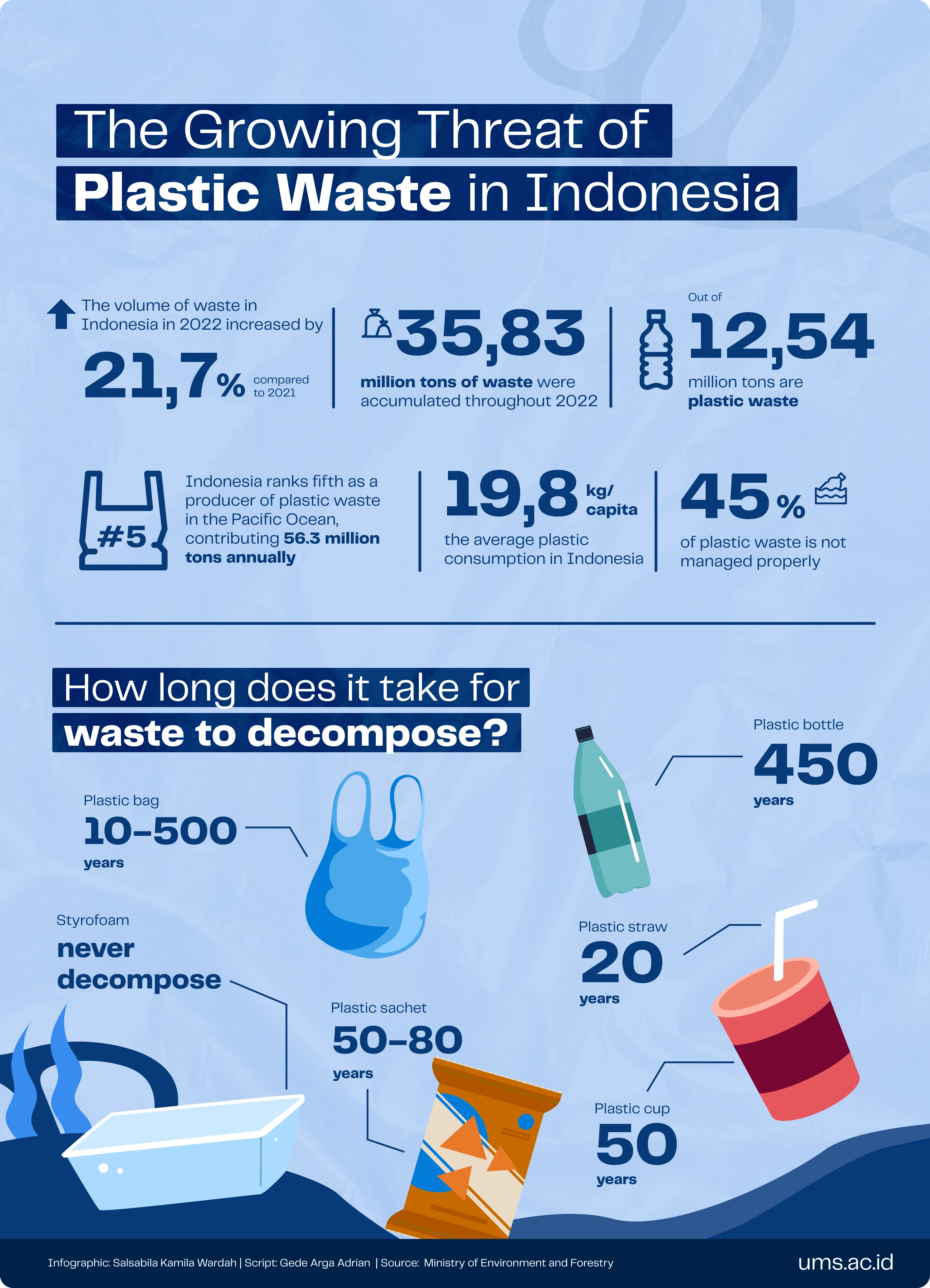
Although some types of plastic can decompose quickly, the danger does not disappear immediately. There is a threat of microplastics that are invisible to the naked eye and how it is extremely polluting to the environment.
Not only that, Indonesia is also facing a growing rate of plastic waste production every year. Kompas (15/06/2023) noted that throughout 2022, Indonesia had produced 12.54 million tons of plastic waste. A fantastic figure that has been growing exponentially since 1995.
In response to the soaring threat of plastic pollution, most of the world's communities are pushing for the reduction of plastic waste to the point of mass recycling of plastic waste. That is what Dhani Mutiari and her team did, creating an innovation in plastic waste processing by building a sturdy plastic waste house.
The Plastic Waste House is a green building initiated by Dhani Mutiari and the UMS Research Team. As stated by the Indonesia Environment & Energy Center, the concept of green building is to design a house or building by reducing the negative impact on the environment and humans. The noble concept of reusing plastic waste seems to rekindle a hope for battling plastic waste across the globe.
She said that the plastic waste house she built was made of recycled bricks, which were made from a combination of plastic waste and wood powder.
She, and the team she formed, have conducted a series of trials, combining several materials such as rice husks, plastic waste, and wood powder. Her first trial produced 20 bricks.
“The first research was all about finding one product material that uses alternative materials, namely plastic waste. We tested the use of wood powder and rice husks. The best result was wood powder and plastic waste,” she continued.
After a period of trial and error, Dhani was able to find the right combination of wood powder and plastic waste
“We used a ratio of 30% plastic waste and 70% wood powder. In the next research, the mixture was printed in large quantities to be used as a building material for house walls,” she said.

Plastic waste bricks made by Dhani and her team.
The use of plastic waste in bricks is not without reason. In addition to environmental factors, Dhani said that the use of plastic waste as an alternative for bricks is intended to reduce the use of clay. She is concerned that the excessive use of clay will disrupt the ecological environment around the clay extraction site.
“Coincidentally, using plastic waste products we aim to avoid the use of clay. The clay available in rural areas is now very low. If it is used continuously, it will run out. We have to find alternative materials for wall products,” explained the member of the Center for Islamic Architecture Studies.
After the success of her first research, Dhani did not stop there. She was inspired to experiment further to see what would happen if the bricks she made were then produced on a large scale to make a building.
“We presented the initial research findings for further exploration. Our attempt involved creating a house using recycled plastic bricks. Collaborating with skilled brick craftsmen, we crafted 700 bricks and assembled them into a building,” she continued.

The plastic waste house built by Dhani is firmly standing.
In addition to collaborating with brick craftsmen, the research also involved plastic waste collectors and woodworkers to find raw materials for the production of recycled plastic bricks.
“We collaborated with collectors to obtain plastic waste material. The plastic we use has been crushed. Then (plastic) is used as a mixture of bricks,” she explained.
To ensure the quality and suitability of recycled plastic bricks as a building material, Dhani and her team have undertaken a comprehensive series of tests.
Dhani stated that her current research aims to test the acoustic properties, specifically the soundproofing level, of buildings constructed from plastic waste. Through a series of conducted tests, it was revealed that structures built with plastic waste bricks demonstrate a livable standard.
Dhani mentioned, “This building is recommended for rest areas or residences with low noise levels. It's not suitable for theaters with significantly high noise levels.”
She explained that the building's nature is to absorb more sound from the exterior into the structure, resulting in a slightly quieter interior compared to structures made of conventional bricks.
“The sound from the outside naturally gets dampened when inside the room. It's a bit quieter, compared to not using this material,” she added.
In her journal, Dhani stated that the sound pressure level (SPL) frequency tested on the building was 52.7 decibels. This figure indicates that the sound inside the room is within reasonable limits and easily audible to humans. Generally, people can comfortably hear sounds ranging from 40 to 60 decibels.
“Nevertheless, the recycled plastic brick material is capable of providing sound transmission between the exterior and interior at 39 dB. This is due to the structure of plastic and wood powder bricks, which is not as soundproof as clay bricks.”
“Because there is wood powder and fragments of plastic waste. Compared to clay, clay bricks are denser and may be heavier,” she emphasized.
The lecturer also explained one of the advantages of recycled plastic bricks. Plastic bricks do not require plaster for finishing, making their aesthetic value superior to conventional bricks.
“If you use AAC walls, you need to apply cement and sand plaster, then add paint. With this (recycled plastic bricks), there's no need for that. It's more like exposed brickwork, more or less,” she explained.
Recycled plastic bricks can be said to be a brilliant idea to address the problem of plastic waste. However, Dhani stressed the need for further research on the strength of recycled plastic bricks.
"So far, we haven't tested the strength because in our first research, we focused on the thermal aspect, and in this current research, we examined the acoustic side. Strength testing falls under Civil Engineering. The next target is indeed to test the structural strength. However, considering the house we built has been standing for two years, it has proven to endure," emphasized Dhani.
However, when asked about the production cost of recycled plastic bricks, Dhani emphasized the need for a cost evaluation. This is because the cost per piece of recycled plastic brick is slightly higher compared to the price of bricks available in the market.
According to calculations by Dhani and her team, the cost of plastic waste bricks is approximately Rp8.000. This price is relatively high compared to autoclaved aerated concrete (AAC) bricks or conventional bricks, which typically range from Rp2.000 to Rp4.000.
If it's still economically expensive, it's because we didn't take the plastic and use it directly; instead, we had to buy it. Even for the sawdust/wood powder, we collaborated with a wood craftsman, and it turned out that the wood used was teak, so it was a bit expensive," explained Dhani
Recognizing the relatively high production costs, Dhani and her team are actively working on improvements to reduce costs. Their goal is to make the unit price of recycled plastic bricks more affordable to the public.
“I am committed to lowering the production costs of this research, providing the public with affordable options for building materials. My goal is to foster collaboration with the industry, ultimately paving the way for independent production of recycled plastic bricks,” she concluded.
Writer: Gede Arga Adrian
Editor: Al Habiib Josy Asheva
Translator: Farizal Luqman Majid
Sheep dunged nutrient-rich organic fertilizer for plants, made with the help of maggots. Built on community empowerment and a zero-waste principle.
Nothing’s more special than reading curated news just for you.
Subscribe to the UMS Newsletter for free today.