
The Scholar Behind UMS's Master's Program in IQT
27 July 2026
Prof. Andri Nirwana, S.TH., M.Ag., Ph.D., pioneered the Master of Al-Quran and Tafsir Studies as a first step in strengthening Quranic studies within Muhammadiyah.




For over 20 years, Indonesia has been embracing regional autonomy, giving local governments more control. The introduction of Law No. 22/1999 marked a significant step in changing the approach to economic development from centralization to decentralization.
When Reformasi started, it opened up opportunities for local governments to take charge of their own areas and grow their economies. Previously, under the New Order's iron grip, regional autonomy was practically non-existent.
Mahameru Rosy Rochmatullah, S.E., M.Si., Ph.D., lecturer in Accounting at the Faculty of Economics and Business, Universitas Muhammadiyah Surakarta (UMS), emphasized that despite the extensive implementation of regional autonomy, local governments continue to receive certain budget allocations from the central government.
“Regional autonomy at its core is the granting of independence or authority to local governments to manage their own affairs. Although they technically still receive fiscal assistance from the central government, such as general allocation funds and special allocation funds,” stated Mahameru on Monday (15/1/2024) afternoon at the Siti Walidah Main Building.

Since 1999, the mantra of “regional autonomy” has fueled economic growth in different parts of Indonesia. Infrastructure development, education and health facilities, along with local economic growth, became the main goals of development. The implementation of regional autonomy has unintentionally fostered competition among local governments to catch up with and outperform other regions.
Mahameru explains that while the concept of competitiveness in local governments may be somewhat abstract, in practice, their actions reflect steps taken to stimulate competition with other regions in Indonesia.
This abstract concept of local government competitiveness has motivated Mahameru, who is also a public policy expert, to investigate how the competitiveness evolves within local government institutions. The findings of Mahameru's research have been published in the journal Problems and Perspectives in Management under the title “Local Government Competitiveness Analysis Using The Perspective of Organizational Excellence: Evidence from Indonesia”.
Local government competitiveness may still seem unfamiliar to many, a sentiment that Mahameru acknowledges. This is attributed to the abstract nature of the concept, with no concrete written records available to fully understand it.
“This competitiveness is not something conceptualized or commonly considered in local government management; perhaps it's more associated with the private sector,” remarked Mahameru. “Nevertheless, local governments actively engage in activities aimed at enhancing their competitiveness.”
The concept of local government competitiveness revolves around the allocation of the central government's budget to different regions. Mahameru stated that the utilization of the central budget by local governments is subject to specific procedures outlined in laws, government regulations, presidential regulations, and regional regulations.
The presence of a standardization in budget utilization leads Mahameru to suspect the existence of a uniform institutional practice. His reasoning is that this uniformity is established based on indicators set by the central government to assess the performance of local governments.
“Since the practice is uniform, the measuring instrument used to assess the performance of local governments can be applied universally to all local governments in Indonesia,” elaborated Mahameru.
The research, which involved 34 government experts and took three years to complete, outlined three main factors that drive local government competitiveness.
The foremost priority to enhance the competitiveness of local governments is ensuring the quality of products and services. Local governments directly impact the lives of many people. As such prioritizing quality not only increases competitiveness but also fosters increased public satisfaction and trust in local government institutions.
Secondly, strategic planning that emphasizes socio-economic development plays a crucial role in driving local governments to greater competitiveness. Thoughtful planning enables local governments to create a focused roadmap for policies, aimed at catching up with other regions.
Thirdly, the effectiveness of integrity systems in managing government organizations is a crucial requirement for local government projects. An efficient integrity system will promote lawful and ethical conduct among individuals within the government, ensuring they fulfill their duties and responsibilities with integrity.
In addition to implementing the three supporting factors mentioned earlier, Mahameru encourages local governments to bolster economic strength through community empowerment. This encouragement is rooted in an anomaly he discovered during his research.
“To address the competition among regions, local government development often prioritizes physical infrastructure. However, in Indonesia, the dominant issue lies in the economic well-being of the people,” highlighted Mahameru.
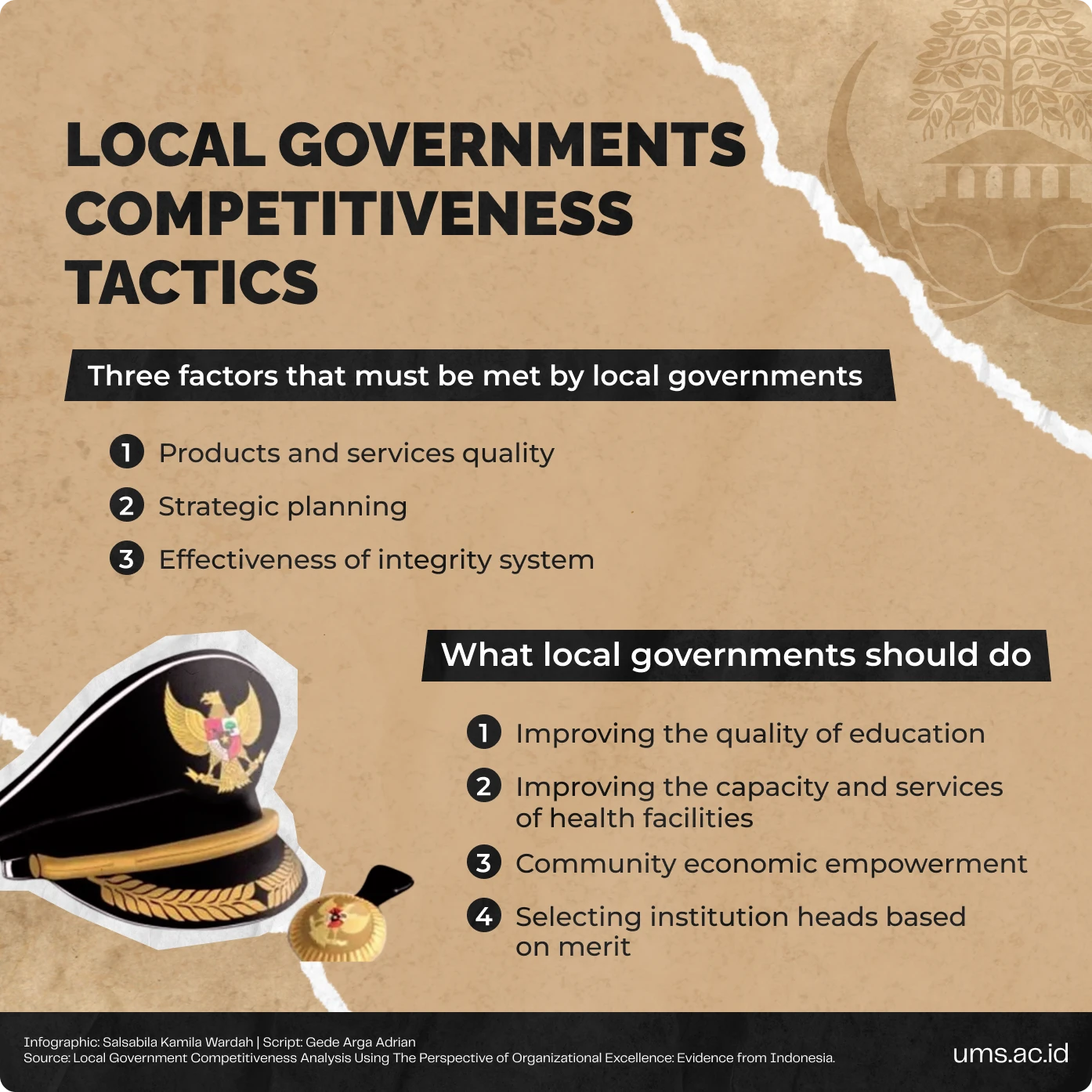
While acknowledging the importance of infrastructure development, Mahameru underscored that such initiatives should not overlook the empowerment of the community's economy.
According to Mahameru, three essential points must be addressed to advance a region: education, health, and economy. He emphasized, “Those three should be prioritized first, and then infrastructure.”
According to data released by the Central Statistics Agency (BPS), the poverty rate in March 2023 stood at 9.36 percent, marking a 0.21 percentage point decrease compared to the data from September 2022.
Mahameru observes a decline in the poverty rate, but he notes a simultaneous increase in vulnerabilities indexes that require immediate attention. These vulnerable individuals, he explained, are currently above the poverty line. However, due to economic fluctuations, they are at risk of falling below the poverty line.
“When aiming for competitiveness, the mindset that needs to be adopted is focused on enhancing physical quality, such as infrastructure, as well as ensuring a balance with the economic growth of the people in the region,” he explained.
Integrity is a crucial factor influencing the competitiveness of local governments, according to Mahameru. He connects integrity with the challenge of corruption within local governments. This issue gains urgency, especially considering Indonesia's Corruption Perception Index in 2022 has shown a significant decrease since 1995.
As reported by Tempo on Saturday (9/12/2023), Indonesia's Corruption Perception Index scored 34 out of 100, ranked 110 out of 180 surveyed countries. This marks a four-point decrease from 2021. The report from Transparency International serves as a red flag for all state apparatus, including local governments, to strengthen their integrity again.
“We can observe the reality at the KPK (Corruption Eradication Commission), where numerous corruption cases involve local governments. The reported cases can reach up to 10 thousand. This indicates that government management still carries the risk of unethical and illegal behavior,” remarked Mahameru.
Mahameru suggested that the government simplify the process of reporting corruption to make it more effective and efficient. He highlighted that the existing complaint channel is excessively bureaucratic, involving the collection of personal identity and other documents from the reporter.
“That is actually unnecessary. If the report is inaccurate, it can be clarified. If multiple reporters raise similar issues, it can serve as an indicator to pinpoint the main problem,” he continued.
Strengthening the supervision of local government is essential. Through enhanced supervision, the integrity and dignity of local governments can be preserved. This increased oversight will essentially “force” government officials to operate in an ethical and legal manner.
In addition to legal reinforcement and community empowerment, prioritizing professionalism within the local government is crucial. Mahameru directs his research focus towards the quality of human resources occupying leadership roles in government institutions and regionally-owned enterprises.
A merit-based recruitment process should be prioritized to ensure the appointment of qualified and professional leaders. Mahameru emphasizes the importance of implementing meritocracy in every local government agency or institution.
In reality, recruitment not based on merit is prevalent in various regional agencies, including Regional-Owned Enterprises (BUMD).
"BUMD is profit-oriented. These entities generate profits from services and contribute to local revenue. However, in reality, the recruitment process in some cases often lacks meritocracy. This issue needs to be addressed immediately," emphasized Mahameru.
With the commitment of the local government to prioritize leadership professionalism, it is feasible for the head of the institution to be filled by professionals with a commendable track record.
By upholding professionalism in their work, it is entirely possible for the competitiveness of local governments to advance significantly.
“In government bureaucracy, everyone is under the authority of one leader. If the leader instructs 'A,' then everyone must follow 'A.' Therefore, to propel an institution forward, the crucial factor lies in the leadership,” he concluded.
Writer: Gede Arga Adrian
Editor: Al Habiib Josy Asheva
Translator: Farizal Luqman Majid
Prof. Andri Nirwana, S.TH., M.Ag., Ph.D., pioneered the Master of Al-Quran and Tafsir Studies as a first step in strengthening Quranic studies within Muhammadiyah.
Nothing’s more special than reading curated news just for you.
Subscribe to the UMS Newsletter for free today.