The Scholar Behind UMS's Master's Program in IQT
27 July 2026
Prof. Andri Nirwana, S.TH., M.Ag., Ph.D., pioneered the Master of Al-Quran and Tafsir Studies as a first step in strengthening Quranic studies within Muhammadiyah.




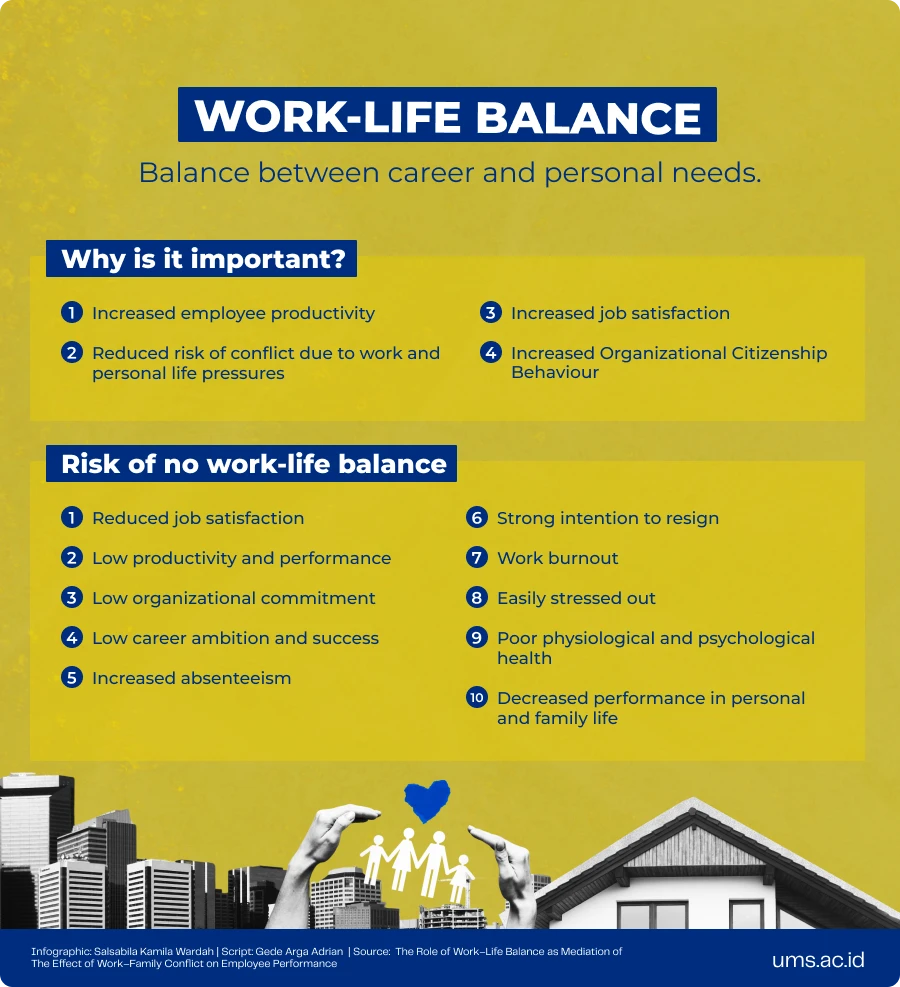
Often, employees focus too much on career and overlook the importance of maintaining a balance between their work and personal lives. The pursuit of career goals, whether for wealth, status or other aspirations, can lead employees to yearn for a balance between work and life - a concept commonly referred to as work-life balance.
Wawan, a 25-year-old employee working in a digital operation center company in Yogyakarta, is keenly aware of the challenges associated with his demanding job. The constant pressure proves to be a substantial obstacle in his efforts to attain a work-life balance.
“I still have difficulty implementing work-life balance because my job can impact other tasks or people’s livelihoods. So, the demands are greater,” expressed Wawan via WhatsApp on Monday (26/2/2024).
Work-life balance refers to the balance between work and personal needs. It means that the time spent at work doesn’t overshadow the time available for other aspects of life, such as pursuing hobbies, engaging in physical activity, managing household responsibilities and attending to family needs.
“The mind needs to be refreshed with activities different from our work. For example, if we work in the analytical field, then engaging in creative activities can serve as a way to refresh the mind,” Wawan continues.
Work-life balance is a luxury valued by all age groups, including Millennials and Gen Z. The SEEK Asia research in early 2023, compiled by Tribunnews.com (1/3/2023), stated that 43% of respondents in Indonesia considered work-life balance as a top priority when choosing a job. Some researchers emphasize the importance of work-life balance as it enhances work performance and reduces the risk of conflict arising from work demands.

UMS Management Lecturer Dr. Muzakar Isa, S.E., M.Si., highlights the importance of work-life balance in helping employees manage conflicts arising from dual roles between family and work demands. His research, titled “The Role of Work-Life Balance as Mediation of The Effect of Work-Family Conflict on Employee Performance”, was published in the SA Journal of Human Resource Management and indexed by Scopus Q2.
Isa's one-year research revealed a correlation between work-life balance and job performance. The positive impact of maintaining work-life balance is reflected in improved employee performance, driven by higher job satisfaction.
“People who achieve work-life balance typically experience lower stress levels,” explained the lecturer, often known as Pak Isa. “In addition to increased job satisfaction, they exhibit high Organizational Citizenship Behavior (OCB) levels. This means they are more likely to volunteer for additional tasks, including overtime.”
Indicators of an unfulfilled work-life balance can manifest in employee performance, characterized by low job satisfaction and a subsequent decline in overall work performance.
The research highlights the significance of establishing a favorable work-life ecosystem to mitigate the risk of work-family conflict. “A good work ecosystem will support employee work performance, thereby reducing existing conflicts,” he explained.
Government support is crucial for maintaining existing work-life balance policies. This includes policies such as flexible working hours, maternity and paternity leave, lactation room, remote work options, and other measures that support work-life balance. Such support is important in boosting work motivation and enhancing overall employee performance within the company.
Taking leave from work is one method to implement work-life balance. According to Isa, granting employees time off from work provides an opportunity for them to take a break and spend quality time with their families.
Work-family conflict, or dual role conflict, is a challenge faced by employees who have to deal with conflicting roles. The dual responsibilities of work and family demand individuals and require them to balance the expectations of both. This conflict arises when the time and energy invested, the stress experienced and the behaviors expected at work prevent employees from fulfilling their work and family responsibilities.
“Working people, particularly those who are married, are likely to experience conflicts,” explained Isa. Dual role conflicts can arise from varying perspectives and values embraced within the family. “For instance, some husbands may permit their wives to work full-time, while others may restrict their working hours, believing that it is a woman's inherent nature to serve her husband and manage household responsibilities.”
Isa emphasized that dual role conflicts can affect anyone irrespective of gender. Such conflicts can arise for both husbands and wives who juggle responsibilities at home while also earning a living. Despite the differing roles male and female employees may have in their families, they share similar roles in the workplace.
“Sometimes, husbands are required to work overtime. When they share this with their wives, they might receive complaints, affecting their motivation at work. The job becomes less enjoyable,” continued the Vice Chairman of the UMS Alumni Association (IKA UMS).
Dual role conflicts within the household can obstruct employees from attaining work-life balance. Failure to achieve work-life balance often leads to diminished work performance.
“There is a tendency for employees experiencing work-family conflict to withdraw from their jobs or exhibit withdrawal behavior,” added the researcher from the Center for PPMB Studies at UMS.
The withdrawal is a consequence of the absence of work-life balance to overcome the conflict of multiple roles and work demands. The consequences that occur are:
Work-family conflict that plagues the welfare of workers is not impossible to overcome. They can minimize its impact by paying attention to each other in the domestic or family sphere. Isa believes that workers should never give up in striving for a conducive office work climate.
The ability to offer motivation and effective communication is a strategy that companies can employ to sustain employee performance while preventing conflicts arising from dual roles. The Vice Dean I of FEB UMS underscored the significance of communication between employees and leaders, aiming for a mutual agreement on workload distribution. Leaders must demonstrate wisdom in balancing the demands of work roles and the personal lives of employees.
“There must be good communication between employees and leaders. Leaders must be aware so that they can understand the conditions of employees. On the one hand, employees must also communicate if they experience problems that can interfere with their work,” he explained.
Alongside effective communication, Isa highlights the significance of creating a positive work culture. Collaborating well with colleagues and supervisors enhances work productivity, enabling employees to better manage their time and roles in the workplace. This positive work environment supports a healthier balance between professional and personal life.
When hiring, it's crucial to prioritize employees whose values align with the company. Making the right selections ensures a match with job satisfaction and enhances overall employee performance.
After the selection process, it's important to conduct a briefing and orientation period for employees. This helps them understand their main duties and workload. The aim is to impart a sense of understanding among employees and their families, creating a mutual understanding of responsibilities towards the company.
“If you don't understand the job, you will get stressed. The end result will be resignation. So we must maintain communication, work roles, and motivation,” Isa concluded.
Writer: Gede Arga Adrian
Editor: Al Habiib Josy Asheva
Translator: Farizal Luqman Majid
Prof. Andri Nirwana, S.TH., M.Ag., Ph.D., pioneered the Master of Al-Quran and Tafsir Studies as a first step in strengthening Quranic studies within Muhammadiyah.
Nothing’s more special than reading curated news just for you.
Subscribe to the UMS Newsletter for free today.