
Far From Home, Closer to the Dream
6 July 2026
Sili built a good life as a government engineer in Fiji. To answer his father's promise, he had to leave all of it behind


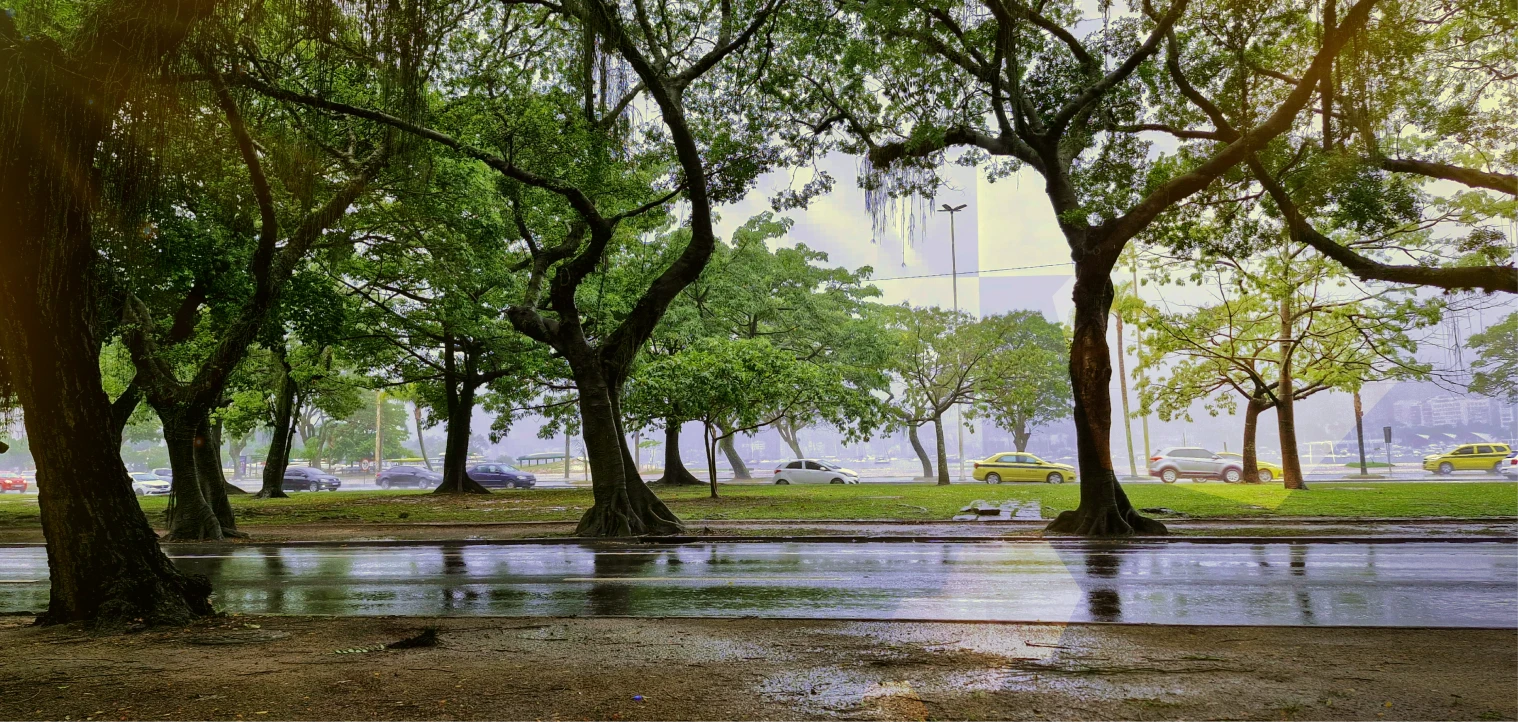
Despite being mid-May, rainfall continues across various regions in Indonesia. Although the intensity has started to decline in areas like Central Java and Yogyakarta, a consistent dry-season pattern has yet to emerge. Climatologically, this period should mark the transition into the dry season.
This lingering rainfall has sparked speculation about a wet dry season, a condition where the dry season is not entirely dry and is instead characterized by continued rainfall at the beginning of the normally dry period. According to data from the Meteorology, Climatology, and Geophysics Agency (BMKG), the dry season this year is expected to arrive later and last for a shorter duration compared to previous years. But what’s causing this?
Climatology expert from Universitas Muhammadiyah Surakarta (UMS), Drs. Yuli Priyana, M.Si., explained that the shortened dry season in 2025 is likely due to a combination of atmospheric and climatological factors that have prolonged the rainy season and delayed the onset of the dry season.
“There are several factors causing continued rainfall in May, even though we should already be in the transitional period,” said Yuli Priyana, a geography lecturer at UMS, during an online discussion on Thursday (22/5/2025).
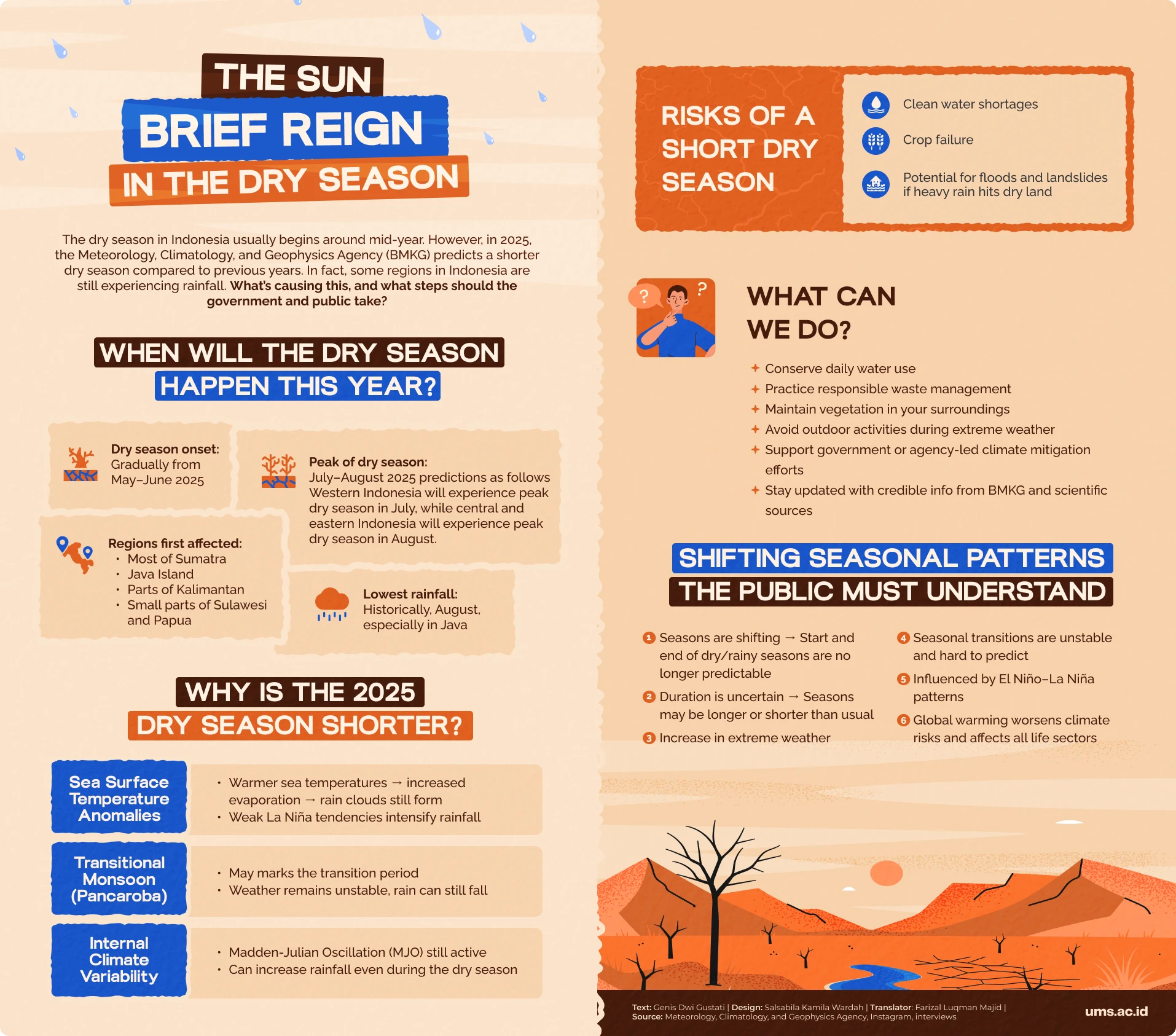
According to Yuli, there are at least three main reasons behind the shorter dry season this year. The first factor is warmer-than-usual sea surface temperatures around Indonesia. This increase in ocean heat causes higher evaporation rates, which in turn raises the chances of rain cloud formation.
“This condition is one of the reasons why rainfall persists, even though climatologically, the region should be drying out,” Yuli explained. Simultaneously, a weak La Niña trend is contributing to higher-than-average rainfall in several areas.
The second factor is the transitional monsoon period. May is typically a transitional month, the shift from the wet season to the dry season.
Even so, during this transitional period, weather tends to be unstable, and rain is still possible, although its frequency and intensity are lower compared to the peak of the rainy season. “This transition doesn’t occur uniformly across all regions and can vary from year to year,” Yuli said.
The third factor is internal climate variability, or fluctuations in weather systems from year to year. One significant phenomenon at play, Yuli noted, is the Madden-Julian Oscillation (MJO), an atmospheric wave that moves eastward across the tropics.
MJO can trigger rainfall activity even when Indonesia is entering its dry season. “The rainfall that’s still occurring in Central Java and Yogyakarta this May is likely due to a combination of these meteorological and climatological factors,” he added.
According to BMKG forecasts, the dry season is expected to begin gradually in June across much of Indonesia, including parts of Sumatra, Java, Kalimantan, and small portions of Sulawesi and Papua. The peak of the 2025 dry season is projected to occur between July and August.
“After reviewing the forecasts, for western Indonesia, the peak of the dry season will occur in July, while the central to eastern regions are expected to peak in August,” Yuli explained.
Climate data from BMKG confirms that August 2025 is projected to have the lowest rainfall levels across most parts of Indonesia, including Java. “Generally, the lowest monthly rainfall in Indonesia occurs in August,” he added.
This aligns with the projection that the 2025 dry season will be shorter than usual. In other words, it will arrive later and end earlier than in previous years.
Then when will the 2025 dry season end? Responding to this question, Yuli said that if current climate trends continue, the end of the dry season could arrive earlier than usual, possibly before the end of September.
However, he cautioned that this prediction could still shift depending on global and regional atmospheric dynamics in the coming months. From a climatological standpoint, he noted that seasonal variability in duration is normal and heavily influenced by global phenomena such as El Niño and La Niña (ENSO).
El Niño usually causes a drier and longer dry season, while La Niña makes it shorter and wetter. “Currently, ENSO is in a neutral phase, but there’s a tendency for a weak La Niña, which is why the rain is still persisting,” he added.
In addition, global climate change also plays an important role. The warming of sea surface and atmospheric temperatures due to greenhouse gas emissions disrupts atmospheric circulation stability and causes seasonal patterns to become inconsistent
“Although it’s referred to as a ‘wet dry season’ and may be followed by heavy rain, this is not guaranteed. Rainfall may not be evenly distributed. Some regions may receive adequate rainfall, while others may still experience a deficit,” Yuli warned.
If the rainy periods are inconsistent and interspersed with prolonged dry spells, drought could still pose a serious threat, especially for the agricultural sector, which relies on a steady water supply.
To anticipate the risk of such disasters, Yuli advised local governments to strengthen weather monitoring systems, manage water resources, prepare risk mitigation plans, and improve cross-sector coordination.
Meanwhile, at the community level, measures such as conserving water, responsible waste management, and preserving local vegetation are important early forms of adaptation. “For example, farmers can also adjust their planting schedules based on local dry season predictions to prevent crop failure,” he added.
The public should also actively seek credible information from BMKG and other scientific sources. Finally, they are encouraged to support all climate change mitigation efforts carried out by the government or relevant agencies.
“People can no longer rely on traditional seasonal calendars like Pranata Mangsa, traditional Javanese agricultural calendar system. We must depend on scientific data and information,” Yuli stated.
He emphasized the importance of building collective awareness regarding changing seasonal patterns in Indonesia. In increasingly dynamic climate conditions, readiness and adaptability are key.
Writer: Genis Dwi Gustati
Translator: Farizal Luqman Majid
Editor: Al Habiib Josy Asheva
Sili built a good life as a government engineer in Fiji. To answer his father's promise, he had to leave all of it behind
Nothing’s more special than reading curated news just for you.
Subscribe to the UMS Newsletter for free today.