
How Sheep Manure Turns into Nutrient Rich Fertilizer
16 July 2026
Sheep dunged nutrient-rich organic fertilizer for plants, made with the help of maggots. Built on community empowerment and a zero-waste principle.




Indonesia has experienced five consecutive months of deflation, signaling potential economic slowdown. According to a report by the Statistics Indonesia (BPS), deflation reached 0.12 percent in September 2024.
Deflation refers to the decrease in the prices of goods and services due to a reduced money supply over a specific period. The initial deflation in May was recorded at 0.03 percent, which deepened to 0.18 percent by July, before briefly improving to 0.03 percent in August and worsening again in September.
Key commodities contributing to deflation include red chilies (0.09 percent), bird's eye chilies (0.08 percent), gasoline (0.04 percent), and poultry products such as chicken eggs and meat (0.02 percent).
Prof. Dr. Anton Agus Setyawan S.E., M.Si., an economic expert from Universitas Muhammadiyah Surakarta, attributes this prolonged deflation primarily to the declining purchasing power of the middle class.
Read more: Reviving Indonesia's Middle Class
One of the major factors behind this decline is the crisis in Indonesia's labor-intensive industries, particularly the textile sector, which has resulted in widespread company closures and mass layoffs.
A report from Kumparan (1/10/2024) stated that seven textile companies had to declare bankruptcy and layoff, while eight others implemented layoffs as part of cost-saving measures.
The Confederation of All Indonesian Workers' Unions (KSPN) recorded 15,114 factory workers losing their jobs between January and September 2024, while the Ministry of Manpower reported 46,240 workers being laid off by August. The impact has been immediate, with rising unemployment and a downturn in businesses within the textile supply chain.
In addition to layoffs, wages are also an issue. According to Anton, the insufficient increase in the minimum wage has further squeezed households’ purchasing power, compounded by high bank interest rates. As a result, many people are forced to prioritize essential payments, such as vehicle and home loans, over basic consumption.
“People are focusing on paying off monthly loan installments and cutting back on other spending,” said Anton on Tuesday (9/10/2024).
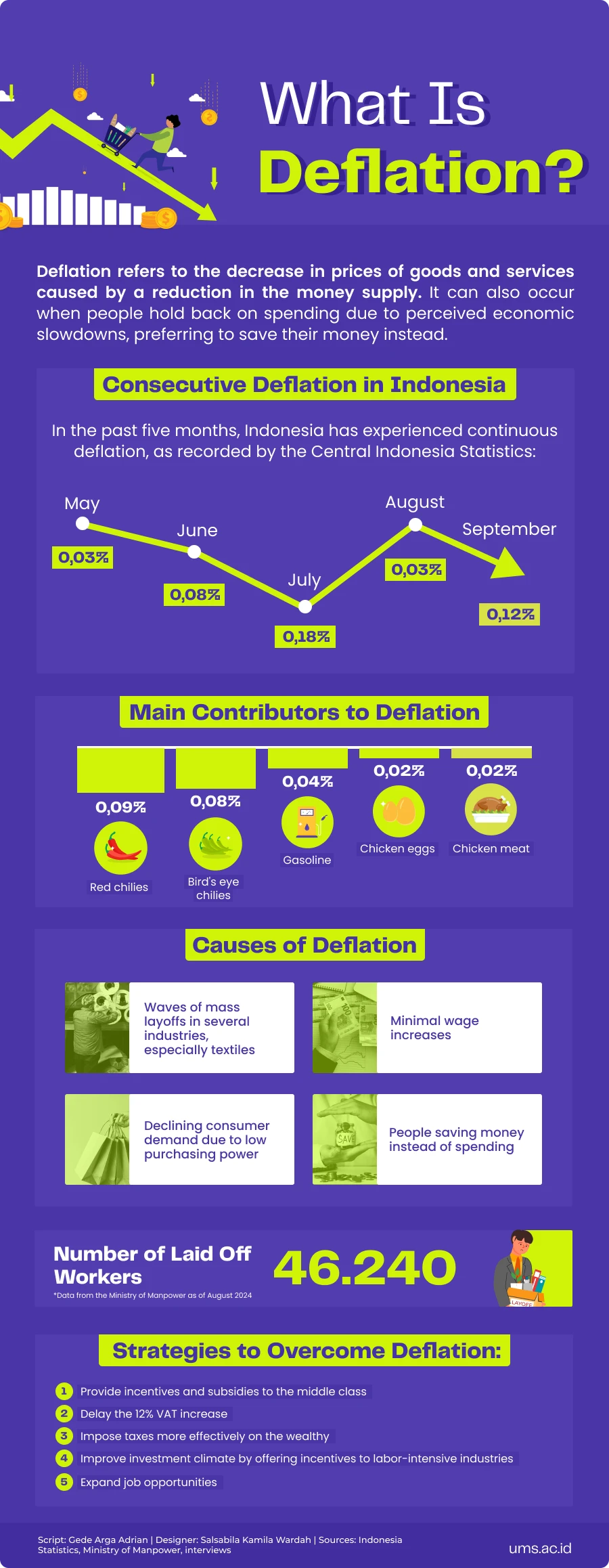
Deflation prompts many people, aware of the economic slowdown, to hold back on spending. This decline in purchasing power contributes to deflation. Consecutive deflation are warning signs for the national economy.
Anton explained that price drops result from a decrease in demand for goods and services. One indication of this decline is seen in the Laporan Perkembangan Nilai Tukar Petani dan Harga Gabah Produsen (Farmer Exchange Rate and Producer Grain Price Report) for September 2024, showing a 0.28% decrease in household consumption.
This is further supported by data from the BPS, which reported that household consumption grew by only 4.93% in Q2 2024, down from 5.22% in Q2 2023 and 5.52% in Q2 2022.
“This confirms that deflation in Indonesia is due to a decline in consumer purchasing power,” explained Anton, the Dean of the Faculty of Economics and Business at UMS.
He added that the medium-term impact of deflation could be a reduction in industrial production capacity, given the decreased demand for goods and services.
However, Anton believes the current deflation does not signal an imminent economic crisis or the risk of recession. Despite the slowdown, Indonesia's GDP growth in Q1 2024 was 5.11%, although it fell to 3.79% in Q2.
“Macroeconomic indicators are still stable, even though there are signs of an economic slowdown,” he elaborated.
Year-on-year basis speaking, Q2 2024 GDP grew by 5.05%. Additionally, sectors like accommodation, food, and beverages contributed 10.17% to GDP growth.
“Economic recession is defined by negative GDP growth over two consecutive quarters. Based on current data, there are no signs of a recession,” clarified the UMS Center for Development of Business and Management researcher.
The government must implement strategies to mitigate the negative effects of deflation. The professor of Management program emphasized two key actions: increasing household purchasing power and improving the investment climate.
To boost consumer purchasing power, the government could provide financial assistance to middle-income groups earning between Rp3-5 million per month. This assistance might come in the form of cash transfers, food vouchers, housing subsidies (not the Tapera regulation), and expanded educational and healthcare subsidies through increased distribution of Kartu Indonesia Pintar and Kartu Indonesia Sehat.
Additionally, reducing the financial burden on the middle-income group is crucial. One measure would be postponing the planned 12% value added tax (VAT) hike in 2025.
Anton also suggested that the government intensify tax collection from high-income earners and to enhance tax revenue. The shortcomings of President Jokowi's tax amnesty program should serve as a lesson in designing a new initiative to enhance tax revenue from the wealthiest segments of society.
Improving the investment climate is another essential step. Providing incentives to labor-intensive industries that employ a large workforce is crucial, especially considering the ongoing closures of textile factories. Formal industries must now compete with the rapidly growing digital and capital-intensive sectors.
“While digital businesses and capital-intensive industries like mining are booming, their workforce absorption is not as significant as labor-intensive industries,” Anton remarked.
Looking ahead to 2025, Anton projected that the government must enhance the quality of economic growth by increasing the proportion of investment. He also urged for the creation of more jobs, as the rise in layoffs aligns with the increase in deflation.
“If no improvements are made in job creation, the situation could worsen,” he cautioned.
Writer: Gede Arga Adrian
Editor: Al Habiib Josy Asheva
Translator: Farizal Luqman Majid
Sheep dunged nutrient-rich organic fertilizer for plants, made with the help of maggots. Built on community empowerment and a zero-waste principle.
Nothing’s more special than reading curated news just for you.
Subscribe to the UMS Newsletter for free today.