How Sheep Manure Turns into Nutrient Rich Fertilizer
16 July 2026
Sheep dunged nutrient-rich organic fertilizer for plants, made with the help of maggots. Built on community empowerment and a zero-waste principle.



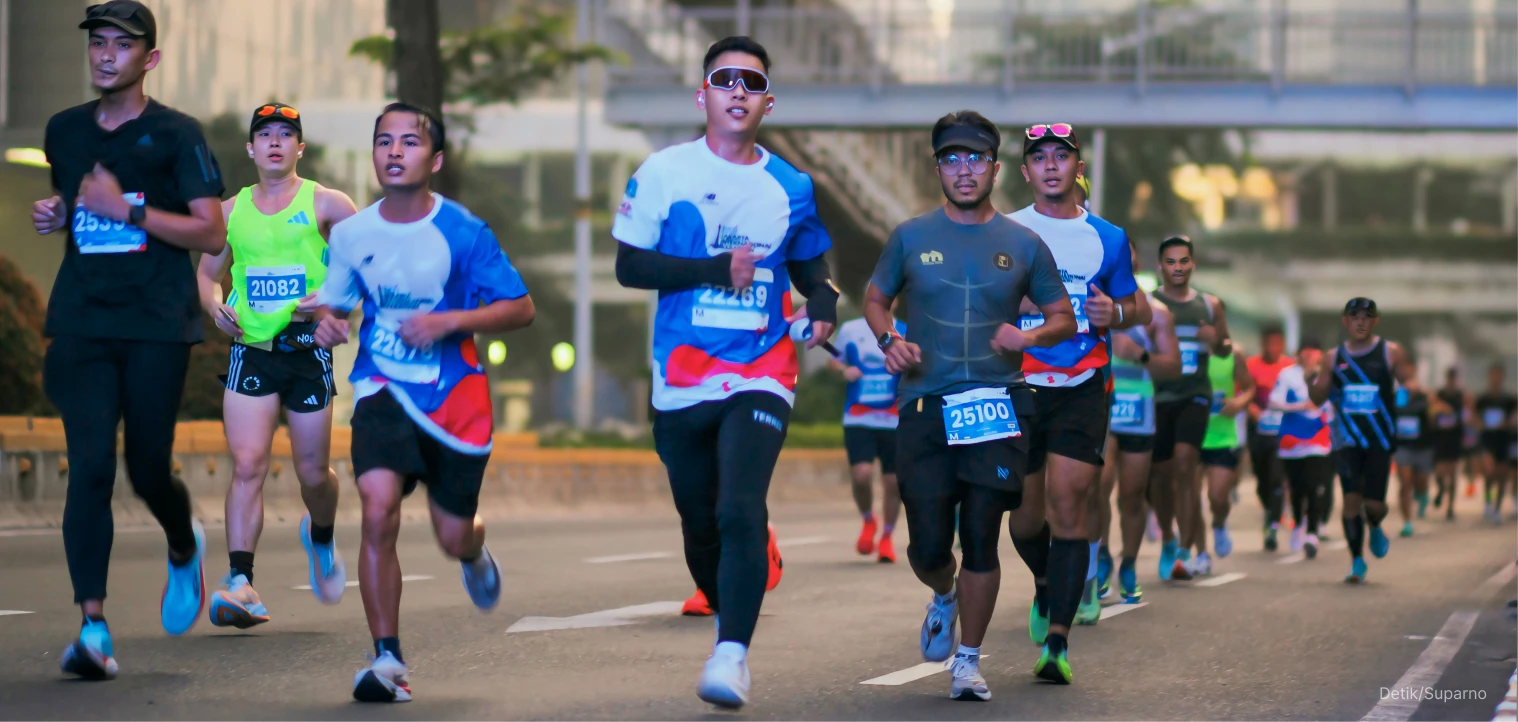
Several times now, Duta, 26, has run along unusual routes. Usually, he runs around Gelora Bung Karno, Senayan, Jakarta, but recently he has had to take a different route.
The young man from Ponorogo, East Java, said he chose alternative routes because he felt uncomfortable with the growing presence of running photographers in various areas across Indonesia, including Jakarta. Duta said these photographers upload their shots to the Fotoyu platform.
Fotoyu is a marketplace dedicated to personal photography documentation. It uses artificial intelligence (AI) facial recognition technology to help users find their photos from specific events.
Duta explained that the Fotoyu app allows his face to be visible to other users. “There are many cameras aimed at the body. Not just one or two cameras. On the app, we can be seen by other users,” Duta said via WhatsApp on Friday, (31/10/2025).
Duta has enjoyed running since mid-2024, when he lived in Yogyakarta. He regularly runs around Malioboro and the Kraton area in Yogyakarta, frequently encountering photographers along his routes.
“There are many photographers because the industry grew from there. They usually appear in places crowded with runners,” he added.
The trend of using the Fotoyu platform in the running photography industry has been growing since 2022, alongside the rising popularity of running among the public. Running photographers often “station” themselves in public spaces, such as parks, sports arenas, and streets.
They then sell their shots through Fotoyu. Photographers have the freedom to set their own prices, which range from Rp25,000 to Rp100,000 per photo.
People who want to purchase the photos simply need to scan their face using the Fotoyu app. The app will automatically detect similar photos. This is what has raised public concerns about privacy protection.
Some running enthusiasts have shared the same concerns. This anxiety gained attention after a tweet by Drone Emprit founder Ismail Fahmi about Fotoyu. In the replies, several netizens firmly opposed having their photos sold on the Fotoyu app.
“I never want to be photographed and have my photos sold without consent like this. Personally, I feel uncomfortable exercising in public. I end up exercising in private spaces or, at most, going to the gym. In developed countries, there are rules against photographing others without permission,” tweeted account @ortermald.
Gunawan Ariyanto, S.T., M.Comp.Sc., Ph.D., a lecturer in Informatics Engineering at Universitas Muhammadiyah Surakarta, explained that Fotoyu uses AI technology in the form of face recognition.
Fotoyu detects the traits or features of a person’s face. These features are then stored and referred to as facial biometric data. “If a new photo appears later, the facial features will be extracted and compared with the existing biometric data,” Gunawan said.
A public concern that has since emerged is that running photos could be used as data to train AI. Responding to this, Gunawan confirmed the potential use of runners’ photos to “feed” the AI. However, he emphasized that the data is used to generate photos that have no real-world counterpart.
“They’re not exactly the same. So the generated faces don’t have a real-world match. The AI photos are completely random, with random facial features as well,” he explained.
Concerns arise when individual photos circulating on digital media are used for criminal purposes, one example being deepfake technology.
Gunawan said that the use of specific photos in deepfake technology carries the risk of triggering various cybercrimes, including fraud, terror, and pornography.
Read more: Deepfake: A Weapon of Mass Deception in the 2024 Election?
Diana Setiawati, S.H., LLM., a lecturer in Laws at UMS, stated that uploading images on the Fotoyu platform is often done without the consent of the photo subjects, in this case, the runners. She expressed concern that the widespread phenomenon of running photos in public spaces could violate individual privacy
“Activities in public spaces that were once considered casual suddenly become commercial objects or data without prior notice,” she explained.
Diana added that this phenomenon can cause psychological effects, making people feel constantly monitored in public spaces. It also opens up the possibility of photos being used in places where they are not wanted.
According to her, the Fotoyu case touches on two main issues. The first is the right to privacy and protection of individuals’ personal data. The second is the responsibility of platforms or commercial applications that use such photos as part of their business model.
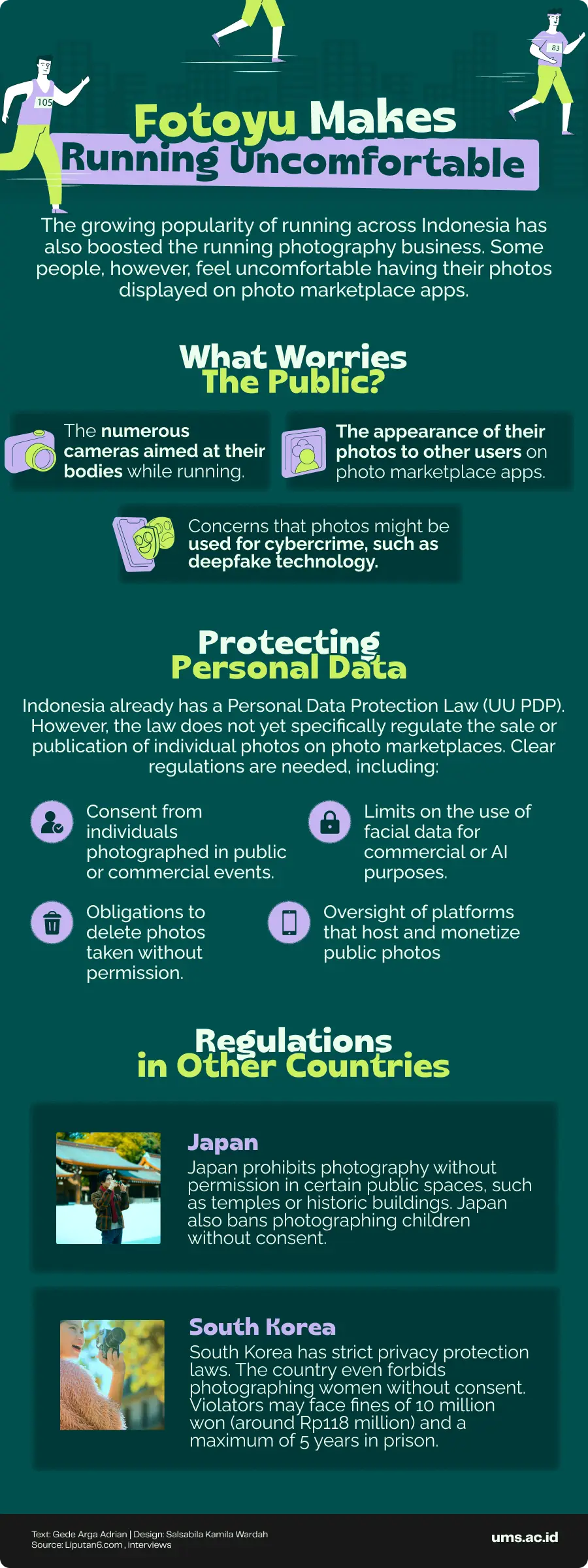
Indonesia actually already has regulations protecting individuals’ privacy rights. These are contained in Law Number 27 of 2022 concerning Personal Data Protection (UU PDP). The law regulates the protection of personal data, including individual biometric facial data.
However, Indonesia does not yet have specific rules regarding taking photos in public spaces without clear consent, storing facial data on application servers, or using automated photo searches via facial recognition.
“There is no regulation that specifically governs public photography marketplaces with business models like this,” Diana explained. “Recent studies also conclude that taking portraits without permission still has many regulatory gaps in its implementation.”
Diana urged the government to tighten regulations on unauthorized photography in public spaces, citing the need to protect individual privacy rights, regulate commercial use and data monetization, ensure fairness and business transparency, and provide special protection for vulnerable groups.
For example, Japan has regulations prohibiting photography in public spaces, particularly photographing children. South Korea also has fairly strict personal data protection laws. Taking photos without permission there can be punished with a fine of 10 million won (around Rp118 million).
Indonesia needs to regulate types of photography in public spaces that require permission, establish consent mechanisms for those being photographed, set limits on commercial use, and guarantee the right to delete photos or data.
“This is not meant to restrict creativity or street photography, but to balance freedom of expression with individual privacy rights,” she said.
Implementation should also be accompanied by education, supervision, and clear sanctions to ensure effectiveness. This way, creativity can continue to flourish without compromising individuals’ privacy rights.
Writer: Gede Arga Adrian
Translator: Farizal Luqman Majid
Editor: Al Habiib Josy Asheva
Sheep dunged nutrient-rich organic fertilizer for plants, made with the help of maggots. Built on community empowerment and a zero-waste principle.
Nothing’s more special than reading curated news just for you.
Subscribe to the UMS Newsletter for free today.