


How Sheep Manure Turns into Nutrient Rich Fertilizer
16 July 2026
Sheep dunged nutrient-rich organic fertilizer for plants, made with the help of maggots. Built on community empowerment and a zero-waste principle.




Thuggery is like a thorn in the flesh, eroding security, the economy, and even the authority of the law itself. Amid the government's efforts to grow the economy and attract investment, thuggery still clings on, from traditional markets to national industries.
Thuggery cases in Indonesia remain prominent. Data from the National Criminal Information Center of the Indonesian National Police (Polri) recorded 2,028 thuggery cases across the country that have been handled by the police since the beginning of 2025.
In the most recent case at the Kramat Jati Main Market, East Jakarta, six parking attendants and a member of a mass organization were arrested for collecting illegal parking fees of up to Rp40,000 and intimidating security officers. “The operation targeted illegal levies disguised as cooperatives and unauthorized parking practices. These actions have disturbed both vendors and market visitors,” said East Jakarta Metro Police Chief, Commissioner Nicolas Ary Lilipaly, quoted from Kompas.id, Thursday (5/6/2025).
So why does thuggery still persist and seem so difficult to eradicate? Criminal law expert from Universitas Muhammadiyah Surakarta (UMS), Dr. Muchamad Iksan, S.H., M.H., argues that Indonesia is not lacking in legal provisions. The penalties exist and are not light either. However, the most influential factor in these actions is the law enforcement itself.
“The data only shows the number of cases that have been processed. Criminal statistics are like the tip of an iceberg. What’s visible is just the tip above the water, while the submerged part is massive and unreadable,” Iksan explained when met in the Director’s Office of the Sharia Pension Fund, Siti Walidah Main Building, Thursday (5/6/2025).
According to Iksan, thuggery is a social term, not a specific term in the field of law. In the Indonesian Penal Code (KUHP), there is no specific article that directly addresses thuggery. However, the behaviors associated with thugs can still be prosecuted under the law.
“Thuggery is an umbrella for many criminal acts. Extortion, illegal land occupation, assault, threats, robbery with violence, all of these are forms of thuggery that are already regulated in the Penal Code,” explained the lecturer of Criminal Law.
He gave examples such as extortion in markets and bus terminals as forms of coercion. The occupation of land that prevents rightful owners from accessing their property can also be prosecuted as a criminal offense.
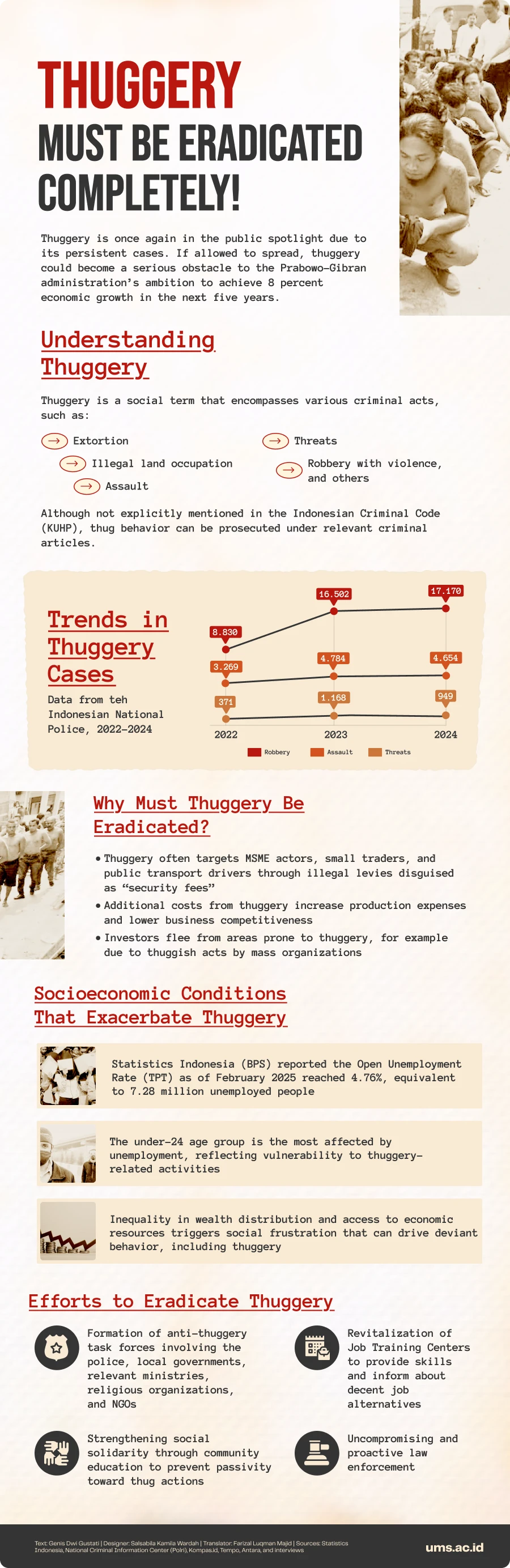
Thugs often target people from lower socioeconomic groups, such as Micro, Small, and Medium Enterprises (MSMEs), public transport drivers, and daily laborers. They are forced to pay illegal fees disguised as “security money.” If they don’t pay, they may face intimidation, violence, or even sabotage.
“This disrupts the business climate. Hidden costs due to thuggery increase production expenses and reduce business competitiveness,” said Iksan. He saw this as a serious structural barrier to the government’s goal of achieving 8 percent economic growth in the next five years.
This climate of uncertainty further discourages investors from putting in their money. “If Indonesia is full of thugs and unexpected costs, those with capital will choose places that feel safer and more profitable,” he said.
Referring to a report by Tempo, the impact of thuggery on investment was also raised by Sanny Iskandar, Chairman of the Association of Industrial Estates (HKI). He claimed to have suffered losses amounting to hundreds of trillions of rupiah. Investors fled because many mass organizations forced their involvement in construction processes or factory operations.
Normatively, the legal instruments to eradicate thuggery already exist. But law enforcement is often weak. “Thuggery is a regular offense, not one that requires a report. The police can act without waiting for a complaint,” emphasized Iksan. However, in practice, law enforcement officers are often passive, even seemingly indifferent.
Why is that? According to Iksan, legal effectiveness depends on at least five crucial factors. They are legal regulations, law enforcement officers, infrastructure, society, and legal culture.
“Our problem isn't with the laws but with the officers and the culture. If the police know there’s extortion but don’t act, the public will be suspicious, they’ll wonder if someone powerful is backing them,” said the UMS law lecturer.
Iksan emphasized the need for goodwill and courage. “If a police chief at the regional or city level is determined, thugs can be eradicated. But if leadership at the top lacks spirit, those below will follow suit,” he said.
Thuggery also cannot be separated from economic conditions and high unemployment. “Logically, the higher the unemployment, the more fertile the ground for thuggery,” Iksan stated. When people lose their jobs but still have needs to meet, some turn to thuggery as a shortcut.
According to Kompas.id, a study by the Committee for Monitoring Regional Autonomy Implementation from 2001–2005 showed that since the beginning of the reform era, businesses have faced thuggery as an investment risk. Now, a quarter-century later, not much has changed.
Meanwhile, the 2024 Criminal Statistics report from Statistics Indonesia (BPS) shows a surge in crime cases, from 372,965 in 2022 to 584,991 in 2023. The main contributors are offenses that fall under the category of thuggery.
Upon further investigation, one of the key issues in combating thuggery, according to Iksan, is public trust in law enforcement. When police officers stay silent in the face of extortion, or refuse to act on the grounds of “no formal complaint,” the public loses faith.
“If it’s a regular offense, the police should be able to act even without a report. Just like in drug or terrorism cases the police can find the perpetrators on their own. Why doesn’t that apply to thuggery?” he questioned. The law lecturer warned that the police’s reluctance to take action could damage the institution’s image.
Eradicating thuggery cannot rely solely on repressive measures. There must be preventive and preemptive strategies. “Criminal law only works after a crime has occurred. But to prevent it, we need cross-sectoral collaboration,” he said.
Iksan proposed the formation of a special anti-thuggery task force involving the police, local governments, the Ministry of Manpower, the Ministry of Social Affairs, religious organizations, and NGOs. “We need job training, moral development, and the strengthening of social solidarity. Don’t just focus on arrests, prevent people from entering the world of thuggery in the first place,” he emphasized.
Revitalizing Job Training Centers (BLK), strengthening MSMEs, and community development through religious organizations are all crucial to providing people with more decent and dignified employment alternatives. Besides the state, society also has a role to play. Thuggery will persist as long as the public remains silent.
“Many become victims but choose to stay quiet. They're afraid or feel it's pointless to report. But if everyone keeps silent, authorities can claim they have no grounds to act. On the other hand, if there are reports and witnesses, the police can’t ignore it,” said Iksan.
In fact, in the legal system, citizen testimony is highly important. Moreover, creating social solidarity is equally vital in efforts to suppress thuggery.
As for the possibility of eradicating thuggery at its roots, Iksan believed that it is not impossible. However, it depends entirely on the state's will and concrete actions.
“If the economy continues to decline, unemployment rises, and law enforcement remains passive, it’s easy to say that thuggery will keep spreading uncontrollably,” he remarked with concern.
He noted that recent cases , such as declining consumer purchasing power, mass layoffs, and factory closures, have the potential to trigger a surge in criminal activity. In such a situation, the government is expected to respond swiftly and decisively.
If the state responds slowly, then the economic crisis and social fear will intensify. “In other words, thuggery will continue to haunt public spaces that should be safe,” Iksan concluded.
Writer: Genis Dwi Gustati
Translator: Farizal Luqman Majid
Editor: Al Habiib Josy Asheva
Sheep dunged nutrient-rich organic fertilizer for plants, made with the help of maggots. Built on community empowerment and a zero-waste principle.
Nothing’s more special than reading curated news just for you.
Subscribe to the UMS Newsletter for free today.