
How Sheep Manure Turns into Nutrient Rich Fertilizer
16 July 2026
Sheep dunged nutrient-rich organic fertilizer for plants, made with the help of maggots. Built on community empowerment and a zero-waste principle.


Research collaboration is seen as the frontline for universities in Indonesia to boost the quality and quantity of internationally reputable scientific publications. Addressing this need, Universitas Muhammadiyah Surakarta (UMS) reaffirmed its commitment through a workshop titled "Research Universities and International Research Networks," organized by the Office of Public Relations and Rankings (BHP) on Friday (20/12/2024).
The workshop, held in the Meeting Room of the Daily Supervisory Board, 6th Floor, Siti Walidah Main Building, featured two main speakers: Prof. Akhmaloka, Ph.D., former Rector of Institut Teknologi Bandung (ITB) for the 2010–2015 period, and Dimas Ria Angga Pribadi, S.Kep., M.Sc., Ph.D., a Nursing lecturer at UMS with extensive experience in international research networks.
This workshop is part of UMS efforts to enhance the research environment on campus. UMS Vice-Rector V, Prof. Supriyono, S.T., M.T., Ph.D., expressed his hope that the event would act as a catalyst for faculty members to actively network and strengthen their research capabilities.

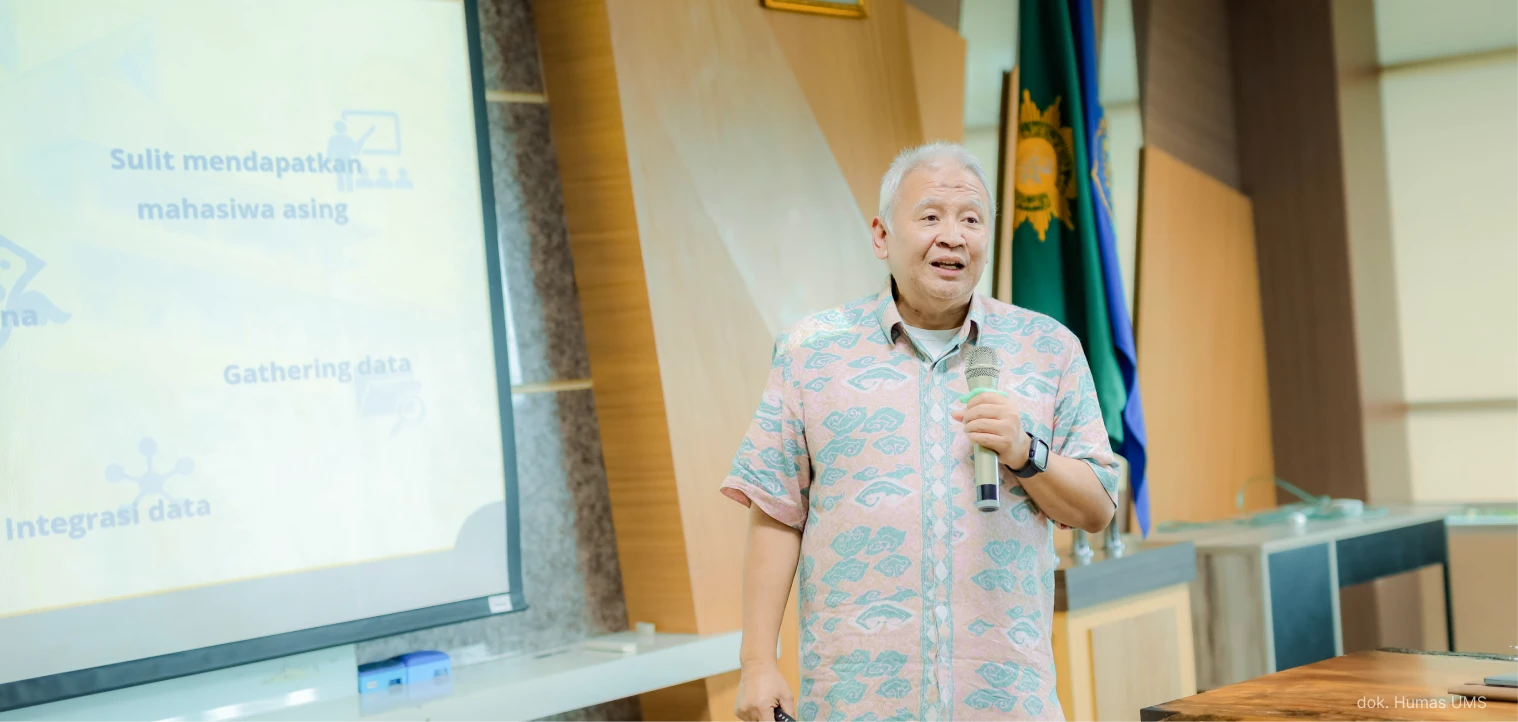
From left to right: UMS Nursing lecturer Dimas Ria Angga Pribadi, former ITB Rector Akhmaloka, and UMS Vice-Rector V Supriyono at the "Research Universities and International Research Networks" Workshop in the BPH Meeting Room, Siti Walidah Main Building, Friday (20/12/2024). UMS Public Relations/Imam Safi'i
“We want research groups at UMS to seize this opportunity to improve the research atmosphere on campus. Additionally, the networks established by Mr. Dimas should be maintained, followed, and expanded for broader benefits,” said Supriyono
The first session of the workshop was delivered by Prof. Akhmaloka, Ph.D., who shared ITB experience in becoming a world-class research university. His focus zeroed in on two leadership periods of ITB rectors aligned with this workshop's theme: the tenure of Prof. Dr. Ir. Djoko Santoso, M.Sc. (2005–2010) and his own tenure (2010–2015).
During Prof. Djoko Santoso's tenure, ITB underwent extensive governance reforms.
The goal was to transform ITB into a research university by increasing the number of publications, enhancing human resource (HR) capacity, and improving the organizational structure to be more efficient and productive.
When Akhmaloka began his tenure as rector in 2010, his focus shifted toward internationalization. “I encouraged every faculty to have internationally accredited study programs. Additionally, we launched initiatives such as the Double Degree Program, the Sandwich Program, and student and faculty exchange programs abroad,” Akhmaloka explained on Friday (20/12/2024).
Internationalization at ITB extended beyond developing academic programs. It also emphasized strengthening global networks through the International Relations Office–Bureau of Partnerships. During this period, ITB became a member of various international university associations, such as the ASEAN University Network (AUN), the Asia-Oceania Top University League on Engineering (AOTULE), and the Global Engineering Education Exchange (GE3), among others.
“To establish a research university, a culture of research must become an integral part of academic life. This starts with shifting the mindset of faculty members and creating a habit of research, supported by adequate infrastructure,” Akhmaloka emphasized.
One of ITB flagship programs under Akhmaloka’s leadership was the International Research Network. This program was designed to ensure that research collaborations with overseas partner universities produced high-quality publications. Each collaboration was targeted to yield at least three publications with zero citations initially.
According to Akhmaloka, strengthening research requires a holistic strategy, from enhancing human resource capacity to managing sustainable partnerships. “We promote efficient, long-term partnerships. The outcome not only increases publication output but also broadens ITB’s academic influence globally,” he added.
However, he acknowledged the significant challenges in building a research culture, particularly in terms of resources. “Many universities face hurdles, such as difficulties in recruiting international faculty, limited funding, and integrating research data. But these challenges can be overcome with dedication and a clear strategy. I think these issues are not unique to ITB, perhaps UMS also experiences them,” he quipped with a laugh.
In addition to institutional strengthening at the university level, opportunities can also emerge from individual initiatives by lecturers. Dimas Ria Angga Pribadi, S.Kep., M.Sc., Ph.D., shared his personal experience in building an international research network. He mentioned that his journey in international research collaboration began during his doctoral studies in Taiwan in 2019.
"I started my international research network while studying in Taiwan. There, international collaboration is already an integral part of research activities, it’s almost like a requirement," Dimas shared during the second session of the workshop.
He conducted a small observation to compare his research outcomes from cross-disciplinary collaboration with those involving international collaborators. The difference, he said, was striking. "Cross-program research received only four citations, while my latest research in Taiwan in 2023 garnered nearly 5,889 citations," Dimas stated candidly.
The UMS lecturer emphasized that international collaboration not only increases citation numbers but also opens up various opportunities, such as research funding, enhanced data quality, and the development of research methods.
"Collaboration becomes a way to expand networks and insights, strengthen research capacity, and improve the quality of our publications," he explained.
In his presentation, Dimas also highlighted the crucial role of collaborators in international research. According to him, “Such research collaboration enables us to strengthen data and methodologies, making research outcomes more globally relevant. Additionally, collaborators often serve as the lead authors of our research publications, thus amplifying their impact.”
Dimas encouraged lecturers at UMS to actively seek partnerships with international collaborators, either through existing networks or by establishing new partnerships.
As a concrete example, Dimas provided a detailed overview of the levels within the collaborator network he is part of, the GBD (Global Burden of Disease) Collaborator Network. This network comprises four tiers of collaborators, each offering increasing benefits.
“Tier 1 is the GBD Collaborator level, where collaborators have the opportunity to serve as co-authors in GBD publications. They also gain access to virtual meetings and networking events, allowing interaction with other competent collaborators,” Dimas explained while switching to a PowerPoint slide.
Tier 2, he added, is the GBD Senior Collaborator level. This tier provides collaborators the opportunity to become first authors in scientific publications and participate in more in-depth discussions on methodologies, findings, and data analyses.
At Tier 3, the GBD Lead Collaborator level, collaborators receive funding access to support their research projects. Finally, at Tier 4, the GBD Principal Collaborator level, members gain exclusive opportunities to be considered for positions in the GBD Scientific Council.
Dimas shared steps for joining the GBD Collaboration Network. The initial process is relatively straightforward: researchers need to submit an application including a comprehensive CV along with relevant skills and interests aligned with the research themes of the network.
Applicants are then required to attend a short course to gain a thorough understanding of the GBD system and network methodologies. Once accepted, collaborators gain access to the GBD collaborator portal, enabling them to participate in ongoing GBD studies.
“The essence of joining such research collaboration networks is that it opens doors to funding, significantly enhances publication quality, and broadens the impact of research,” he concluded. As a closing remark, Dimas recommended interested participants to explore further information through the official GBD Collaborator Portal.
Writer: Genis Dwi Gustati
Translator: Farizal Luqman Majid
Editor: Al Habiib Josy Asheva
Sheep dunged nutrient-rich organic fertilizer for plants, made with the help of maggots. Built on community empowerment and a zero-waste principle.
Nothing’s more special than reading curated news just for you.
Subscribe to the UMS Newsletter for free today.